| x | f(x) |
|---|



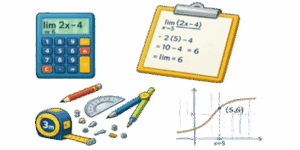
This calculator finds the limit of a function as the variable approaches a finite point or infinity. It supports left and right one-sided limits and combines symbolic techniques with numeric checks so you get a robust answer in most practical cases. The goal is a friendly, transparent solution you can trust for study, debugging or quick engineering checks.
Table of Contents
What to enter
Type the expression using common math functions: sin(x), cos(x), exp(x), log(x), x^2, (x^2-1)/(x-1) and so on. Specify the variable, the target point a which can be a number or Infinity and choose the direction: both sides, left or right. Pick the method: symbolic, L’Hôpital, numeric or auto which picks the best sequence. Set the maximum L’Hôpital iterations and the detail level for the steps you want to see.
How the calculator works
- Direct substitution first. If f(a) is finite the limit is done and reported.
- Symbolic simplification attempts algebraic cancellation and factorization to remove indeterminate forms without taking derivatives.
- L’Hôpital’s rule is applied when the expression is a quotient giving 0/0 or ∞/∞. The numerator and denominator are differentiated and the check repeats up to the iteration limit.
- Symbolic differentiation is used when taking derivatives is required. The software generates exact derivative formulas and compiles them into numeric evaluators and TeX for readable steps.
- Numeric sampling is used when symbolic methods fail. A sequence of points approaches the target and a convergence test estimates the limit and its stability.
- Final result and diagnostics. If the outcome is uncertain the tool flags the issue and suggests switching method, increasing iterations or boosting the number of samples.
Your chosen detail level changes both what you see and how the solver behaves. The brief mode gives a short verdict and the method used. The detailed mode shows key transformations, any L’Hôpital iterations and a few numeric probes for confirmation. The pro mode exposes every symbolic manipulation, the full chain of derivatives and a table of many numeric samples with convergence diagnostics. Use pro mode for tricky expressions or to audit the solver’s reasoning.
Core rules and formulas used
Below are the principal identities and tactics the engine relies on. These are the workhorses that let the tool convert an indeterminate expression into a concrete number.
- Basic derivatives: \((x^n)’ = n x^{n-1}\), \((\sin x)’ = \cos x\), \((\cos x)’ = -\sin x\), \((e^x)’ = e^x\), \((\ln x)’ = 1/x\).
- L’Hôpital’s rule for quotients: when the limit gives 0/0 or ∞/∞
$$\lim_{x\to a}\frac{f(x)}{g(x)} = \lim_{x\to a}\frac{f'(x)}{g'(x)}$$
provided the right-hand limit exists or can be evaluated. - Logarithmic transform for power indeterminacies: for expressions of the form \(1^\infty\) set \(L = \lim (1+u(x))^{v(x)}\), take \(\ln L = \lim v(x)\ln(1+u(x))\) and evaluate that limit then exponentiate back.
- Taylor series expansions near the point give asymptotic forms that often resolve subtle cancellations. For small arguments use approximations like \(\sin x \approx x – x^3/6\) and \(\ln(1+t) \approx t – t^2/2\).
Reference Tables of Common Limits
| Function | Taylor series expansion | Comments and interval of convergence |
|---|---|---|
| ex | 1 + x + x2/2! + x3/3! + x4/4! + x5/5! + x6/6! + x7/7! + x8/8! + … | For all x (converges everywhere) |
| sin x | x − x3/3! + x5/5! − x7/7! + x9/9! + … | For all x |
| cos x | 1 − x2/2! + x4/4! − x6/6! + x8/8! + … | For all x |
| tan x (formal) | x + x3/3 + 2x5/15 + 17x7/315 + … | Radius of convergence π/2 (singularities at larger x) |
| sinh x | x + x3/3! + x5/5! + x7/7! + … | For all x |
| cosh x | 1 + x2/2! + x4/4! + x6/6! + … | For all x |
| ln(1 + x) | x − x2/2 + x3/3 − x4/4 + x5/5 − … | |x| < 1 (conditionally convergent at x = 1; diverges at x = −1) |
| 1 / (1 − x) (geometric) | 1 + x + x2 + x3 + x4 + … | |x| < 1 |
| (1 + x)α (general binomial series) | 1 + αx + α(α−1)x2/2! + α(α−1)(α−2)x3/3! + … | |x| < 1 for general α; finite series for integer α ≥ 0 |
| arctan x | x − x3/3 + x5/5 − x7/7 + … | |x| ≤ 1 (conditional convergence at endpoints) |
| arcsin x | x + x3/6 + 3x5/40 + 5x7/112 + … | |x| < 1 (radius 1) |
| arccos x | π/2 − x − x3/6 − 3x5/40 − … | Around x = 0, |x| < 1 |
| √(1 + x) = (1 + x)1/2 | 1 + x/2 − x2/8 + x3/16 − 5x4/128 + … | |x| < 1 |
| 1/√(1 + x) = (1 + x)−1/2 | 1 − x/2 + 3x2/8 − 5x3/16 + 35x4/128 − … | |x| < 1 |
| ln x (expansion around x = 1) | ln x = (x−1) − (x−1)2/2 + (x−1)3/3 − (x−1)4/4 + … | For 0 < x < 2 (radius 1 around 1) |
| eax | 1 + ax + a2x2/2! + a3x3/3! + … | All x |
| sin(ax) | ax − (ax)3/3! + (ax)5/5! − … | All x |
| cos(ax) | 1 − (ax)2/2! + (ax)4/4! − … | All x |
| ln(1 − x) | − (x + x2/2 + x3/3 + x4/4 + …) | |x| < 1 (converges to ln(1−x)) |
| Useful small-x approximations | sin x ≈ x, cos x ≈ 1 − x2/2, ln(1+x) ≈ x, (1+x)α ≈ 1 + αx | For |x| ≪ 1 — first terms of the series |
| Remainder | Remainder of order n: Rn(x) = f(n+1)(ξ) xn+1/(n+1)! (Lagrange form) | ξ between 0 and x — used for error estimation |
| Limit | Value | Comment |
|---|---|---|
| limx→0 sin x / x | 1 | Fundamental limit; provable geometrically or via series |
| limx→0 (1 − cos x) / x2 | 1/2 | Use cos x = 1 − x2/2 + … |
| limx→0 tan x / x | 1 | tan x = sin x / cos x |
| limx→0 (sin ax) / (sin bx) | a / b | Using sin t ≈ t for small t |
| limx→0 (tan ax) / (tan bx) | a / b | Analogous to the previous one |
| limx→0 sin x / (1 − cos x) | ∞ | Numerator is order x, denominator is order x2 |
| limx→0 (1 − cos ax) / x2 | a2/2 | Use cos(ax) ≈ 1 − a2x2/2 |
| limx→0 (sin x − x) / x3 | −1/6 | From sin x = x − x3/6 + … |
| limx→0 (1 + x)1/x | e | Classic limit, derived via ln or L’Hôpital |
| limx→0 (ex − 1)/x | 1 | From ex ≈ 1 + x + … |
| limx→0 ln(1 + x)/x | 1 | ln(1+x) ≈ x |
| limx→0 (ax − 1)/x | ln a | For a > 0 |
| limx→0 ((1 + x)α − 1)/x | α | From binomial series or logarithm |
| limx→0 (sin x)/x − 1 over x2 | −1/6 | Use the series of sin x |
| limx→0 (arctan x)/x | 1 | arctan x ≈ x |
| limx→0 (arcsin x)/x | 1 | arcsin x ≈ x |
| limx→0 (1 − cos x)/x2 = 1/2 (repeat) | 1/2 | Useful to memorize |
| limx→0 (sin x − x)/x3 = −1/6 (repeat) | −1/6 | Repeated for emphasis |
| limx→0 (1 − cos x)/x2 − 1/2 over x | 0 | Higher-order remainder |
| limx→0 (sin x)/(x + x3) | 1 | Taking higher-order terms into account |
| limx→0 (cos x − 1)/x | 0 | Because cos x − 1 = O(x2) |
| limx→0 (tan x − x)/x3 | 1/3 | From tan x = x + x3/3 + … |
| limx→0 (sin 2x)/(sin 3x) | 2/3 | sin(kx) ≈ kx |
| limx→0 (1 + ax)1/x | ea | Generalization of the classic limit |
| limx→0 (a1/x − b1/x) | Depends on a, b; generally undefined without context | Should be transformed using ln |
| limx→∞ sin x / x | 0 | Oscillations are bounded while denominator grows |
| limx→∞ (ln x)/xα | 0 (for α > 0) | Logarithm grows slower than any power |
| limx→∞ xα/eβx | 0 (for β > 0, finite α) | Exponential dominates any power |
| limx→∞ (1 + 1/x)x | e | Analog of the classic limit as x → ∞ |
| limx→0 xα ln x | 0 (if α > 0) | Decreases to zero |
| limx→0+ xx | 1 | Since ln(xx) = x ln x → 0 |
| limx→0+ xa (a > 0) | 0 | Power function tends to zero |
| limx→0 (sin x)/x − cos x | 0 | Both have the same leading series terms |
| limx→0 (1 + x)1/x − e | 0 | Difference tends to zero; rate O(1/x) |
| limx→0 (arctan x − x)/x3 | −1/3 | From arctan expansion |
| limx→0 (ln(1+x) − x + x2/2)/x3 | −1/3 | From ln(1+x) expansion |
| limx→0 ((1 + x)α − 1 − αx) / x2 | α(α−1)/2 | Second term of the binomial formula |
| limx→0 ((1 + x)1/x − e) / x | e/2 | Can be obtained from ln(1+x) expansion |
| Note | — | For limits with indeterminate forms 0/0 or ∞/∞, L’Hôpital’s rule or Taylor expansions are especially useful |
Detailed examples
Example A: \(\lim_{x\to 0} \frac{\sin x}{x}\)
Substitution gives 0/0 so further steps are needed. Use Taylor series: \(\sin x = x – x^3/6 + \dots\). Cancel x, the leading term is 1. The calculator will return 1 via symbolic simplification, L’Hôpital or numeric sampling.
Example B: \(\lim_{x\to 1} \frac{x^2 – 1}{x – 1}\)
Direct simplification factors the numerator: \(x^2 – 1 = (x-1)(x+1)\). Cancel the factor and substitute to get 2. Symbolic reduction solves this fastest and avoids unnecessary differentiation.
Example C: \(\lim_{x\to\infty} \bigl(1 + 1/x\bigr)^x\)
The expression is of the type 1 to the power infinity. Take natural log and transform: \(\ln L = \lim_{x\to\infty} x\ln(1+1/x)\). Use the expansion \(\ln(1+t)\approx t\) for small t to find \(\ln L = 1\). Therefore the original limit is e. The solver applies this log trick automatically in the auto mode.
When symbolic approaches fail the tool falls back to an adaptive numeric routine. It samples a geometric sequence of points that approach the target and performs a convergence test. If the recent values stabilize within the requested tolerance the result is accepted numerically and flagged as such. If stability is weak the calculator warns and suggests smarter settings.
Tips for reliable input
Write functions explicitly using standard names: sin(x), cos(x), tan(x), exp(x), log(x). Use the caret for powers: x^2 or x^(1/3) for roots. For infinity type Infinity or -Infinity. If you expect heavy symbolic work choose the pro mode and increase the maximum L’Hôpital iterations and the sample count. If you get “not determined” try a symbolic rearrangement such as factoring or rationalizing differences.

Recommended settings
- Typical maximum L’Hôpital iterations: between 3 and 6.
- Numeric sample count for detailed checks: 12 to 30 points. Increase for borderline cases.
- Numeric differentiation step: around 1e-4 or use an adaptive scale relative to the target.
Summary and when to trust the result
This limits calculator blends algebraic simplification, L’Hôpital’s rule and careful numeric checks. Start with auto mode and the detailed step level. If the result looks suspicious or the expression is structurally complex switch to pro mode and increase iterations and samples. For final engineering or formal proofs cross-check with a symbolic CAS or manual algebraic reasoning.
Further reading
- James Stewart — Calculus: Early Transcendentals
- Tom Apostol — Calculus, Vol. 1: One-Variable Calculus with an Introduction to Linear Algebra
- Michael Spivak — Calculus
- Richard Courant and Fritz John — Introduction to Calculus and Analysis
- William F. Trench — Introduction to Real Analysis

David Parry — Senior Engineering Analyst
Specializing in electronics and physics-based simulations with 20+ years of engineering experience. David ensures the mathematical and physical accuracy of the tools at ProCalcLab.
