| Parameter | Value |
|---|
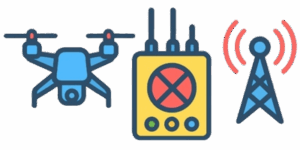
This educational simulator demonstrates how a suppression zone changes when transmitter power, an interfering source and separation vary. All computations are illustrative and intended for classroom or research demonstration only. Real radio physics are more complex and require professional oversight and legal clearance.


Table of Contents
Modelling approach and core relation
The model uses a simplified relation linking relative source strength and separation to an effective suppression radius. The formula is presented as an abstract mapping rather than a deployment recipe.
Abstract relation expressed symbolically:
\[ R = K \cdot F\!\left(\frac{P_{\text{interf}}}{P_{\text{tx}}}\right)\cdot H(d)\]
\(R\) denotes the modelled suppression radius in generic length units.
<li\(P_{\text{interf}}\) denotes relative interfering source level in simulator units.
- \(P_{\text{tx}}\) denotes relative transmitter level in simulator units.
- \(d\) denotes separation expressed in the user interface units, for example miles.
- \(K\) is a scaling constant used to keep the visualization within screen limits.
The simulator implements a gently saturating behaviour so the radius does not grow without bound. That saturation is represented by a smooth limiting function in the model rather than a hard cutoff.
Correction factors and smoothing
The educational model applies soft correction factors to illustrate realistic dependencies without claiming operational accuracy. Corrections cover frequency offset, receiver sensitivity and antenna characteristics. Symbolically the extended relation can be shown as
\[
R = K \cdot \left(\frac{(P_{\text{interf}} + \epsilon)^{\alpha}}{(P_{\text{tx}} + \epsilon)^{\beta}}\right)
\cdot
\]
\[
\cdot L(d)\cdot C_{\text{freq}}\cdot C_{\text{rx}}
\]
- \(\epsilon\) is a small positive offset used to avoid singularities in the expression.
- \(\alpha\) and \(\beta\) are exposition parameters that shape sensitivity to relative levels.
- \(L(d)\) is a distance dependent factor that increases smoothly with separation but includes a logarithmic or sublinear term to reflect diminishing marginal effect of very large separations.
- \(C_{\text{freq}}\) and \(C_{\text{rx}}\) are gentle penalization factors representing frequency mismatch and receiver threshold relative effect.
What the model intentionally omits
- No antenna pattern engineering or detailed gain pattern synthesis.
- No terrain, building propagation, multipath or atmospheric fading models.
- No step by step parameters for real interference generation or operational jamming.
- No device configuration recommendations that could be used in real hostile actions.
How to use the simulator responsibly
- Use the tool only for teaching concepts of interference, coexistence and spectrum planning.
- Treat simulated radii as qualitative indicators of effect size, not deployment targets.
- Document simulation settings, environment assumptions and the version of the model used when publishing results.
- When performing any live tests consult local regulations and obtain explicit permission from spectrum authorities and property owners.
Illustrative examples for classroom use
Provide students with hypothetical scenarios that compare relative trends. Use unitless examples or interface units, for example miles for separation, and avoid mapping simulator units directly to hardware power or frequencies.
- Scenario A: equal levels at short separation produce a modest suppression radius in visualization units.
- Scenario B: the interfering level increases while separation remains moderate; the visual radius grows but is limited by the soft cap function.
- Scenario C: large separation reduces effective interaction despite high relative interfering level, showing diminishing influence with distance.
Validation and calibration suggestions
For academic research calibrate the model against laboratory measurements carried out in controlled shielded environments. Record measurement metadata such as antenna heights, laboratory geometry and instrumentation. Use calibration data only to refine abstract scaling coefficients for purely analytical comparisons.
Reference tables — quick lookup
Units and conversions
| Item | Value |
|---|---|
| 1 mile | 1,609.344 m |
| 1 mile | 1.609 km |
| 1 km | 0.6214 miles |
| 1 foot | 0.3048 m |
| 1 meter | 3.2808 ft |
Typical receiver sensitivities
| Protocol / receiver class | Typical sensitivity |
|---|---|
| Wi-Fi (legacy) | −85 … −95 dBm |
| Wi-Fi (modern OFDM) | −65 … −85 dBm |
| Bluetooth / BLE | −90 … −100 dBm |
| Zigbee / 802.15.4 | −95 … −110 dBm |
| LoRa (long range) | −120 … −137 dBm |
| NB-IoT / CAT-M | −110 … −130 dBm |
| Cellular (typical UE) | −100 … −118 dBm |
| Professional narrowband receiver | −110 … −140 dBm |
Typical transmitter powers
| Device class | Typical transmit power |
|---|---|
| Small access point / repeater | 0.1 … 2 W |
| Portable two-way radio | 0.5 … 5 W |
| FPV / small repeater | 0.1 … 2 W |
| Site amplifier / professional repeater | 1 … 50 W |
| High power broadcast | 100 W and above |
Common antenna gains (dBi)
| Antenna type | Typical gain (dBi) |
|---|---|
| Monopole / small vertical | 0 … 3 dBi |
| Half-wave dipole | ~2.1 dBi |
| Patch / panel | 5 … 9 dBi |
| Yagi (small array) | 6 … 15 dBi |
| Sector | 8 … 15 dBi |
| Small parabolic dish | 20 … 40 dBi |
Cable loss (approx., at 2.4 GHz, per 100 ft)
| Cable type | Approx. loss per 100 ft |
|---|---|
| Thin RG-58 style | ~40 … 70 dB / 100 ft |
| LMR-200 style | ~25 … 45 dB / 100 ft |
| RG-213 / thicker | ~12 … 25 dB / 100 ft |
| LMR-400 / low-loss | ~6 … 15 dB / 100 ft |
Measurement checklist (what to record)
| Item | Reason to record |
|---|---|
| Timestamp | Correlate with environment and noise |
| Coordinates and antenna height | Reproducibility and modelling |
| Receiver and antenna model | Adjust sensitivity and gain |
| Frequency and bandwidth | Noise floor depends on bandwidth |
| Local noise/interference level | Assess detection margin |
| Weather and visibility | Propagation and attenuation factors |
Regulatory and ethical checklist
| Requirement | Action |
|---|---|
| Regulatory permission | Obtain license or authority approval before on-air tests |
| Protect critical services | Avoid experiments near emergency or public safety bands |
| Consent for field tests | Get property owner and stakeholder agreement |
| Documentation | Log settings and results for audit and safety |
Ethics, law and safe practice
Emphasize legal constraints and ethical considerations. Any on-air tests must follow law and frequency licensing rules. Avoid providing or seeking advice on how to interfere with operational systems, critical infrastructure or public safety communications.

This simulator offers an intuitive route to explore how relative source strength and separation influence a conceptual suppression zone. It is a teaching aid and not a source of operational parameters. Use the model to understand trends, to train students on spectrum coexistence, and to prepare lawful experiments under proper oversight.
Further reading
- David M. Pozar, Microwave Engineering, a fundamental resource on RF and antenna theory.
- Antenna Theory: Analysis and Design by Constantine A. Balanis, a practical reference on antenna patterns and gain.
- Andrea Goldsmith, Wireless Communications, for principles of propagation and system-level analysis.

David Parry — Senior Engineering Analyst
Specializing in electronics and physics-based simulations with 20+ years of engineering experience. David ensures the mathematical and physical accuracy of the tools at ProCalcLab.