| Parameter | Value |
|---|
Quick reference and calculator for a DIY double-quad double diamond antenna for digital TV DVB-T and DVB-T2. Contains formulas, practical feed gap and feeding recommendations, worked examples and a compact 3D visualization workflow.


Table of Contents
Quick start
- Enter the center operating frequency in MHz — typical DVB-T band 470–862 MHz.
- Enter the wire or tube diameter or the strip width in millimetres for your frame.
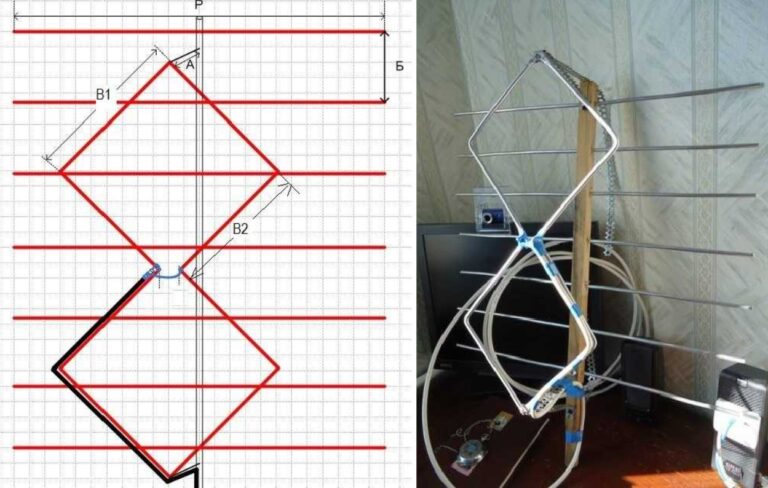
- Choose size mode: Full wave, Half wave or Quarter wave to scale the geometry. For DIY DVB-T quads use the empirical side coefficient 0.30–0.33 times the wavelength.
- Click Calculate to obtain diamond side, wire lengths, recommended feed gap, an approximate characteristic impedance and a 3D preview.
Symbols and main formulas
- f — operating frequency in MHz.
- λ — wavelength in metres: \[ \lambda = \frac{300}{f} \]
- s — diamond side in metres. This is the primary dimension.
- Total conductor length for one double-quad (two diamonds): \[ L_{\text{total}} = 8\,s \]
- Recommended feed gap is 5–10 mm as a general practical range.
- Approximate characteristic impedance: \[ Z_0 \approx 60\cdot\ln\!\left(\frac{2s}{r}\right) \]where r is the conductor radius in metres and a flat strip should use an equivalent radius.

Choosing the diamond side
Older theory sometimes used s = 1/4 λ. For practical DIY DVB-T use an empirical factor:
\[
s = k_{\text{side}}\cdot\lambda \quad k_{\text{side}} \approx 0.30 \text{ to } 0.33
\]
Using k = 0.32 produces dimensions commonly used by hobbyists. Example values follow below.
Calculator outputs
- Wavelength λ.
- Practical diamond side s with chosen coefficient.
- Wire length per diamond and total conductor length for both diamonds.
- Recommended feed gap, default around 7 to 8 mm.
- Approximate characteristic impedance Z0 in ohms for matching estimates to 50 or 75 ohm feeders.
- Feeding notes and short construction tips.

Worked example
Input: frequency f = 570 MHz, conductor diameter d = 3.2 mm, k_side = 0.32.
Calculations
Wavelength
\[
\lambda = \frac{300}{570} = 0.526 \text{ m} \approx 52.63 cm
\]
Diamond side
\[
s = 0.32 \cdot \lambda = 0.32 \cdot 0.5263 \approx 0.168 \text{ m}
\]
Wire lengths
\[
L_{\text{one diamond}} = 4s \approx 0.673 \text{ m}
\]
\[
L_{\text{total}} = 8s \approx 1.347 \text{ m}
\]
Feed gap example: 7.5 mm.
Estimated characteristic impedance
\[
r = \frac{d}{2} = 1.6 \text{ mm} = 0.0016 \text{ m},
\]
\[
Z_0 \approx 60 \ln\!\left(\frac{2\cdot 0.16842}{0.0016}\right) \approx 321 \, \Omega
\]
Note: This Z0 is an estimate. Real geometry and nearby items alter impedance. Use a 4:1 transformer or another matching network for 75 ohm or 50 ohm feeders.
DVB-T channel reference
| Channel | Frequency MHz | Wavelength mm |
|---|---|---|
| 21 | 474 | 632 |
| 22 | 482 | 622 |
| 23 | 490 | 612 |
| 24 | 498 | 602 |
| 25 | 506 | 593 |
| 26 | 514 | 583 |
| 27 | 522 | 574 |
| 28 | 530 | 566 |
| 29 | 538 | 557 |
| 30 | 546 | 549 |
| 31 | 554 | 541 |
| 32 | 562 | 534 |
| 33 | 570 | 526 |
| 34 | 578 | 519 |
| 35 | 586 | 512 |
| 36 | 594 | 505 |
| 37 | 602 | 498 |
| 38 | 610 | 492 |
| 39 | 618 | 485 |
| 40 | 626 | 479 |
| 41 | 634 | 473 |
| 42 | 642 | 467 |
| 43 | 650 | 461 |
| 44 | 658 | 456 |
| 45 | 666 | 450 |
| 46 | 674 | 445 |
| 47 | 682 | 440 |
| 48 | 690 | 435 |
| 49 | 698 | 430 |
| 50 | 706 | 425 |
| 51 | 714 | 420 |
| 52 | 722 | 415 |
| 53 | 730 | 411 |
| 54 | 738 | 406 |
| 55 | 746 | 402 |
| 56 | 754 | 398 |
| 57 | 762 | 393 |
| 58 | 770 | 389 |
| 59 | 778 | 385 |
| 60 | 786 | 381 |
| 61 | 794 | 378 |
| 62 | 802 | 374 |
| 63 | 810 | 370 |
| 64 | 818 | 367 |
| 65 | 826 | 363 |
| 66 | 834 | 359 |
| 67 | 842 | 356 |
| 68 | 850 | 353 |
| 69 | 858 | 349 |
Reference size table with k_side = 0.32
| Frequency MHz | λ cm | Diamond side s cm | One diamond cm | Total wire cm |
|---|---|---|---|---|
| 570 | 52.63 | 16.84 | 67.37 | 134.74 |
| 600 | 50.00 | 16.00 | 64.00 | 128.00 |
| 546 | 54.95 | 17.58 | 70.33 | 140.66 |
| 500 | 60.00 | 19.20 | 76.80 | 153.60 |
| 470 | 63.83 | 20.43 | 81.70 | 163.40 |
Construction notes and tips
- Before building the double-quad, test reception with a simple quarter-wave whip to confirm the signal.
- Use 75 ohm coax for DVB-T. If the quad’s estimated Z0 is high, fit a 4:1 transformer or other matching network to reach 75 or 50 ohm.
- Feed gap 5–10 mm is convenient for soldering or bolting; 7 mm is a common practical choice.
- Flat strips reduce equivalent radius and make the simple Z0 formula less accurate. Measure SWR or use EM modelling for precise matching.
- Thicker conductors and flat bars increase stiffness and widen bandwidth slightly but shift resonance; retune by a few percent if needed.
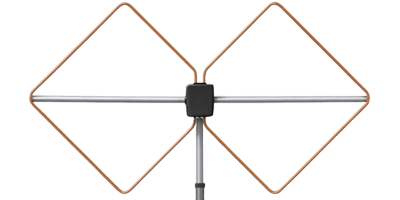
- Mount diamonds in the same plane and ensure they touch at the corner feed point. Fix mounting brackets so geometry stays stable and feed contacts both edges of the gap.
Checks after assembly
- Measure SWR and return loss across the target band.
- Measure TV signal level and BER or MER after pointing and mounting.
- Small adjustments of ±2–5 percent of element size often improve resonance.
📈 Important: All impedance and gain numbers are approximate. Use full EM modelling or an antenna analyser for accurate design. This calculator is a fast practical tool for DIY builds where absolute precision is not required.
A properly sized reflector increases forward gain and range but requires correct spacing and geometry. In most home cases a single well-matched double-quad with a good matching network and adequate mast height is the best balance of simplicity and performance.
References
- Antennas: Theory and Analysis — Constantine A. Balanis.
- The ARRL Antenna Book — American Radio Relay League.
- Practical Antenna Handbook — Joseph J. Carr.
- Antenna Engineering Handbook — John L. Volakis (editor).

Markus Fletcher — Structural Design Specialist
Expert in structural integrity, 3D modeling, and applied mathematics. Markus focuses on creating precise tools for construction professionals and DIY engineers.