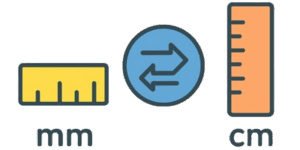
Length converter that converts distances instantly across metric, imperial and astronomical units. Fast reliable conversions suit everyday use, engineering, mapping, navigation and research. The interface is compact, results are copy ready and visual gauges adapt to the scale of numbers for clear comparison.


Table of Contents
What this tool does
- Convert any length from very small to very large units, from picometers and angstroms up to kilometers, astronomical units and parsecs.
- Simple workflow, choose source unit, choose target unit, type a number or move the slider, the result updates immediately.
- Two visual gauges help compare values, left gauge uses a fixed scale for direct comparison, right gauge adapts the order of magnitude automatically.
- Output is formatted for reading and copying, with compact and scientific notation options for high precision transfer to spreadsheets or reports.
- Supports fractional inputs, very large numbers and scientific notation for professional workflows.
Supported units
| Code | Unit | Short | Typical use |
|---|---|---|---|
| pm | Picometer | pm | Nanotech, physics |
| Å | Angstrom | Å | Crystallography, chemistry |
| nm | Nanometer | nm | Optics, materials |
| µm | Micrometer | µm | Precision mechanics, biology |
| mm | Millimeter | mm | Workshops, drawings |
| cm | Centimeter | cm | Everyday measurement |
| m | Meter | m | Construction, science |
| km | Kilometer | km | Transport, geography |
| in | Inch | in | Machining, US markets |
| ft | Foot | ft | Building, aviation |
| yd | Yard | yd | Materials, landscaping |
| mi | Statute mile | mi | Road distances |
| nmi | Nautical mile | nmi | Navigation, shipping |
| chain | Chain | chain | Surveying |
| furlong | Furlong | furl. | Historic measures |
| AU | Astronomical unit | AU | Astronomy |
| ly | Light year | ly | Cosmic distances |
| pc | Parsec | pc | Large scale astronomy |
Conversion factors to meters
Multiply a value in the listed unit by the factor to get meters.
| Unit | Factor to meters | Example |
|---|---|---|
| pm | 1e-12 m | 1 pm = 1×10⁻¹² m |
| Å | 1e-10 m | 1 Å = 1×10⁻¹⁰ m |
| nm | 1e-9 m | 1 nm = 1×10⁻⁹ m |
| µm | 1e-6 m | 1 µm = 0.000001 m |
| mm | 0.001 m | 1 mm = 0.001 m |
| cm | 0.01 m | 1 cm = 0.01 m |
| m | 1 m | 1 m = 1 m |
| km | 1000 m | 1 km = 1000 m |
| in | 0.0254 m | 1 in = 0.0254 m |
| ft | 0.3048 m | 1 ft = 0.3048 m |
| mi | 1609.344 m | 1 mi = 1609.344 m |
| nmi | 1852 m | 1 nmi = 1852 m |
| chain | 20.1168 m | 1 chain = 20.1168 m |
| furlong | 201.168 m | 1 furlong = 201.168 m |
| AU | 149597870700 m | 1 AU ≈ 1.4959787×10¹¹ m |
| ly | 9.4607304725808e15 m | 1 ly ≈ 9.4607×10¹⁵ m |
| pc | 3.08567758149137e16 m | 1 pc ≈ 3.0857×10¹⁶ m |
Quick rules and examples
| From to | Multiplier | Example |
|---|---|---|
| mm to m | ÷ 1000 | 12 500 mm = 12.5 m |
| m to km | ÷ 1000 | 2 300 m = 2.3 km |
| inch to mm | × 25.4 | 8 in ≈ 203.2 mm |
| ft to m | × 0.3048 | 6 ft ≈ 1.8288 m |
| mile to km | × 1.609344 | 7 mi ≈ 11.2654 km |
| AU to km | × 149597.8707 | 0.3 AU ≈ 44 879 361 210 m |
Ready examples
- 25 000 mm → 25 m
- 0.62 mi → 0.997 km
- 4 ft → 1.2192 m
- 0.3 AU → 44 879 361 210 m
- 1.5 ly → 1.41910957188712×10¹⁶ m

Practical tips
- Choose units that make numbers compact and readable, use meters for technical data exchange.
- For mapping use meters and kilometers, for navigation prefer nautical miles.
- When handling very large or very small values use scientific notation to preserve precision.
- If integrating the converter into a system, send the raw value and unit, convert to meters on the server, then derive target units from meters to avoid rounding drift.
- For mixed inputs like feet and inches supply parts separated by space or use the combined input option, the converter will sum parts into one value.
Displayed numbers may use exponential notation for readability. That format preserves significance. For machine processing, use the canonical value in meters. Some references may round conversion constants, so for critical calculations verify constants against authoritative standards before finalizing results.
Further reading
- NIST Special Publication 811, Guide for the Use of the International System of Units SI
- BIPM, The International System of Units SI, latest brochure
- CRC Standard Mathematical Tables and Formulae, for conversion constants and numeric references

David Parry — Senior Engineering Analyst
Specializing in electronics and physics-based simulations with 20+ years of engineering experience. David ensures the mathematical and physical accuracy of the tools at ProCalcLab.