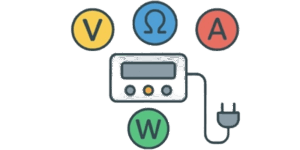
This tool converts electrical and related physical units instantly and accurately. It supports SI prefixes – micro, milli, kilo, mega, giga, etc., and many common specialty units used in electronics, power engineering and instrumentation. Use it to avoid unit errors, check quick calculations, learn unit relationships, or prepare values for schematics, BOMs and reports.


Table of Contents
Who this is for
- Students learning electronics and electrical engineering
- Engineers and technicians doing circuit design and measurements
- Hobbyists working with microcontrollers, sensors and power supplies
- Anyone who needs fast, reliable unit conversions for electrical quantities
Supported categories
The converter covers:
- Voltage — V, mV, µV, kV, MV
- Current — A, mA, µA, nA
- Resistance / Impedance — Ω, mΩ, kΩ, MΩ
- Conductance — S, mS, µS
- Capacitance — F, mF, µF, nF, pF
- Inductance — H, mH, µH, nH
- Power — W, mW, kW, MW, dBm, dBW
- Energy — J, kJ, Wh, kWh, eV
- Charge — C, Ah, mAh
- Frequency — Hz, kHz, MHz, GHz
- Reactance / Impedance — treated in Ω units; see notes about complex values
- Temperature — °C, K, °F
- And extra helpers — bits/bytes, SI prefixes, common automotive / power conversion helpers
SI prefixes quick reference
| Prefix | Symbol | Factor | Example |
|---|---|---|---|
| pico | p | 1e-12 | 1 pF = 1×10⁻¹² F |
| nano | n | 1e-9 | 100 nF = 100×10⁻⁹ F |
| micro | µ | 1e-6 | 10 µA = 10×10⁻⁶ A |
| milli | m | 1e-3 | 2 mA = 0.002 A |
| kilo | k | 1e3 | 2.2 kΩ = 2200 Ω |
| mega | M | 1e6 | 1 MW = 1×10⁶ W |
| giga | G | 1e9 | 3 GHz = 3×10⁹ Hz |
Practical worked examples
Example 1 — DC power
Given V = 12 V and I = 2 A:
P = V × I = 12 × 2 = 24 W
Example 2 — SI prefixes & resistance
Given R = 2.2 kΩ → convert to ohms:
2.2 kΩ = 2.2 × 1000 = 2200 Ω
Example 3 — dBm to watts
0 dBm → P = 1 mW = 0.001 W. 20 dBm → P = 0.1 W
How to use the converter
- Choose the correct category (voltage, current, capacitance, etc.). The converter prevents nonsensical conversions across incompatible types.
- Use SI prefixes rather than hand multiplying values when possible. E.g., enter “2.2k” or select “kΩ”.
- For frequency-dependent quantities (reactance), provide the frequency in Hz.
- For power expressed in dBm/dBW use the provided decibel units — those require logarithmic conversion and are handled specially.
- When dealing with impedance of AC networks, remember the converter handles scalar unit conversion; computing complex impedance (R + jX) and AC phasor math requires complex arithmetic.

Advanced notes & caveats
- Temperature: temperature conversions are affine (they have offsets). The converter treats these correctly (C ↔ K ↔ F).
- dBm/dBW: logarithmic units reference a fixed power (1 mW or 1 W) and must be handled with log/antilog formulas — results may be -Inf for 0 W.
- Reactance & impedance: these share units with resistance (Ω) but represent frequency-dependent values. Provide frequency when converting capacitance/inductance into reactance.
- Rounding & significant figures: the tool uses smart rounding. When accuracy matters, increase displayed decimals or use full numeric result.
- Complex conversions: conversions that require complex numbers (e.g., converting impedance expressed as magnitude/angle ↔ real+imag) are outside pure scalar unit conversion; use the dedicated AC circuit tool.
Type numbers in plain numeric form or use scientific notation (e.g., 3.3e-6). When pasting values from measurements, clear thousand separators (commas) first or use the field that accepts formatted numbers.
Common quick-conversions
| From | To | Result |
|---|---|---|
| 1 A | mA | 1000 mA |
| 2.2 kΩ | Ω | 2200 Ω |
| 100 nF at 1 kHz | Xc (Ω) | ≈ 1.59 kΩ |
| 0 dBm | W | 0.001 W |
| 1 kW | W | 1000 W |
| 3600 J | Wh | 1 Wh |
| 1 mAh | C | 0.0036 C |
Example workflows
- Designing a power supply: convert transformer output (V) → RMS → power (W) → required current (A) at load.
- Choosing passive components: compute reactance of capacitors/inductors at operating frequency and compare to target impedance in Ω.
- RF link budgeting: convert dBm ↔ watts, convert power to dB gains/losses and adjust antenna power levels.
The converter is designed to work on desktop and mobile browsers. Keyboard navigation, clear labels and copy function help when using assistive technologies.
Final notes
Unit mistakes are a common source of errors in electronics. This converter is intended to reduce those mistakes by providing immediate, accurate unit translation for electrical quantities. If you need compound calculations (phasor math, complex impedance networks, power factor calculations), combine the converter with a dedicated circuit solver or calculator that supports complex numbers.
Disclaimer: the converter provides numeric conversions and engineering guidance but does not replace detailed design tools, simulation, or safety checks required for high-voltage, high-current or safety-critical systems.
References
- International System of Units (SI) — Bureau International des Poids et Mesures (BIPM).
- Electrical Engineering Reference Manual — John A. Camara, Professional Publications Inc.
- Handbook of Electrical Engineering — Alan L. Sheldrake, Wiley.
- Schaum’s Outline of Electrical Engineering — Mahmood Nahvi, McGraw-Hill.

David Parry — Senior Engineering Analyst
Specializing in electronics and physics-based simulations with 20+ years of engineering experience. David ensures the mathematical and physical accuracy of the tools at ProCalcLab.