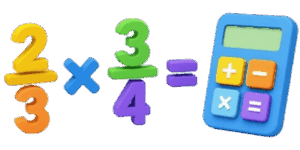
Fractions have long been the stumbling block for learners around the world. Abstract numbers floating above and below a tiny line often fail to make sense in the real world. Rote memorization of mathematical rules works for a short time but spatial reasoning is what truly builds permanent understanding. Visualizing mathematics turns a daunting task into an intuitive process. The 3D Fraction Multiplication Calculator is built precisely for this purpose. It strips away the confusion of abstract arithmetic and replaces it with tangible visual models. By representing numbers as three-dimensional objects users can instantly see how parts of a whole interact when multiplied together.
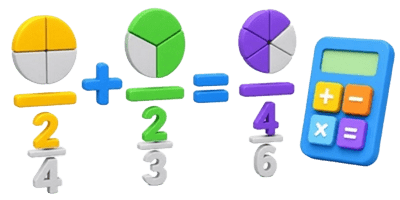
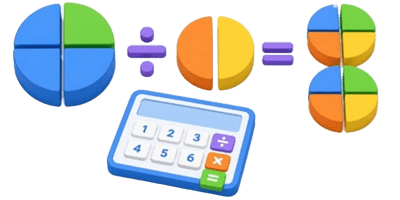
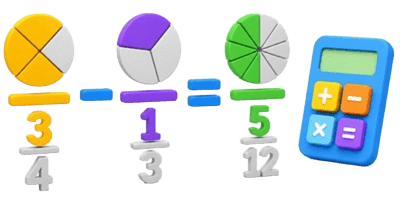
✍ This comprehensive guide explores the mechanics of fraction multiplication details the operation of the interactive 3D tool and provides practical examples to bridge the gap between theory and everyday application. Whether scaling a recipe down for a smaller dinner party or calculating material requirements for a construction project mastering this skill is essential. Let us delve into the visual world of fractions and discover how seeing the math makes solving the math easier than ever before.
Table of Contents
Why Visualizing Multiplication Changes the Game
Multiplying numbers usually implies making things bigger. Two times three equals six resulting in a larger quantity. Fractions break this intuitive rule. Multiplying a half by a half results in a quarter a smaller quantity. This conceptual leap confuses many people. Abstract formulas do not explain why the number shrinks. A visual representation provides immediate clarity. When a visual model shows half of a pie and then cuts that half into another half the brain instantly registers the resulting quarter piece.
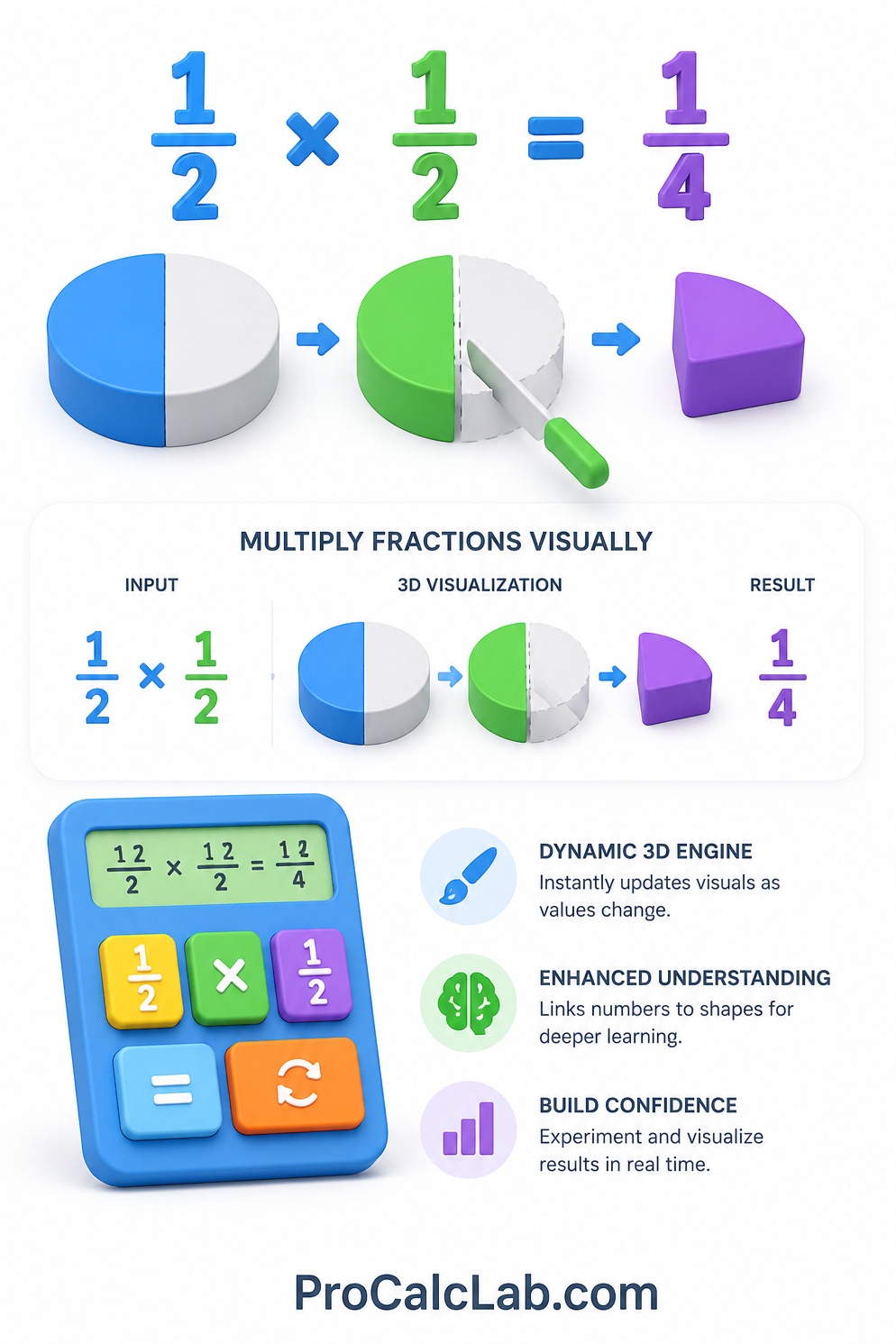
The 3D calculator renders these relationships as solid cylinders. Whole numbers appear as complete blocks while fractions appear as perfectly sliced wedges. As input values change the 3D engine dynamically repaints the scene. This instant feedback loop allows users to experiment with quantities and watch the physical representation expand or contract accordingly. Cognitive science strongly supports this type of learning. Connecting a numerical input to a physical shape activates different parts of the brain cementing the logical rule behind the calculation.
Navigating the 3D Fraction Calculator Interface
Operating the calculator requires no advanced technical skills. The interface is purposefully minimal focusing entirely on the input values and the resulting 3D geometry. Here is a detailed breakdown of how to interact with the system.
The Central 3D Canvas
The top section of the tool houses the interactive canvas. This is where the geometric representations live. Users can click and drag across this area to rotate the camera exploring the 3D fractions from any angle. The left side displays the first fraction the multiplier. The middle shows the multiplication sign. The right side displays the second fraction the multiplicand. Finally the bottom level or the far right depending on the screen size reveals the final result. The objects are color-coded to help distinguish between the starting values and the final product.
Input Fields and Sliders
Below the 3D view lie the control panels. There are two identical sections for the left and right values. Each section contains inputs for the whole number the numerator and the denominator. Users can either type numbers directly into the white boxes or drag the horizontal sliders for rapid adjustments. The sliders are particularly useful for observing how incremental changes affect the 3D shapes in real time. The limits are set to a maximum of 20 to keep the visual models clean and easy to interpret.
The Real-Time Result Display
As soon as a number is typed or a slider is moved the calculation engine processes the data. The tool computes the product simplifies it to its lowest terms and updates the text display immediately. The result is formatted as a proper vertical fraction with a clear horizontal dividing line. This ensures maximum readability preventing the confusion often caused by slanted slash formats. A download button at the very bottom captures a high-resolution screenshot of the current 3D state perfect for saving notes or sharing homework solutions.
The Mathematics of Fraction Multiplication
While the 3D models handle the heavy lifting understanding the underlying mathematics empowers users to verify the results. The rules for multiplying fractions are remarkably straightforward compared to addition or subtraction because there is no need to find a common denominator.
Core Formulas and Steps
The fundamental rule of fraction multiplication is to multiply the top numbers together and then multiply the bottom numbers together. If the problem involves mixed numbers they must first be converted into improper fractions.
Step 1: Convert mixed numbers to improper fractions.
Nimproper = W × D + Noriginal
Where W is the whole number D is the denominator and N is the numerator.
Step 2: Multiply the numerators.
Nfinal = N1 × N2
Step 3: Multiply the denominators.
Dfinal = D1 × D2
Step 4: Simplify the fraction by finding the greatest common divisor and dividing both the final numerator and final denominator by that number.
Practical Example 1: Simple Fraction by a Simple Fraction
Consider a situation where a recipe calls for 3/4 of a cup of sugar but the cook only wants to make 1/2 of the recipe. This requires multiplying 3/4 by 1/2.
Setting up the calculator involves entering 0 for the whole numbers on both sides. On the left set the numerator to 3 and the denominator to 4. On the right set the numerator to 1 and the denominator to 2.
The internal math calculates: 3 × 1 = 3 for the top number. 4 × 2 = 8 for the bottom number. The result is 3/8.
Looking at the 3D canvas the user sees a cylinder with one quarter missing multiplied by a cylinder cut exactly in half. The resulting green cylinder at the bottom displays three tiny wedges representing exactly three-eighths of a whole. The visual confirms that taking a half of three-quarters leaves a piece slightly smaller than a half.
Practical Example 2: Whole Number by a Fraction
Imagine a carpenter needs to cut 5 wooden boards and each board must be 2/3 of a meter long. To find the total length of wood required the carpenter multiplies 5 by 2/3.
In the calculator the left side receives a 5 in the whole number box with the fraction left at 0/1. The right side receives a 0 in the whole number box a 2 for the numerator and a 3 for the denominator.
The mathematical process turns the whole number into a fraction by placing it over 1 making it 5/1. Then it multiplies 5 × 2 = 10 for the numerator and 1 × 3 = 3 for the denominator. The fraction 10/3 is improper. Dividing 10 by 3 yields a whole number of 3 with a remainder of 1. The final simplified answer is 3 1/3.
The 3D scene dramatically illustrates this. Five solid blue cylinders appear on the top. The middle shows a single orange cylinder missing a third. The final result combines all those pieces to generate three perfectly solid green cylinders and one tiny piece representing the remaining third.
Practical Example 3: Mixed Number by a Mixed Number
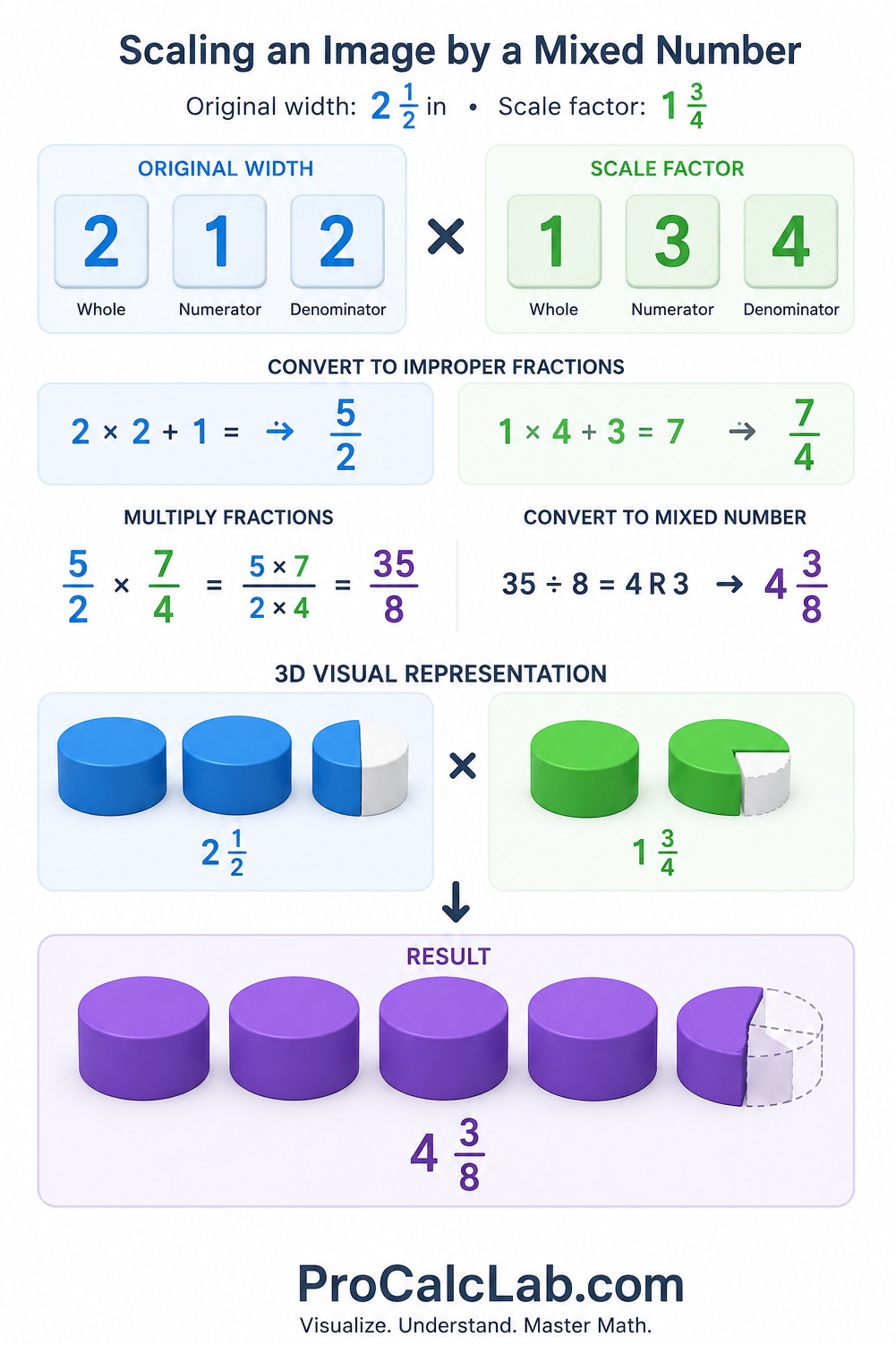
A graphic designer is scaling a printed image. The original image is 2 1/2 inches wide and the client wants it scaled up by a factor of 1 3/4. This is a classic mixed number multiplication scenario.
The user inputs 2 for the left whole number 1 for the numerator and 2 for the denominator. On the right the inputs are 1 for the whole number 3 for the numerator and 4 for the denominator.
The engine converts the first number: 2 × 2 + 1 = 5 making it 5/2. It converts the second number: 1 × 4 + 3 = 7 making it 7/4. Multiplying the top numbers 5 × 7 = 35. Multiplying the bottom numbers 2 × 4 = 8. The improper fraction is 35/8. Dividing 35 by 8 gives 4 whole units with a remainder of 3. The final result is 4 3/8.
The 3D canvas displays two full cylinders and a half cylinder on one side. The other side shows one full cylinder and a three-quarter wedge. The final output is four massive solid cylinders and a smaller three-eighths slice providing a brilliant visual proof of a complex calculation.
Reference Data: Essential Conversions and Multipliers
To further assist in practical tasks having quick reference tables eliminates the need to calculate basic equivalents repeatedly. The following tables provide essential data for cooking construction and general mathematics rounded to a practical minimum.
Table 1: Standard Fraction to Decimal and Percent Equivalents
This table covers the most common fractions encountered in daily life converting them into standard decimal and percentage formats for quick reference.
| Fraction | Decimal Value | Percentage |
|---|---|---|
| 1/2 | 0.5 | 50% |
| 1/3 | 0.33 | 33.3% |
| 2/3 | 0.67 | 66.7% |
| 1/4 | 0.25 | 25% |
| 3/4 | 0.75 | 75% |
| 1/5 | 0.2 | 20% |
| 2/5 | 0.4 | 40% |
| 3/5 | 0.6 | 60% |
| 4/5 | 0.8 | 80% |
| 1/6 | 0.17 | 16.7% |
| 5/6 | 0.83 | 83.3% |
| 1/8 | 0.13 | 12.5% |
| 3/8 | 0.38 | 37.5% |
| 5/8 | 0.63 | 62.5% |
| 7/8 | 0.88 | 87.5% |
| 1/10 | 0.1 | 10% |
| 3/10 | 0.3 | 30% |
| 7/10 | 0.7 | 70% |
| 9/10 | 0.9 | 90% |
| 1/12 | 0.08 | 8.3% |
Table 2: Construction and Carpentry Tape Measure Guide
Builders frequently multiply lengths by fractional scales. Knowing the exact decimal equivalent of tape measure marks speeds up job site calculations.
| Tape Mark Fraction | Decimal Inch Equivalent | Nearest Millimeter |
|---|---|---|
| 1/16 inch | 0.06 inch | 2 mm |
| 1/8 inch | 0.13 inch | 3 mm |
| 3/16 inch | 0.19 inch | 5 mm |
| 1/4 inch | 0.25 inch | 6 mm |
| 5/16 inch | 0.31 inch | 8 mm |
| 3/8 inch | 0.38 inch | 10 mm |
| 7/16 inch | 0.44 inch | 11 mm |
| 1/2 inch | 0.50 inch | 13 mm |
| 9/16 inch | 0.56 inch | 14 mm |
| 5/8 inch | 0.63 inch | 16 mm |
| 11/16 inch | 0.69 inch | 17 mm |
| 3/4 inch | 0.75 inch | 19 mm |
| 13/16 inch | 0.81 inch | 21 mm |
| 7/8 inch | 0.88 inch | 22 mm |
| 15/16 inch | 0.94 inch | 24 mm |
| 1 inch | 1.00 inch | 25 mm |
Table 3: Culinary Scaling Multipliers
Scaling a recipe up or down requires multiplying every ingredient by a specific factor. This table provides the exact fraction to multiply by based on the desired yield change.
| Original Yield | Desired Yield | Multiply All Ingredients By |
|---|---|---|
| 4 Servings | 2 Servings | 1/2 |
| 4 Servings | 3 Servings | 3/4 |
| 4 Servings | 6 Servings | 1 1/2 |
| 4 Servings | 8 Servings | 2 |
| 6 Servings | 2 Servings | 1/3 |
| 6 Servings | 3 Servings | 1/2 |
| 6 Servings | 4 Servings | 2/3 |
| 6 Servings | 9 Servings | 1 1/2 |
| 8 Servings | 2 Servings | 1/4 |
| 8 Servings | 4 Servings | 1/2 |
| 8 Servings | 6 Servings | 3/4 |
| 8 Servings | 12 Servings | 1 1/2 |
| 10 Servings | 5 Servings | 1/2 |
| 12 Servings | 3 Servings | 1/4 |
| 12 Servings | 4 Servings | 1/3 |
| 12 Servings | 8 Servings | 2/3 |
Tips for Success and Avoiding Common Mistakes
Even with visual aids certain numerical traps exist. A very common error is adding the numerators instead of multiplying them. Always remember the multiplication rule applies strictly across the top and across the bottom. Furthermore forgetting to convert mixed numbers into improper fractions before multiplying will completely break the mathematical formula leading to wild inaccuracies.
🎓 The beauty of this 3D interface is that it catches human errors visually. If an incorrect manual calculation yields an answer that is larger than the starting numbers when multiplying by a proper fraction the visual model will immediately expose the contradiction. A piece cannot become larger when taking a fraction of it. Users should always cross-reference their mental math with the rendered cylinders. If the green result block looks disproportionately huge double check the input values.
Conclusion
Mathematics thrives on clarity. The transition from numbers on a flat page to interactive geometric models provides a deeper profound understanding of fractional relationships. The 3D Fraction Multiplication Calculator acts as an invaluable asset for anyone struggling with arithmetic or simply needing a rapid reliable visual confirmation of a calculation. By manipulating the sliders observing the dynamic models and referencing the robust conversion tables built into this guide mastering fractions transforms from a frustrating chore into an engaging visually satisfying experience.
List of References
- Fosnot C. T. & Dolk M. Constructing Fractions Decimals and Percents. Heinemann 2002.
- Van de Walle J. A. Karp K. S. & Bay-Williams J. M. Elementary and Middle School Mathematics: Teaching Developmentally. Pearson 2018.
- National Governors Association Center for Best Practices. Common Core State Standards for Mathematics. Council of Chief State School Officers 2010.
- Boaler J. Mathematical Mindsets: Unleashing Students Potential through Creative Math Inspiring Messages and Innovative Teaching. Jossey-Bass 2015.
- Siegler R. S. et al. Developing Effective Fractions Instruction for Kindergarten Through 8th Grade. National Center for Education Evaluation and Regional Assistance 2010.

Markus Fletcher — Structural Design Specialist
Expert in structural integrity, 3D modeling, and applied mathematics. Markus focuses on creating precise tools for construction professionals and DIY engineers.