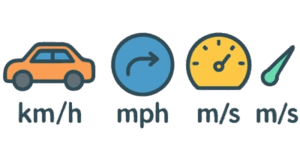
This fast speed converter turns any speed figure into a different unit with no delay, converting values precisely by using meters per second as the internal reference. The tool suits transport planners, athletes, mariners, pilots and engineers who need immediate, reliable conversions for calculations, displays and logging.


Table of Contents
What the converter delivers and how it helps
- Convert between a wide range of units, from millimetres per second up to kilometres per second, including metres per second, kilometres per hour, miles per hour, knots and mach number
- Pick the source unit, pick the target unit, type a value or adjust the slider for instant feedback
- Results render immediately, with a readable rounded display while the full numeric value remains available for precise calculations
- Visual gauge automatically chooses a convenient scale, such as tens, hundreds or thousands, to keep numbers compact and legible
- Slider controls are convenient for rapid exploration, while the numeric input accepts fractional values for precision work
Supported units and common uses
| Code | Unit name | Abbreviation | Typical application |
|---|---|---|---|
| mm_s | Millimetre per second | mm/s | Micro motion and lab measurements |
| cm_s | Centimetre per second | cm/s | Small scale testing and experiments |
| m_s | Metre per second | m/s | Physics, engineering and scientific work |
| km_h | Kilometre per hour | km/h | Road speed and transport planning |
| km_s | Kilometre per second | km/s | Astrophysics and extreme velocity contexts |
| m_min | Metre per minute | m/min | Industrial feed rates |
| m_h | Metre per hour | m/h | Very slow processes and inspection tasks |
| km_min | Kilometre per minute | km/min | Satellite and rapid transit calculations |
| ft_s | Foot per second | ft/s | Aerospace and construction engineering |
| in_s | Inch per second | in/s | Mechanics and precision motion |
| mph | Mile per hour | mph | Road use in several countries |
| mi_s | Mile per second | mi/s | Orbital and high speed computations |
| knot | Knot | kt | Marine and aviation navigation |
| mach | Mach number | M | Aeronautics and sonic regimes |
Conversion coefficients into metres per second
Multiply a value by the listed coefficient to get the speed in metres per second, which is the recommended unit for further numeric processing.
| Unit | To metres per second | Example |
|---|---|---|
| mm/s | 0.001 m/s | 7 mm/s becomes 0.007 m/s |
| cm/s | 0.01 m/s | 3 cm/s becomes 0.03 m/s |
| m/s | 1 m/s | 5.5 m/s remains 5.5 m/s |
| km/h | 0.2777777778 m/s | 45 km/h becomes 12.5 m/s |
| km/s | 1000 m/s | 0.02 km/s becomes 20 m/s |
| m/min | 0.0166666667 m/s | 120 m/min becomes 2 m/s |
| m/h | 0.0002777778 m/s | 3600 m/h becomes 1 m/s |
| km/min | 16.6666666667 m/s | 0.5 km/min becomes 8.3333 m/s |
| ft/s | 0.3048 m/s | 20 ft/s becomes 6.096 m/s |
| in/s | 0.0254 m/s | 100 in/s becomes 2.54 m/s |
| mph | 0.44704 m/s | 80 mph becomes 35.7632 m/s |
| mi/s | 1609.344 m/s | 0.003 mi/s becomes 4.8280 m/s |
| knot | 0.5144444444 m/s | 12 kt becomes 6.1733 m/s |
| mach | approximately 343 m/s | 0.25 M becomes 85.75 m/s |
👉 For machine to machine transfers and API workflows, use metres per second as the canonical unit to avoid accumulated rounding errors. For user interfaces and instrument displays, format the number for readability, but keep a stored version with full precision for subsequent calculations. When working with vectors or signed velocities, include the sign to indicate direction, so negative values represent motion opposite to the chosen positive axis.
Quick conversion rules and handy multipliers
| From to To | Multiplier | Example |
|---|---|---|
| m/s to km/h | times 3.6 | 8 m/s becomes 28.8 km/h |
| km/h to m/s | divide by 3.6 | 90 km/h becomes 25 m/s |
| m/s to mph | times 2.2369362921 | 12 m/s becomes 26.8432 mph |
| mph to m/s | divide by 2.2369362921 | 55 mph becomes 24.5872 m/s |
| m/s to knots | times 1.9438444924 | 7 m/s becomes 13.6069 kt |
| knots to m/s | divide by 1.9438444924 | 15 kt becomes 7.7160 m/s |
Converted value examples
- 6 m/s converts to 21.6 km/h
- 31 m/s converts to 111.6 km/h
- 50 mph converts to 22.3520 m/s and 80.6218 km/h
- 18 m/s converts to 34.9892 knots
- 0.8 km/h converts to 0.2222 m/s

Practical tips for different domains
- Use kilometres per hour and metres per second for road design and traffic modelling
- For maritime and aviation navigation, prefer knots and feet per second where appropriate
- For research into extreme speeds or astrophysical motion, use metres per second or kilometres per second
- To preserve numeric accuracy, copy the raw numeric output rather than relying on visually rounded values
Common questions and short answers
How do I switch the direction of conversion
Change the active units in the from column and the to column, then enter a value or use the slider. The result updates instantly.
Can I enter decimal values
Yes, the input field accepts fractions for precise conversions. The slider uses a coarse step by default but can be adjusted in settings if needed.
Are the results exact
The conversions use exact coefficients when converting through metres per second. The display may round for readability while the full numeric value remains available for calculations and export.
⚖ If you work in aviation or high precision navigation, remember that mach depends on the speed of sound, which varies with temperature and altitude. Apply environmental corrections when high accuracy is required.
This expanded guide explains unit choices, coefficients and quick formulas to help you make reliable conversions. Treat metres per second as the base unit for computations and keep formatted values for display. Use this speed converter for rapid checks and retain full precision for technical workflows.
Further reading
- Units and Measurements in Physics by F. Brown
- Engineering Unit Conversions Handbook by A. Smith
- Practical Navigation and Nautical Calculations by R. Clarke

David Parry — Senior Engineering Analyst
Specializing in electronics and physics-based simulations with 20+ years of engineering experience. David ensures the mathematical and physical accuracy of the tools at ProCalcLab.