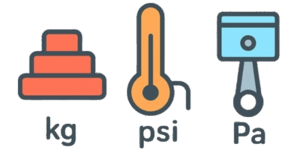
This pressure converter converts values between common metric, imperial and specialized pressure units with accuracy suitable for engineering, laboratory work and everyday use. Results are computed via pascals as the canonical base so conversions remain consistent and precise.



Table of Contents
What the pressure converter does
- Converts pressure between a wide range of units including pascal, kilopascal, megapascal, bar, millibar, atmosphere, torr, millimeter mercury, psi and more.
- Simple workflow: choose the input column, choose the output column, then type a number or use the slider to explore values.
- Instant results update as you type so you see conversions without delay.
- Left visual gauge is fixed for easy comparison of common baseline values, right gauge scales to the output magnitude for clear presentation.
- Input supports decimals and scientific notation so very large or very small pressures are handled without loss of precision.
Supported units and common uses
| Code | Unit | Typical use |
|---|---|---|
| Pa | Pascals | Science and engineering |
| kPa | Kilopascals | Climate control and automation |
| MPa | Megapascals | Materials testing and hydraulics |
| hPa | Hectopascals | Meteorology and weather reports |
| mbar | Millibars | Weather stations and charts |
| bar | Bar | Industrial systems and pumps |
| atm | Atmospheres | Reference and laboratory work |
| torr | Torr | Vacuum measurement |
| mmHg | Millimeters of mercury | Medicine and barometers |
| psi | Pounds per square inch | Automotive and pneumatics |
| inHg | Inches of mercury | Aviation and barometry |
| inH2O | Inches of water | HVAC and ventilation |
| cmH2O | Centimeters of water | Medical devices and breathing systems |
| kgf/cm² | Kilogram-force per square centimeter | Legacy specifications and technical manuals |
| ksi | Ksi | Material strength and structural engineering |
All conversions use pascals as the base unit. Multiply the input value by the unit factor to get pascals. Then divide by the target unit factor to get the output value. This two step approach guarantees consistent results across any chain of conversions.
Conversion coefficients to pascal
| Unit | Factor to Pa | Example |
|---|---|---|
| Pa | 1 | 1 Pa equals 1 Pa |
| kPa | 1 000 | 1 kPa equals 1 000 Pa |
| MPa | 1 000 000 | 1 MPa equals 1 000 000 Pa |
| hPa | 100 | 1 hPa equals 100 Pa |
| mbar | 100 | 1 mbar equals 100 Pa |
| bar | 100 000 | 1 bar equals 100 000 Pa |
| atm | 101 325 | 1 atm equals 101 325 Pa |
| torr | 133.322 | 1 torr equals approximately 133.322 Pa |
| mmHg | 133.322 | 1 mmHg equals approximately 133.322 Pa |
| psi | 6 894.757 | 1 psi equals approximately 6 894.757 Pa |
| inHg | 3 386.389 | 1 inHg equals approximately 3 386.389 Pa |
| inH2O | 249.082 | 1 inH2O equals approximately 249.082 Pa |
| cmH2O | 98.0665 | 1 cmH2O equals approximately 98.0665 Pa |
| kgf_cm2 | 98 066.5 | 1 kgf per cm squared equals approximately 98 066.5 Pa |
| ksi | 6 894 757.293 | 1 ksi equals 1 000 psi which is approximately 6.8948 times ten to the sixth Pa |
Quick formulas and practical examples
Keep internal calculations unrounded and only round numbers for display. That avoids accumulation of rounding error when converting between several units.
- 120 000 Pa converts to about 1.185 atm
- 85 kPa converts to about 12.33 psi
- 0.9 bar converts to 90 000 Pa which is about 13.06 psi
- 745 mmHg converts to about 99 330 Pa
- 60 psi converts to about 413 685 Pa which is about 4.137 bar
To convert a pressure difference to a liquid column height use the relation p equals rho times g times h. Here rho is liquid density, g is local gravity, and h is column height. This shows why readings from liquid column manometers depend on temperature and fluid composition. When converting millimeters or inches water to pascals make sure the reference fluid is specified.

Best practices and application tips
- For weather and atmospheric data use hectopascal or millibar.
- For hydraulic systems prefer kilopascal and megapascal.
- For HVAC and ventilation prefer inch water or centimeter water for small differential pressures.
- When exchanging values between systems always transmit the canonical value in pascals together with the unit label.
- When accuracy matters, log raw values, measurement time, sensor serial number and last calibration date to enable later verification and correction.
Common questions
How do I switch conversion direction
Choose the input unit in the left column and the output unit in the right column. The active buttons highlight and conversion happens automatically.
Can I enter scientific notation and decimals
Yes. The input accepts decimal values and scientific notation for very large or very small pressures.
How accurate are the results
All calculations use pascals with standard coefficients. Display output may be rounded for readability, but the result line contains the unrounded numeric value for copying into calculations.
📊 Use this pressure converter for quick reliable conversions, for checking sensor readings and for preparing specifications. For laboratory and critical engineering tasks prefer pascals as the canonical unit to avoid ambiguity and accumulation of rounding error.
Recommended further reading
- Measurement and Instrumentation Handbook by John G. Webster
- Principles of Instrumental Analysis by Douglas A. Skoog
- Fluid Mechanics by Frank M. White
- Process Control Instrumentation Technology by Curtiss D. Foster

David Parry — Senior Engineering Analyst
Specializing in electronics and physics-based simulations with 20+ years of engineering experience. David ensures the mathematical and physical accuracy of the tools at ProCalcLab.