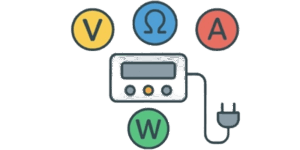
| U, V | R, Ω | I, A | P, W |
|---|---|---|---|
| 12 | 6 | 2 | 24 |
Electricity can look complicated at first, but the basic relationships behind it are simple once the pieces are named clearly. Voltage, current, resistance, and power are the four values that show up again and again in electrical work. An Ohm’s Law calculator brings those values together in one place and makes them easier to understand, compare, and use.



📊 This kind of calculator is useful because it does more than show numbers. It helps connect the dots. A user can change one value, watch the others update, and immediately see how the circuit behaves. That makes it a strong tool for learning, troubleshooting, planning, and quick reference. Whether the task is a homework problem, a small electronics project, or a basic check on a device, the calculator gives a fast way to work with the core electrical values without getting lost in manual calculations.
The goal of this guide is simple: show how to use the calculator, explain what each value means in plain language, and give practical reference information that helps the tool make more sense. No heavy theory. No unnecessary jargon. Just the essentials in a format that is easy to use.
Table of Contents
What this calculator does
The calculator is built around the four most important electrical values in basic circuit work: voltage, resistance, current, and power. These values are linked, which means changing one of them affects the others. The calculator uses that relationship so the user can enter known values and get the missing ones automatically.
👉 This is especially useful when solving simple circuit questions. Instead of doing every step by hand, the calculator shows the result immediately. It also includes graphs, so the relationship between values is easier to see visually. That makes it more than a number box. It becomes a learning aid and a reference tool at the same time.
The interface is designed to be direct. Each quantity has its own input, unit selector, and slider. That makes it easy to work in volts, ohms, amps, millivolts, kiloohms, milliamps, or other common units without leaving the page. The result table shows the current values clearly, and the graphs update to match.
How to use it
- Using the calculator is straightforward. Start by entering or adjusting the values you already know. The last two values changed by the user are treated as the fixed values, and the calculator uses those to work out the other two. That means the user does not need to solve the circuit manually every time.
- For example, if voltage and resistance are known, the calculator can find current and power. If current and resistance are known, it can find voltage and power. If voltage and current are known, it can find resistance and power. The same idea works for the other combinations too.
- The unit selectors are there for convenience. If a value is easier to think about in millivolts or kiloohms, the calculator can display it that way. The actual calculation still uses the base value internally, so the result stays consistent. This is helpful when moving between small and large numbers.
- The sliders give a quick visual way to change values. That is useful when exploring how the graph changes or when testing a range of inputs. The number field gives a precise way to enter an exact value. Using both together keeps the interface flexible.
- The screenshot button is there for saving a result view. That can be useful for notes, reports, classroom work, or sharing a setup with someone else.
What the four main quantities mean
Voltage
Voltage is the electrical pressure that pushes charge through a circuit. It is often described as the force behind the flow of electricity. Higher voltage means a stronger push, although the exact result also depends on resistance.
In practical terms, voltage is what powers the circuit. Batteries, adapters, and power supplies all provide voltage. Without voltage, current does not flow.
Resistance
Resistance is the opposition to current flow. It tells how hard it is for electricity to move through a material or circuit path. A higher resistance makes current smaller for the same voltage. A lower resistance allows more current to flow.
Resistance is one of the easiest values to picture. A thin wire, a long path, or a poorly conducting material usually has more resistance than a short, thick, or highly conductive one.
Current
Current is the flow of electric charge. It shows how much electricity is moving through the circuit at a given moment. In simple terms, current is the amount of flow, not the push.
Current is important because it helps determine how a device behaves and how much load a circuit carries. Too little current and a device may not work. Too much current and parts may overheat or fail.
Power
Power shows how much electrical energy is being used or delivered over time. It is the working result of voltage and current together. In everyday electrical work, power often helps describe how strong or demanding a load is.
Power is useful when choosing parts, checking adapters, or estimating how much energy a device consumes. It is one of the most practical values in real-world circuit work.
Why these values belong together
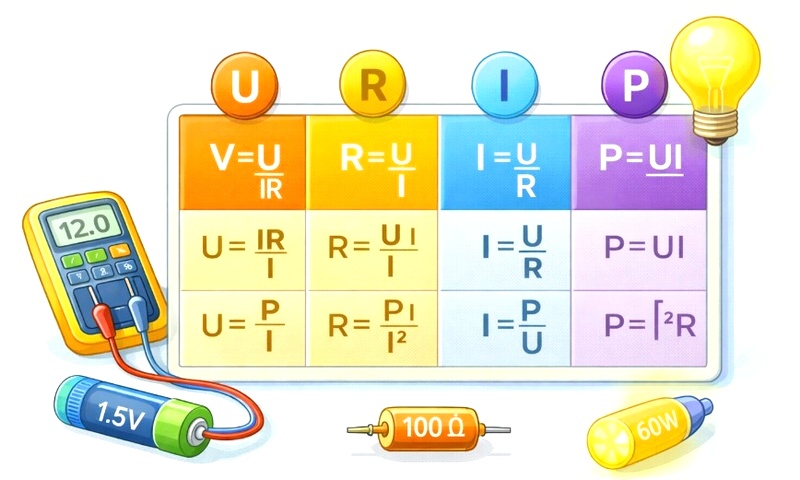
These four quantities are linked by a few simple relationships. That is the whole reason the calculator can work so well. Once two values are known, the others can usually be found from them. This makes the tool useful both as a calculator and as a learning aid.
👉 When the values are shown together, the circuit becomes easier to understand. A user can see that higher voltage can drive more current, that higher resistance reduces current, and that power depends on both voltage and current. This is the kind of pattern that often becomes much clearer when numbers update live on the screen.
That is also why the table and graph views matter. A formula can be correct, but a visual display helps the pattern stick. For many users, seeing the line on the graph is easier than reading the equation alone.
Core formulas at a glance
| Formula | What It Means | When It Helps |
|---|---|---|
| U = I × R | Voltage equals current times resistance. | Used when current and resistance are known. |
| I = U / R | Current equals voltage divided by resistance. | Used when voltage and resistance are known. |
| R = U / I | Resistance equals voltage divided by current. | Used when voltage and current are known. |
| P = U × I | Power equals voltage times current. | Used for power calculation in most basic cases. |
| P = I² × R | Power can also be found from current and resistance. | Useful when current and resistance are known. |
| P = U² / R | Power can also be found from voltage and resistance. | Useful when voltage and resistance are known. |
These formulas are the backbone of the calculator. The user does not need to memorize all of them at once, but they are worth understanding because they explain why the results change when one value changes.
How the table helps
The results table shows the current values of voltage, resistance, current, and power in one view. That makes it easy to compare them without flipping between separate fields. The table also updates units automatically, so the displayed values stay readable and matched to the selected unit.

A good habit is to use the table as the main reference point while working. The calculator may be doing the math behind the scenes, but the table is where the user sees the outcome. It is the cleanest way to check whether the numbers make sense.
| Symbol | Common Unit | Smaller Unit Example | Larger Unit Example |
|---|---|---|---|
| U | V | mV | kV |
| R | Ω | mΩ | kΩ, MΩ |
| I | A | mA | kA |
| P | W | mW | kW |
These unit options are important because not every problem uses the same scale. Small electronics may be easier to think about in milliamps and ohms, while larger loads may make more sense in volts and watts. The unit selectors make it easier to stay in a comfortable range.
How to read the graphs
The calculator includes two graphs: one for current as voltage changes at fixed resistance, and one for power as current changes at fixed resistance. These graphs are not there just to look nice. They help show the shape of the relationship.
The current-versus-voltage graph usually rises in a straight line when resistance stays constant. That means more voltage gives more current in a predictable way. The power-versus-current graph rises faster because power grows with the square of current when resistance is fixed. That is why power can climb quickly even when current changes only a little.
For users who learn better with visuals, these graphs can make the formulas easier to remember. A straight line means one kind of relationship. A curved line means another. Seeing both side by side helps connect the math to the behavior of the circuit.
When to use this calculator
This tool is useful in a lot of everyday situations. It works well for school assignments, electronics practice, quick checks on devices, and basic planning for projects. It can also help when comparing parts or trying to understand why a simple circuit is not behaving as expected.
Here are some common uses:
- Checking whether a resistor and voltage source will produce the expected current.
- Estimating how much power a load will consume.
- Comparing low-voltage and higher-voltage versions of the same setup.
- Learning how current changes when resistance goes up or down.
- Getting a quick answer without doing manual math.
The tool is also useful because it makes basic circuit values feel less abstract. Instead of only seeing formulas, the user sees the effect of changing one number on the others. That makes the concepts easier to remember.
Practical reading guide
If the calculator is being used for the first time, the easiest way to think about it is this: voltage is the push, resistance is the opposition, current is the flow, and power is the work being done. That four-part picture covers most of what beginners need to know.
Another helpful way to think about it is through cause and effect. More voltage usually means more current if resistance does not change. More resistance usually means less current if voltage stays the same. More current often means more power when the other values stay connected in the usual way. This is the logic behind the calculator’s live updates.
Users do not need to know advanced electrical theory to benefit from this. The calculator is aimed at direct practical use. It gives the most important information in a form that can be read quickly and applied immediately.
Sample combinations
The following examples show how the values relate to each other in simple cases.
| Voltage, V | Resistance, Ω | Current, A | Power, W |
|---|---|---|---|
| 1 | 1 | 1 | 1 |
| 2 | 1 | 2 | 4 |
| 3 | 1 | 3 | 9 |
| 4 | 1 | 4 | 16 |
| 5 | 1 | 5 | 25 |
| 5 | 5 | 1 | 5 |
| 10 | 5 | 2 | 20 |
| 15 | 5 | 3 | 45 |
| 20 | 5 | 4 | 80 |
| 25 | 5 | 5 | 125 |
| 6 | 3 | 2 | 12 |
| 9 | 3 | 3 | 27 |
| 12 | 3 | 4 | 48 |
| 15 | 3 | 5 | 75 |
| 18 | 3 | 6 | 108 |
| 8 | 4 | 2 | 16 |
| 12 | 4 | 3 | 36 |
| 16 | 4 | 4 | 64 |
| 20 | 4 | 5 | 100 |
| 24 | 4 | 6 | 144 |
| 10 | 2 | 5 | 50 |
| 12 | 2 | 6 | 72 |
| 14 | 2 | 7 | 98 |
| 16 | 2 | 8 | 128 |
| 18 | 2 | 9 | 162 |
| 20 | 10 | 2 | 40 |
| 30 | 10 | 3 | 90 |
| 40 | 10 | 4 | 160 |
| 50 | 10 | 5 | 250 |
| 60 | 10 | 6 | 360 |
| 12 | 6 | 2 | 24 |
| 18 | 6 | 3 | 54 |
| 24 | 6 | 4 | 96 |
| 30 | 6 | 5 | 150 |
| 36 | 6 | 6 | 216 |
| 9 | 9 | 1 | 9 |
| 18 | 9 | 2 | 36 |
| 27 | 9 | 3 | 81 |
| 36 | 9 | 4 | 144 |
| 45 | 9 | 5 | 225 |
| 7 | 7 | 1 | 7 |
| 14 | 7 | 2 | 28 |
| 21 | 7 | 3 | 63 |
| 28 | 7 | 4 | 112 |
| 35 | 7 | 5 | 175 |
| 50 | 25 | 2 | 100 |
| 75 | 25 | 3 | 225 |
| 100 | 25 | 4 | 400 |
| 125 | 25 | 5 | 625 |
| 150 | 25 | 6 | 900 |
These examples are not meant to cover every possible case. They are just reference points that make the relationships easier to see.
Common mistakes to avoid
One common mistake is mixing up resistance and power. They are not the same thing. Resistance slows current down, while power describes energy use or delivery. Another common mistake is forgetting to pay attention to units. A number can look right but still be wrong if it is interpreted in the wrong unit scale.
It is also easy to confuse voltage with current. Voltage is not the amount of electricity flowing. It is the push that helps drive the flow. Current is the actual flow. The calculator helps keep those ideas separate by showing each value in its own field.
Finally, it is worth remembering that the calculator is designed for basic Ohm’s law use. It is a practical tool for standard relationships in simple circuits. It is not trying to replace every possible electrical analysis method. For everyday use, though, it is usually exactly what is needed.
Why this tool is useful for learning
Many people can copy a formula and still not understand how to use it. The calculator solves that problem by turning the formula into something interactive. The user changes a value and sees the effect immediately. That is a powerful way to learn because it builds intuition, not just memory.
For students, this can make assignments easier. For teachers, it can make explanations faster. For hobbyists, it can help with planning and troubleshooting. For anyone working with circuits, it saves time and reduces confusion.
The best part is that the interface does not demand a long learning curve. The table, inputs, and graphs are all simple enough to use quickly. That keeps the focus on understanding the circuit rather than fighting the tool.
Quick reference summary
| Quantity | What It Represents | Main Question It Answers |
|---|---|---|
| Voltage | Electrical push | How strongly is charge being driven? |
| Resistance | Opposition to flow | How hard is it for current to pass? |
| Current | Flow of charge | How much electricity is moving? |
| Power | Energy use or delivery | How much work is being done? |
Final notes
The Ohm’s Law calculator is a practical tool for anyone who needs fast answers about voltage, resistance, current, and power. It helps with basic circuit understanding, simple project planning, and quick reference work. The combination of inputs, unit selectors, live updating, tables, and graphs makes the relationship between the main electrical values easier to understand.
At its core, the calculator does one valuable thing: it turns electrical relationships into something visible and easy to use. That makes it a strong choice for users who want clear results without digging through manual calculations. For everyday electrical work, that kind of simplicity is often the most useful feature of all.
Literature
- Horowitz, P., & Hill, W. The Art of Electronics.
- Nilsson, J. W., & Riedel, S. A. Electric Circuits.
- Alexander, C. K., & Sadiku, M. N. O. Fundamentals of Electric Circuits.
- Floyd, T. L. Principles of Electric Circuits.
- Hayt, W. H., Kemmerly, J. E., & Durbin, S. M. Engineering Circuit Analysis.
- Platt, C. Make: Electronics.
- Boylestad, R. L. Introductory Circuit Analysis.
- Moore, D. F. Fundamentals of Electrical Engineering.

David Parry — Senior Engineering Analyst
Specializing in electronics and physics-based simulations with 20+ years of engineering experience. David ensures the mathematical and physical accuracy of the tools at ProCalcLab.