This compact interactive tool converts vehicle speeds and distances into a simple one dimensional motion model and returns a clear estimate of whether an overtaking maneuver will finish safely in the available space. The interface is aimed at drivers, instructors and vehicle engineers who need a quick, practical check without deep simulation setup.
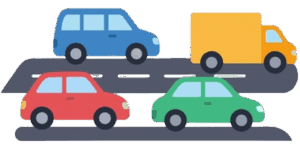


Table of Contents
What the overtaking simulator computes
- Time required to complete an overtake when our vehicle is faster, or time until another vehicle completes an overtake when they are faster.
- Animated preview showing the other vehicle approach, vertical motion across the lane and smooth scaling to convey relative distance.
- Total distance traveled by each vehicle during the maneuver and a compact result table for saving or reporting.
- Optional background engine sound to emphasize motion and a snapshot option to export the current view as an image.
Input fields for the overtake tool
| Field | Meaning |
|---|---|
| Our speed | Current speed of your vehicle, displayed in the selected unit system |
| Other speed | Speed of the target vehicle, faster values mean the other vehicle will overtake |
| Initial gap | Distance between your front and the other vehicle rear, positive when the other vehicle is ahead |
| Our acceleration | Average longitudinal acceleration during the maneuver, positive values indicate acceleration |
| Other acceleration | Acceleration of the other vehicle, set to zero if unknown |
| Vehicle lengths | Physical lengths of both vehicles, used to compute the required clear distance for a full pass |
| Clearance | Extra safety margin after the pass ends, typical values are one to three units in the chosen distance measure |
| Unit selector | Switch between metric and imperial units, input values and output labels update instantly |
Outputs visible on the overtake calculator
- Maneuver time in seconds, the moment when the pass is considered complete
- Distance per vehicle showing the path traveled by your vehicle and the other vehicle during the maneuver
- Initial relative speed represented as vrel, calculated as the absolute difference between speeds in meters per second
- Animation with the other vehicle moving across a vertical lane indicator, scaled to reflect approach and receding distance
- Live indicators that show elapsed maneuver time and current traveled distance

The engine applies basic linear kinematics with constant acceleration and evaluates a scalar gap requirement. Path equation, s equals v times t plus half a times t squared. Relative motion equation, half a sub rel times t squared plus v sub rel times t equals D need. The required distance D need includes vehicle lengths and the chosen clearance. The solver selects the positive real root of the resulting quadratic equation. If no positive root exists or if both relative speed and relative acceleration are zero the maneuver is declared impossible for the provided inputs.
Practical examples
Example A, our vehicle performs the overtake
- Our speed equals 120 km/h, other speed equals 75 km/h, initial gap equals 24 m, other vehicle length equals 5.2 m, clearance equals 3.0 m, accelerations set to zero
- Relative speed equals 12.50 m per second, D need equals 32.2 m, estimated time equals 2.58 seconds
Example B, other vehicle overtakes us
- Our speed equals 65 km/h, other speed equals 95 km/h, initial gap equals 12 m, our vehicle length equals 4.2 m, clearance equals 2.5 m, accelerations set to zero
- Relative speed equals 8.33 m per second, D need equals 18.7 m, estimated time equals 2.24 seconds
Key limitations and interpretation guidance
- Model ignores lateral motion and steering radius, therefore it cannot predict space needed for lane changes
- Model does not include oncoming traffic, surface grip, slope or wind influences, therefore add conservative safety margins for real world use
- Human factors such as driver reaction time and brake response are not simulated, so treat outputs as orientation numbers rather than absolute guarantees
Fast checklist for a safer overtaking decision
- Confirm clear line of sight to the required direction and assess oncoming gap visually
- Verify that the selected clearance is large enough to allow a safe return into the lane
- Prefer a small speed advantage of at least 10 units in the chosen speed measure to reduce maneuver time
- If the overtake calculator reports impossible try increasing clearance or change speed with caution
Reference table for quick planning
| Parameter | Suggested range | Notes |
|---|---|---|
| Minimum straight segment | 180 to 320 m | Depends on speed and visibility |
| Typical overtake time | 3 to 10 s | Values depend on relative speed and clearance |
| Required approach distance to oncoming | 350 to 700 m | Allow extra margin when visibility is reduced |
| Usual speed of overtaken vehicle | 55 to 95 km/h | Common on rural roads |
| Recommended speed advantage | +10 to +25 km/h | Enough to complete the pass comfortably |
FAQ for the simulator
Can the tool factor in oncoming traffic
Not in the basic version. Accounting for multiple opposing vehicles requires a multi agent simulation that models their positions and speeds independently.
Why is turn and steering radius not modelled
The tool uses one dimensional motion to keep computation lightweight. Full lane change dynamics need lateral vehicle dynamics models which are outside the scope of this utility.
How reliable are the results
Results are approximate, intended for rapid assessment and training. Always combine numerical output with direct visual checks and comply with local traffic laws before attempting any maneuver.
🚗 This tool is an educational aid only and does not replace training or professional judgment. Use the outputs as a practical indicator, apply conservative margins in uncertain conditions and never rely on a single numeric result when safety is at stake.
Further reading
- Fundamentals of Vehicle Dynamics by Thomas D. Gillespie, clear introduction to longitudinal behavior and basic dynamics
- Vehicle Dynamics and Control by Rajesh Rajamani, advanced methods for modelling and control of vehicle motion
- Traffic Flow Fundamentals by Adolf D. May, practical coverage of flow, headway and gap estimation
- Traffic Safety by Leonard Evans, evidence based discussion of risk factors and countermeasures

David Parry — Senior Engineering Analyst
Specializing in electronics and physics-based simulations with 20+ years of engineering experience. David ensures the mathematical and physical accuracy of the tools at ProCalcLab.