| Density, ρ | Specific Volume, ν |
|---|---|
| 56.24 lb/ft³ | 0.017781 ft³/lb |
Oils and varnishes may look simple on the surface, but their density can tell a lot about how they behave, how they flow, how they fill a container, and how they compare with one another. A thick oil does not always weigh the same as another thick oil. A varnish that seems similar in the can may still show a different density, a different feel during pouring, and a different result in storage or transport.



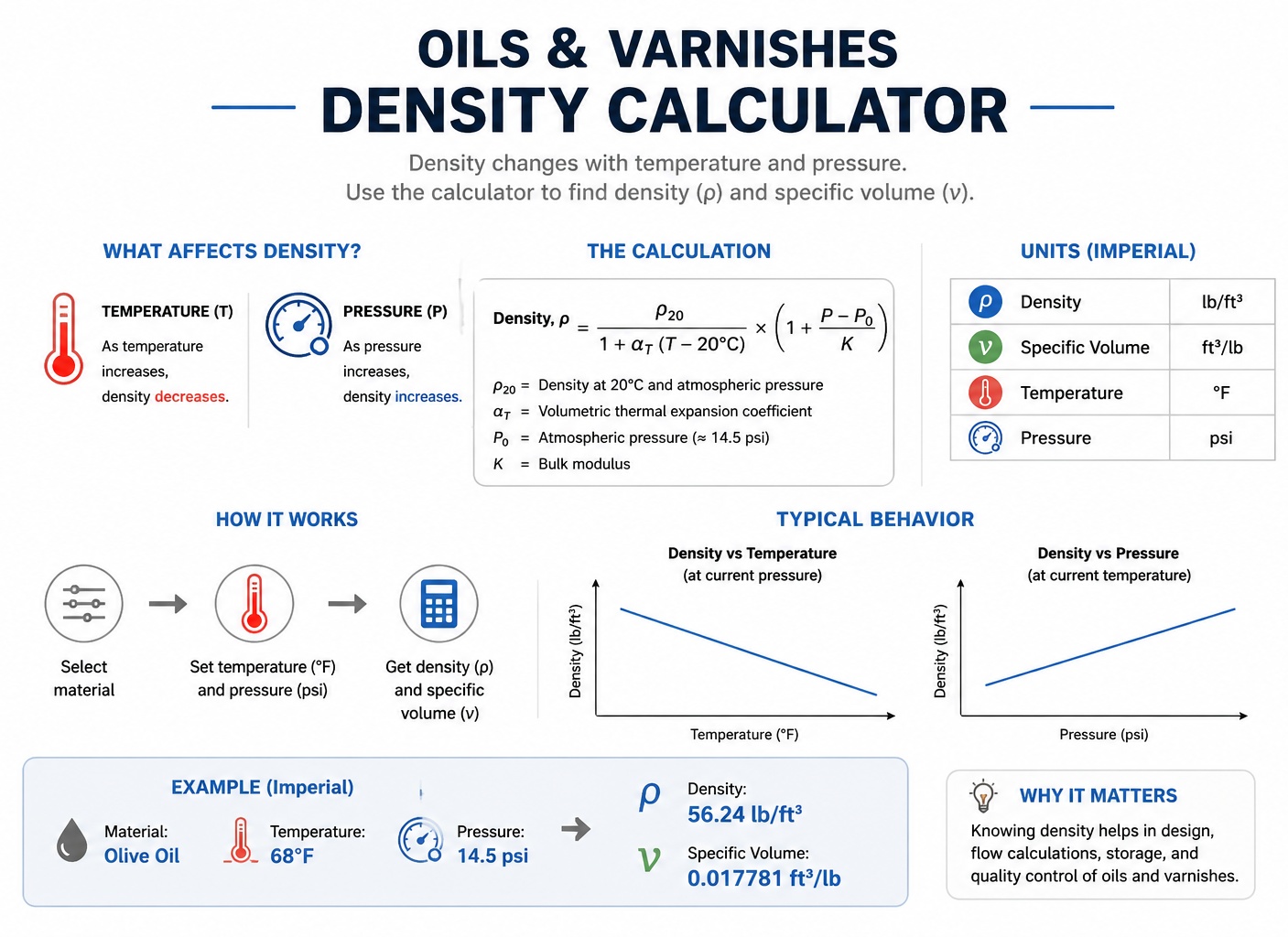
📊 This calculator is built for fast reference. It is not meant to feel heavy or complicated. The goal is simple: choose a material, set temperature, set pressure, and get a density reading right away. The top table gives the main numbers, while the graphs show how the reading changes when the conditions change. The unit switch keeps everything clean by changing the full interface at once.
The default mode is imperial. That means the calculator opens in °F and psi, which is useful for users who work in American units every day. Density appears in lb/ft³ and specific volume appears in ft³/lb. Metric mode is still available, but the default is set for quick imperial use.
Table of Contents
What this calculator is for
This tool helps with everyday reference work for oils, varnishes, paints, primers, and related liquid coatings. It can be useful in a shop, in a warehouse, during product comparison, or while checking a material list. The main job of the calculator is to show how dense the selected material is under the current conditions.
📝 That matters because density affects a lot of practical tasks. It helps estimate shipping weight. It helps compare one product with another. It helps with tank fill checks. It helps with batch planning. It also helps when reading a data sheet and trying to understand what a number really means in a real setting.
The calculator also shows specific volume. That is the amount of space taken by 1 unit of mass. Some users prefer density, some prefer specific volume, and some need both. Having both on the screen at the same time makes comparison faster.
How to use the calculator
The workflow is easy.
- Select the material from the list.
- Keep imperial mode on, or switch to metric if needed.
- Set the temperature.
- Set the pressure.
- Read the density and specific volume in the top table.
- Check the graphs if a visual trend is useful.
That is all most users need. No extra steps. No long setup. No hidden controls.
Why density matters for oils and varnishes
Density gives a simple answer to a practical question: how heavy is this material for its size? That matters with oils and varnishes because many of them look similar while behaving differently. A light oil may pour faster than a heavy one. A dense varnish may sit differently in storage. A primer may behave unlike a finishing coat even when both are liquid at room temperature.
In plain language, higher density means more mass in the same space. Lower density means less mass in the same space. This helps with weight estimates, packaging, labeling, and rough handling decisions.
Specific volume works in the opposite direction. If density goes up, specific volume goes down. If density goes down, specific volume goes up. That is why the calculator shows both values together.
Simple formulas used by the calculator
The formulas below are written in plain text so they stay easy to read.
Density
density = mass / volume
Specific volume
specific volume = 1 / density
Temperature effect: when temperature goes up, density usually goes down a little.
Pressure effect: when pressure goes up, density usually goes up a little.

These changes are often small for oils and varnishes, but they still matter. Warm liquid usually spreads out more. Cool liquid usually becomes slightly more compact. Pressure can compress the material a little, which raises density.
Imperial and metric units
The calculator opens in imperial mode by default. That choice makes the tool easy to use for users who think in Fahrenheit and psi. It also keeps the displayed result in the same system, which reduces confusion.
| System | Temperature | Pressure | Density | Specific Volume |
|---|---|---|---|---|
| Imperial | °F | psi | lb/ft³ | ft³/lb |
| Metric | °C | MPa | kg/m³ | m³/kg |
| Default | °F | psi | lb/ft³ | ft³/lb |
| Best for field use | Imperial | Imperial | Imperial | Imperial |
| Best for reports | Metric | Metric | Metric | Metric |
The unit selector changes everything at once. That keeps the full screen consistent. The temperature input, pressure input, result table, and graph labels all stay in the same unit system.
What kinds of materials are included
The calculator covers many common oils and varnishes, plus related coatings and finishing materials. That makes it useful for more than one type of task. A user can compare cooking-style oils, industrial oils, drying oils, varnishes, paints, primers, and mastic materials without leaving the tool.
| Material | Group | What it is used for | Why density matters |
|---|---|---|---|
| Olive Oil | Natural oil | Food, testing, reference use | Useful as a familiar low-density example |
| Sunflower Oil | Natural oil | Food, blending, comparison | Helps show a common edible oil reading |
| Rapeseed Oil | Vegetable oil | Food and process work | Good for direct comparison with other oils |
| Linseed Oil | Drying oil | Paints, finishes, wood treatment | Useful because it behaves differently from kitchen oils |
| Machine Oil | Industrial lubricant | Equipment, lubrication, service work | Often checked during maintenance and storage |
| Hydraulic Oil | Industrial fluid | Hydraulic systems, machinery | Density supports flow and system checks |
| Gear Oil | Heavy lubricant | Gearboxes and drive systems | Useful for comparing heavy lubricating fluids |
| Motor Oil | Engine lubricant | Vehicle and engine service | Common reference material for many users |
| Transformer Oil | Electrical oil | Cooling and insulation | Used in equipment where stable density matters |
| Drying Oil | Finish-related oil | Coatings and wood work | Good for product comparison in finishing jobs |
| Alkyd Varnish | Varnish | Wood finish, coating, protection | Important for can fill and application estimates |
| Polyurethane Varnish | Varnish | Flooring, wood, protective finish | Often denser and more product-specific |
| Acrylic Lacquer | Lacquer | Finish coats, decorative work | Useful when a lighter coating is needed |
| Nitro Lacquer | Lacquer | Furniture, coating, finishing | Helpful for fast-drying coating comparisons |
| Oil Paint | Paint | Surface coating, art, repair | Common reference for mixed liquid solids |
| Enamel Paint | Paint | Protective and decorative coating | Useful for checking thicker coating products |
| Waterborne Paint | Paint | Wall coating, finishing, cleanup-friendly work | Helpful for lighter coating systems |
| Primer | Base coat | Surface preparation | Good for estimating usage before final paint |
| Epoxy Primer | Special primer | Corrosion resistance, prep work | Useful when a stronger base coat is needed |
| Bituminous Mastic | Protective compound | Sealing, waterproofing, repair | Density helps in bulk handling and fill checks |
How temperature changes the reading
Temperature is one of the most useful controls in the calculator. Even when the change is small, it still helps show how the material behaves in real use.
As temperature rises, oils and varnishes usually get a little less dense. That is because the material expands slightly. A thicker finish may thin out a little when warm. A colder sample may look slightly heavier in the same space.
The change is usually not dramatic, but it is real enough to matter. That is why the temperature graph is useful. It shows the trend instead of forcing the user to guess.
How pressure changes the reading
Pressure has a smaller effect than temperature in most oil and varnish work, but it still belongs in the calculator. A higher pressure can make the material compress slightly, which raises density a little.
That matters when checking conditions in a system, comparing readings from different storage setups, or looking at a material under more than one load condition.
The pressure graph gives a quick visual sense of how much the density changes as pressure rises. For many products, the line stays fairly smooth and predictable.
Imperial example with real numbers
Here is a simple example using imperial units, since that is the default mode.
Example setup
- Material: Olive Oil
- Temperature: 68 °F
- Pressure: 14.5 psi
At these settings, the calculator shows a density close to 56.24 lb/ft³ and a specific volume close to 0.017781 ft³/lb.
What does that mean in plain language?
1 ft³ of olive oil weighs about 56.24 lb.
1 lb of olive oil takes up about 0.017781 ft³.
That is a fast way to understand the material without doing manual conversion work. It is especially useful for shipping estimates, container planning, and product comparison.
More imperial examples to try
These example points help users see how different materials compare at the same settings.
| Material | Suggested Test Point | What usually stands out | Why it helps |
|---|---|---|---|
| Olive Oil | 68 °F, 14.5 psi | Light, smooth reading | Good everyday reference point |
| Sunflower Oil | 68 °F, 14.5 psi | Very close to olive oil | Useful for food and general oil comparison |
| Rapeseed Oil | 68 °F, 14.5 psi | Similar to other vegetable oils | Easy to compare with kitchen and process oils |
| Linseed Oil | 68 °F, 14.5 psi | Often a bit denser | Important for finishing work |
| Machine Oil | 68 °F, 14.5 psi | Lower or mid-range density | Useful in service and maintenance checks |
| Hydraulic Oil | 68 °F, 14.5 psi | Stable fluid behavior | Good for equipment planning |
| Alkyd Varnish | 68 °F, 14.5 psi | Denser than plain oils | Helpful in coating and application work |
| Polyurethane Varnish | 68 °F, 14.5 psi | Often more concentrated | Useful for finish material comparison |
| Enamel Paint | 68 °F, 14.5 psi | Heavier coating behavior | Useful for coverage and can size planning |
| Primer | 68 °F, 14.5 psi | Base-coat density | Helpful before final topcoat work |
What the graphs are good for
The calculator includes 2 graphs.
- The first graph shows density versus temperature at the current pressure.
- The second graph shows density versus pressure at the current temperature.
The graphs are useful when a single number is not enough. A user may want to know whether the material changes slowly or quickly as conditions move. The line shape gives that answer right away.
✍ A gentle curve means the material is fairly steady. A steeper curve means the material reacts more strongly. That can matter when storing products, shipping them in different climates, or preparing them for use on site.
Common mistakes to avoid
There are a few simple things that can lead to confusion.
- Using the wrong unit system.
- Comparing different materials at different temperatures.
- Forgetting that density and specific volume are opposites.
- Treating one reading as a full spec sheet.
- Reading the graph without checking the unit labels.
These mistakes are easy to avoid once the user gets used to the layout. The unit selector helps a lot because it keeps everything in one system from top to bottom.
When this calculator is most useful
This tool is useful anytime a fast, practical density reference is needed for oils, varnishes, paints, and related coating products. It is a good fit for product comparison, packaging checks, storage planning, and simple educational use.
It is also helpful when someone needs a quick answer in imperial units and does not want to stop and convert values by hand. Since imperial is the default, the calculator starts in the format many users expect.
That makes it a good everyday reference, not just a specialized tool.
Key takeaways
This calculator is designed to make density checks simple and fast for oils, varnishes, paints, primers, and related materials. It shows the main value, shows the inverse value, and lets the user see how the numbers change with temperature and pressure. The interface stays easy to follow because one unit selector controls the whole display. Imperial mode is the default. That means users can start right away with °F and psi and get results in lb/ft³ and ft³/lb. For many users, that is the most practical way to work.
References
- CRC Handbook of Chemistry and Physics
- Perry’s Chemical Engineers’ Handbook
- U.S. National Institute of Standards and Technology data resources
- Engineering ToolBox density tables
- Standard technical data sheets for oils, varnishes, paints, and primers
- Industrial coatings and lubricant reference manuals

David Parry — Senior Engineering Analyst
Specializing in electronics and physics-based simulations with 20+ years of engineering experience. David ensures the mathematical and physical accuracy of the tools at ProCalcLab.