Body length excludes the valve, protective collar and external base. The calculation assumes a uniform wall thickness and two hemispherical ends.



Gas storage under pressure is an essential part of modern craftsmanship, manufacturing, and healthcare. Knowing how much gas remains inside a heavy steel or aluminum cylinder is not always straightforward. Unlike a transparent water container where the liquid level is obvious, a gas tank hides its contents behind thick metal walls. Running out of gas mid-job is frustrating and expensive, whether the work involves a home welding workshop, a medical facility, a beverage carbonation setup, or a commercial kitchen. A reliable Gas Cylinder Contents and Volume Calculator solves this puzzle.
Table of Contents
The Critical Difference Between Gas Types
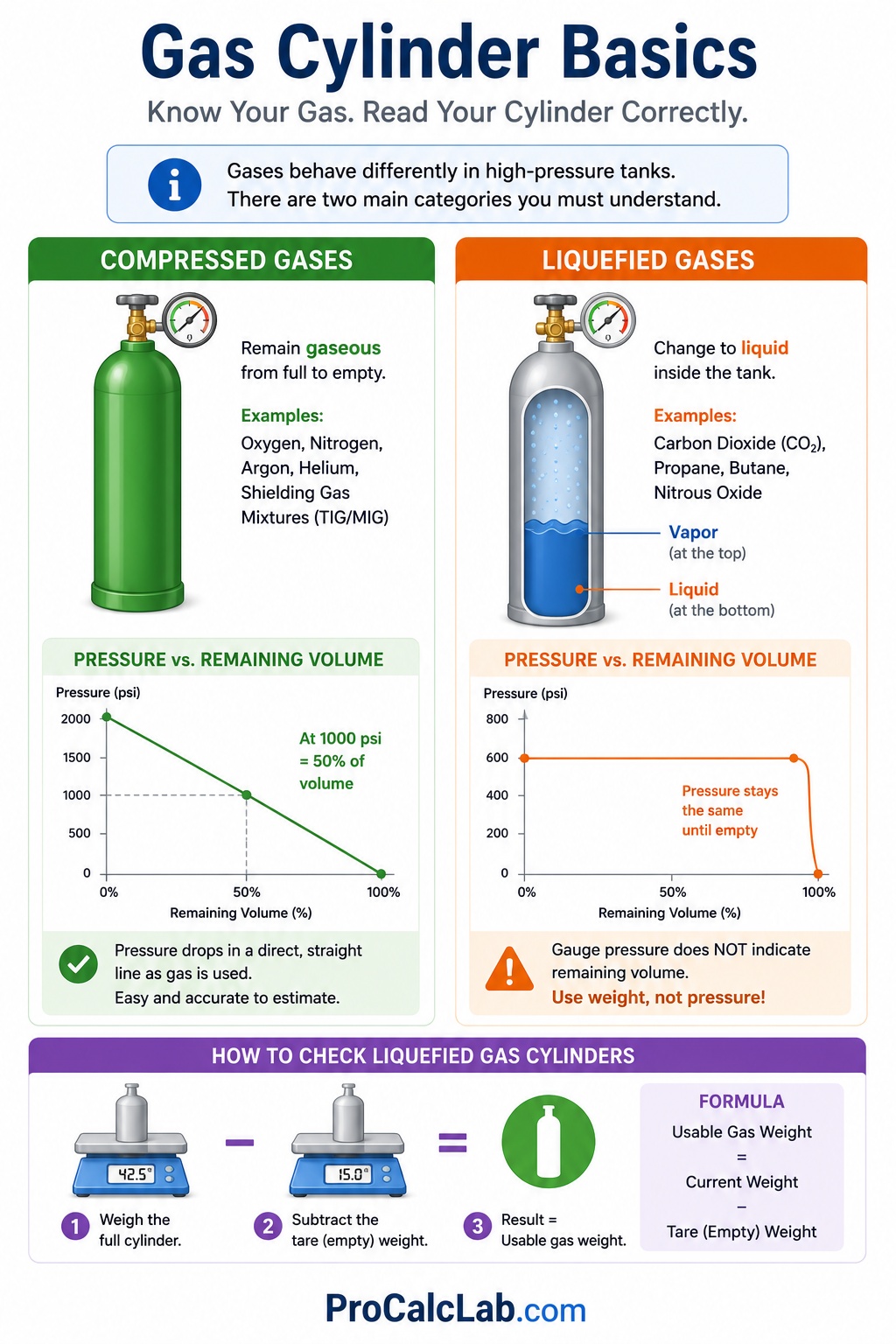
Before entering numbers into any calculator, it is vital to know that gases fall into two main categories based on how they behave inside a high-pressure tank. This distinction completely changes how remaining volumes are measured.
Compressed Gases
Compressed gases remain entirely gaseous from the moment the tank is filled until it is completely drained. Common examples include oxygen, nitrogen, argon, helium, and various shielding gas mixtures used in TIG and MIG welding. For these specific gases, the internal pressure drops in a direct, straight line as the gas leaves the tank. If a cylinder starts at full capacity with a pressure of 2000 pounds per square inch and drops down to 1000 pounds per square inch, it contains exactly half of its original gas volume, provided the temperature has not changed. This linear relationship makes estimation simple and highly predictable.
Liquefied Gases
Liquefied gases change phase when forced into a cylinder under high pressure. Carbon dioxide, propane, butane, and nitrous oxide turn into liquids inside the tank at normal room temperatures. The space inside these cylinders contains a pool of liquid at the bottom and a pocket of vapor at the very top. The gauge pressure on a liquefied gas tank only measures the vapor pressure of that liquid. This pressure stays identical whether the tank is completely full or down to its last cup of liquid. The gauge pressure will only begin to drop when the very last drop of liquid evaporates inside the cylinder. Because of this physical property, gauge pressure cannot be used to calculate remaining volume for liquefied gases. Instead, these tanks must be weighed on a scale. Users must subtract the empty weight of the cylinder, known as the tare weight, from the current total weight to determine how much usable gas remains.
Step-by-Step Instructions for Using the Calculator
To get an accurate reading from a cylinder calculator, specific data points must be gathered and entered correctly. The system relies on real physical parameters to generate dependable results.
Step 1: Select the Specific Gas Type
Different gases have distinct molecular weights and compress uniquely under high pressures. Selecting the exact gas ensures that the underlying calculation factors in the specific physical traits of that substance.
Step 2: Input the Cylinder Internal Water Capacity
This value represents the physical volume inside the empty metal shell. It is frequently stamped directly into the metal on the shoulder or neck of the cylinder. It may be listed in liters, water weight in pounds, or cubic inches depending on the region of manufacture.
Step 3: Enter the Current Gauge Pressure
Read the high-pressure regulator gauge attached to the cylinder valve. Make sure to read the dial that shows the total internal pressure of the tank, which is usually calibrated up to 3000 or 4000 pounds per square inch, rather than the low-pressure delivery gauge that shows the gas flow rate going to your equipment.
Step 4: Input the Ambient Temperature
Temperature alters the behavior of gas molecules significantly. A tank stored in a freezing backyard will show a lower pressure reading than the same tank sitting in a heated workshop, even though the actual amount of gas inside remains identical. Inputting the current temperature allows the calculator to normalize the data and provide an accurate volume output.
The Simple Science of Gas Volume Tracking
The math used by the calculator relies on the fundamental relationship between pressure, volume, and temperature. In an ideal world, doubling the pressure of a gas splits its physical space exactly in half. This behavior is expressed through standard gas laws that connect these variables together. The basic formula used to balance these changes looks like this:
P1 × V1 / T1 = P2 × V2 / T2
In this expression, P represents the absolute pressure, V represents the gas volume, and T represents the absolute temperature. While this works perfectly for a theoretical ideal gas, real-world gases deviate slightly when squeezed into heavy industrial tanks at thousands of pounds per square inch. The gas molecules get crowded so closely together that they begin to exert tiny physical forces on each other. To correct this minor deviation, professional calculators integrate a correction variable known as the compressibility factor, represented by the letter Z. The calculator handles these complex density curves behind the scenes, ensuring the final volume output matches real physics instead of rough textbook approximations.
Practical Example
To see how this works in a practical workshop environment, let us look at a real-world scenario using standard American measurements. Suppose a mobile welder uses a standard Size 125 Argon cylinder for field work. The manufacturer states that this cylinder holds exactly 125 cubic feet of gas when filled to its maximum rated working pressure of 2265 pounds per square inch at a standard baseline temperature of 70 degrees Fahrenheit. The internal water volume of this specific tank model is 0.76 cubic feet.
On a chilly morning in an unheated garage, the thermometer reads 40 degrees Fahrenheit. The welder attaches the regulator, opens the cylinder valve, and notes that the high-pressure gauge reads 1100 pounds per square inch. To find out how much gas is left without running to a computer, the calculator performs the following steps internally.
First, all temperatures are converted to an absolute scale by adding 460 to the Fahrenheit values. The standard baseline temperature becomes 530 Rankine, and the current garage temperature becomes 500 Rankine. Next, absolute pressures are calculated by adding the atmospheric pressure of 14.7 pounds per square inch to the gauge readings.
The calculator takes the internal water volume of 0.76 cubic feet and multiplies it by the current absolute pressure of 1114.7 pounds per square inch. This value is then divided by the standard atmospheric pressure of 14.7 pounds per square inch. To adjust for the cold temperature, the result is multiplied by the temperature ratio of 530 Rankine divided by 500 Rankine. Finally, the specific compressibility factor for Argon gas at 1100 pounds per square inch is applied to correct for real gas behavior.
✍ The calculation reveals that approximately 61 cubic feet of usable Argon gas remain inside the cylinder. This means the tank is sitting at roughly 49 % capacity. The welder knows there is enough gas left for several hours of continuous clean welding before needing a trip to the gas supplier.
North American High-Pressure Cylinder Profiles
Industrial gas cylinders in the United States and Canada use traditional letter and size designators. The tables below provide standard reference data for common compressed gas tanks including Oxygen, Nitrogen, Argon, and Helium.
Table 1: Imperial High-Pressure Cylinder Specifications
| Cylinder Size Style | Internal Water Volume in Cubic Feet | Nominal Gas Yield in Cubic Feet |
|---|---|---|
| Size T | 1.75 | 300 |
| Size K / Industrial 250 | 1.53 | 244 |
| Size 150 | 0.96 | 150 |
| Size 125 | 0.76 | 125 |
| Size Q / Industrial 80 | 0.53 | 80 |
| Size 40 | 0.27 | 40 |
| Size 20 | 0.14 | 20 |
Table 2: Metric Equivalents for North American Cylinders
| Cylinder Size Style | Water Capacity in Liters | Nominal Gas Yield in Cubic Meters |
|---|---|---|
| Size T | 49.5 | 8.50 |
| Size K / Industrial 250 | 43.3 | 6.91 |
| Size 150 | 27.2 | 4.25 |
| Size 125 | 21.5 | 3.54 |
| Size Q / Industrial 80 | 15.0 | 2.26 |
| Size 40 | 7.6 | 1.13 |
| Size 20 | 4.0 | 0.57 |
International Standard Metric Cylinder Reference
Outside of North America, gas cylinders are categorized directly by their internal water capacity measured in liters and their rated working pressure measured in bar.
Table 3: International Metric Gas Cylinder Capacities
| Water Capacity in Liters | Working Pressure in Bar | Approximate Gas Yield in Cubic Meters |
|---|---|---|
| 50 Liter Tank | 200 | 10 |
| 50 Liter Tank | 300 | 15 |
| 40 Liter Tank | 150 | 6 |
| 20 Liter Tank | 200 | 4 |
| 10 Liter Tank | 200 | 2 |
| 5 Liter Tank | 200 | 1 |
| 2 Liter Tank | 200 | 0.4 |
Carbon Dioxide Weight and Volume Tracking
As noted previously, carbon dioxide is stored as a liquid under its own vapor pressure. The volume of gas available depends strictly on the mass of the liquid inside the tank. The following tables show how much gas is produced when the liquid evaporates completely at standard atmospheric conditions.
Table 4: Carbon Dioxide Capacity by Weight
| Tank Size Name | Liquid CO2 Weight in Pounds | Gas Yield at Room Temperature in Cubic Feet |
|---|---|---|
| 100 lb Cylinder | 100 | 874 |
| 50 lb Cylinder | 50 | 437 |
| 20 lb Cylinder | 20 | 175 |
| 10 lb Cylinder | 10 | 87 |
| 5 lb Cylinder | 5 | 44 |
| 2.5 lb Cylinder | 2.5 | 22 |
| Tank Size Name | Liquid CO2 Mass in Kilograms | Gas Yield at Standard Conditions in Cubic Meters |
|---|---|---|
| 45 kg Cylinder | 45.4 | 24.7 |
| 22 kg Cylinder | 22.7 | 12.4 |
| 9 kg Cylinder | 9.1 | 5.0 |
| 4.5 kg Cylinder | 4.5 | 2.5 |
| 2.3 kg Cylinder | 2.3 | 1.2 |
| 1.1 kg Cylinder | 1.1 | 0.6 |
How Temperature Alters Gauge Readings
🌡 The relationship between temperature and pressure is a frequent source of confusion for gas users. When a compressed gas tank gets hot, the gas molecules speed up and slam into the metal walls with more energy, driving the pressure gauge upward. When the tank cools down, the molecules lose energy, and the pressure drops. This happens without any gas entering or escaping the container.
If an industrial cylinder is filled to a full rating of 2000 pounds per square inch in a warm facility at 70 degrees Fahrenheit, its gauge will show significantly different pressures when exposed to extreme weather conditions. The table below outlines how a standard 2000 PSI tank shifts based solely on ambient temperature changes.
Table 6: Temperature vs. Pressure Variance Chart
| Ambient Temperature (°F) | Expected Gauge Pressure (PSI) |
|---|---|
| 120 | 2215 |
| 100 | 2120 |
| 80 | 2040 |
| 70 | 2000 |
| 50 | 1915 |
| 30 | 1830 |
| 10 | 1745 |
| -10 | 1660 |
This table demonstrates that a drop from 70 degrees down to 10 degrees causes the gauge to lose 255 pounds per square inch. A user might assume that the tank has a slow leak or is missing gas, but the actual mass of the gas inside remains identical. The calculator automatically adjusts for this molecular slowing effect to prevent false low readings.
Practical Tips for Managing Gas Cylinders in the Field
Safe and efficient gas management comes down to a few basic habits that prevent waste and keep operations running smoothly.
Never Empty a Tank Completely to Zero
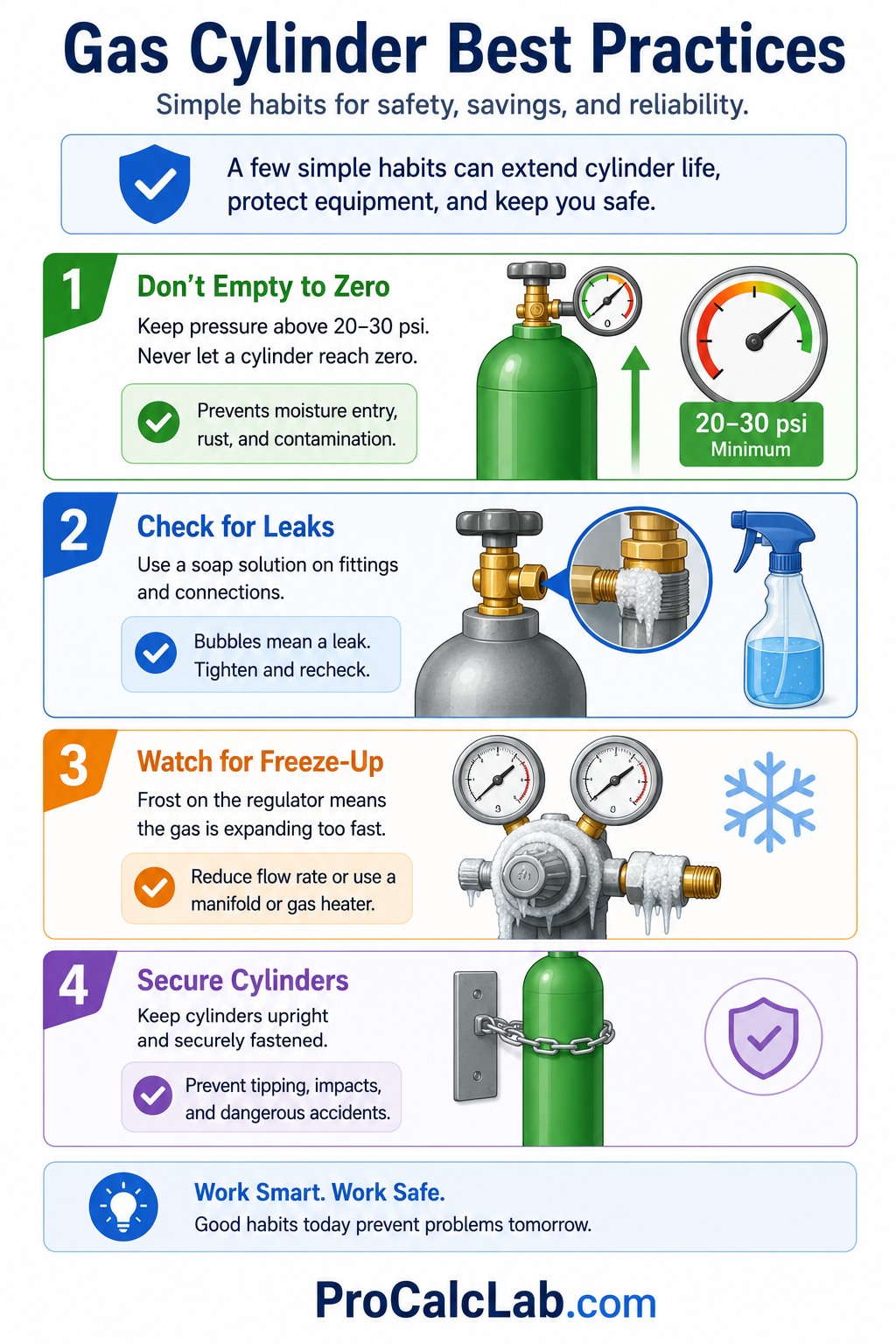
It is best practice to exchange or refill a compressed gas cylinder before its gauge drops below 20 or 30 pounds per square inch. If a cylinder is completely emptied down to zero, atmospheric air and moisture can seep back inside through the open valve. This moisture rusts the interior steel walls and contaminates the next batch of gas filled into the tank. This is critical for specialty gases like Argon or Helium where high purity is required for clean welds.
Check for Leaks with a Simple Soap Solution
Slow leaks around the valve threads or regulator connection can silently drain an expensive cylinder over a weekend. To check for this, mix a few drops of dish soap with water in a spray bottle. Spray the solution over the valve stem, the main outlet threads, and the regulator joints after opening the cylinder. If bubbles begin to form and grow, gas is actively escaping. Shut the valve immediately and tighten the loose connections.
Understand Regulator Freeze-Up
When using carbon dioxide or high flows of other compressed gases, the regulator body can become covered in thick white frost. This happens because gases cool down rapidly when they drop from high tank pressure to low delivery pressure. This freezing action can sometimes lock up the internal components of the regulator, causing the gas flow to fluctuate or cut off entirely. If freeze-up occurs regularly, it means the gas flow rate is too high for a single cylinder setup. The solution is to link multiple cylinders together in a manifold system or install an inline electric gas heater to stabilize the delivery temperature.
Secure Tanks Upright at All Times
High-pressure cylinders contain immense stored energy. If a heavy tank tips over and falls onto a concrete floor, the brass valve can shear off cleanly. The sudden release of high-pressure gas turns the heavy steel cylinder into an uncontrollable unguided rocket that can easily pierce through masonry walls. Always secure cylinders to a solid wall, a heavy workbench, or a dedicated welding cart using steel chains or heavy-duty ratcheting straps.
References
- Compressed Gas Association. Handbook of Compressed Gases. Fifth Edition.
- National Institute of Standards and Technology. Chemistry WebBook for Gas Thermophysical Properties.
- International Organization for Standardization. ISO 10286: Gas Cylinders — Terminology and Definitions.
- American Welding Society. Welding Handbook, Volume 1: Science and Technology.

Markus Fletcher — Structural Design Specialist
Expert in structural integrity, 3D modeling, and applied mathematics. Markus focuses on creating precise tools for construction professionals and DIY engineers.