| # | Name | Intervals |
|---|
A compact, browser-based tool for estimating household energy use and planning device schedules. Add appliances, set their rated power, standby power, quantity and duty cycle or precise schedules, then run the analysis to get hourly and aggregated consumption, peak loads and charts. The calculator is designed for homes, small offices and light industrial setups and works on desktops and mobile devices — no installation required.

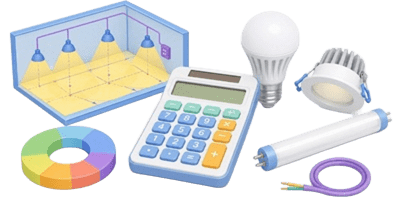

- Add appliances to the list and set: rated power, standby power, quantity, usage factor (duty cycle in %), and optionally a daily schedule.
- Optionally create time-based schedules to switch devices on/off at specific hours.
- Click Calculate — the app computes per-hour power, total energy for chosen periods and draws a load profile graph.
- Inspect peaks and shift or reduce high-demand devices to flatten peaks and save energy.
Table of Contents
What the analyzer computes
- Instantaneous power per device and summed power for each hour.
- Standby (idle) consumption while a device is not fully active.
- Hourly load profile and aggregated energy for day, month and year.
- Identification of peak hours and per-device contribution to peaks.

When you move from one-off estimates to ongoing energy management, the value lies in clean data and sensible comparisons. Ensure that meter readings and device-level measurements share the same time base so you can reliably match spikes to individual appliances. Calibrate estimates against the utility bill at least once a month and treat short-term divergences as a signal to check sensors, wiring or atypical usage rather than as facts to act on immediately. Sampling faster than once per minute rarely changes the big picture for household loads, but it does reveal short inrush currents from motors and compressors that can matter when sizing protective devices or batteries.
Key formulas
Notation:
- Prated — device rated power (W)
- Pstandby — standby power (W)
- N — number of identical devices
- u — duty cycle expressed as fraction (for 50% use u = 0.5)
- Δt — calculation time step in minutes
Active working power of a device group, W:
$$P_{active} = P_{rated} \times N \times u$$
Standby power of a device group, W:
$$P_{standby} = P_{standby} \times N \times (1 – u)$$
Total instantaneous power, W:
$$P_{total} = \sum_{i=1}^{k} \left(P_{active,i} + P_{standby,i}\right)$$
Energy over a period (Wh): with time step Δt, minutes
$$E_{period} = \sum_{t=1}^{T} P_{total}(t) \times \frac{\Delta t}{60}$$
Convert Wh → kWh by dividing by 1000 when presenting results.
Think of the analyzer as a decision support tool rather than an absolute truth engine. Use it to run controlled experiments where you change one variable at a time, for example shifting EV charging by two hours or toggling a programmable thermostat, then compare the resulting profiles. Document each experiment so seasonal effects and weather do not get mixed with the impact of your change. When you see large, consistent shoulders in the daily curve around the same hour every day, that points to scheduled behavior that can be shifted or optimized.
Worked example
Example devices and parameters, single-hour snapshot:
- Electric kettle: 1800 W rated, standby 0 W, duty cycle 4% (u = 0.04), quantity N = 1.
- Laptop: 65 W rated, standby 3 W, duty cycle 50% (u = 0.5), quantity N = 2.
- LED lights: 9 W each, quantity 8, duty cycle 60% (u = 0.6).
Compute active and standby contributions (W):
- Kettle active: 1800 × 1 × 0.04 = 72 W
- Laptops active: 65 × 2 × 0.5 = 65 W; laptops standby: 3 × 2 × 0.5 = 3 W
- Lighting active: 9 × 8 × 0.6 = 43.2 W
Total power = 72 + 65 + 3 + 43.2 = 183.2 W
Hourly energy (kWh) for this hour = 183.2 W × 1 h / 1000 = 0.1832 kWh.
Daily / monthly example table
Below is a sample daily, monthly and yearly estimate using plausible daily run times.
| Device | Rated power | Daily use | Daily energy | Monthly |
|---|---|---|---|---|
| Refrigerator (A+) | 120 W | 24 h | 2.88 kWh | 86.4 kWh |
| Washing machine | 1,500 W | 0.75 h | 1.125 kWh | 33.7 kWh |
| Electric kettle | 1,800 W | 0.15 h | 0.27 kWh | 8.1 kWh |
| Microwave oven | 1,000 W | 0.25 h | 0.25 kWh | 7.5 kWh |
| Laptop ×2 | 65 W | 6 (each) | 0.78 kWh | 23.4 kWh |
| LED lighting (8 × 9W) | 72 W | 5 h | 0.36 kWh | 10.8 kWh |
| Split AC (cooling) | 1,200 W | 3 h | 3.6 kWh | 108 kWh |
Practical notes & tips
- Use real measured values where possible. Nameplate power is often a peak value and actual draw may be lower.
- For cyclic devices (fridge, pumps), choose a duty cycle averaged over 24 hours.
- Include standby consumption. Many devices draw small but continuous power when “off.”
- Use finer time steps (15 minutes or less) for schedules to get accurate peak estimates.
- To reduce peaks, shift heavy loads (washing, EV charging, heating) to off-peak hours.
- If planning backup power or solar + battery, use hourly peak and continuous average when sizing equipment.
Use cases
- Estimate monthly electricity bills and identify high-consumption devices.
- Design schedules to lower peak demand and take advantage of time-of-use tariffs.
- Size batteries and inverters for off-grid or hybrid solar systems.
- Create reports and printable summaries for energy audits or retrofit planning.
The calculator provides engineering-grade approximations for planning and comparison. It does not replace detailed measurements or specialist simulation for complex installations. Factors not modelled exactly here include power factor for large inductive loads, non-linear startup currents, harmonics, network voltage variations and detailed thermodynamic behaviour of HVAC systems.
Suggested quick checks after calculation
- Compare calculated daily kWh with actual meter readings over several days to calibrate duty cycles.
- Identify devices that contribute most to peaks and try simple load shifting experiments.
- When in doubt, increase safety margins for battery or generator sizing by 20–30%.
Automation works best when it is informed by both short term signals and long term trends. Feed the hourly or subhourly outputs into your home controller to implement simple rules such as delay heavy loads when local generation is low or stop noncritical loads when the aggregate exceeds a configurable threshold. Combine consumption data with price signals when time-of-use tariffs apply so the system can choose cheaper windows to run energy intensive tasks. Remember that any automated switching that affects mains powered equipment must respect safety and manufacturer recommendations.
👉 Keep an eye on the edges where simple arithmetic fails. Devices with large startup currents, such as air conditioners and electric motors, distort apparent capacity and require separate treatment when estimating peak demand. Three phase supplies, shared metering and embedded generation complicate the bookkeeping. If your site includes solar, battery storage or a generator, model round trip efficiencies and charging strategy rather than only raw watts in and out.
Finally, make your data portable and auditable. Store raw timestamps alongside computed summaries, export in a standard format such as CSV or JSON, and keep a rolling history long enough to detect seasonal shifts. Automate alerts for sustained deviations from expected baseload and archive experiment logs so improvements are repeatable. With disciplined measurement and staged automation, modest changes to how and when you use appliances will often deliver substantial and persistent reductions in energy cost and peak demand.
Further Reading
- Energy Management Handbook — Wayne C. Turner & Steve Doty.
- ASHRAE Handbook — Fundamentals (American Society of Heating, Refrigerating and Air-Conditioning Engineers).
- Residential Energy: Efficient Home Improvements — John Krigger & Chris Dorsi.
- Smart Grids: Infrastructure, Technology, and Solutions — Stuart Borlase.

Markus Fletcher — Structural Design Specialist
Expert in structural integrity, 3D modeling, and applied mathematics. Markus focuses on creating precise tools for construction professionals and DIY engineers.