| Stage | ΔT / % | Q |
|---|---|---|
| Total | — |
If you need a fast, no-nonsense way to size energy, time, or heater power, this heats_full_calc walkthrough gives clean formulas, US-friendly examples, and real-world tips so your numbers actually match the field.


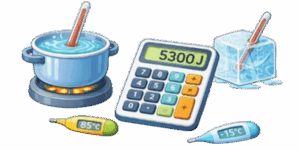
🌡 This calculator handles heating, cooling, melting, solidifying, boiling, and condensing. Enter mass or volume plus density, pick units with buttons, and get a stage-by-stage energy breakdown, a chart, and a dial indicator that updates live on phones and desktops.
Use the heats full calculator to estimate energy needs for lab tests, size heaters for process lines, plan freeze or thaw cycles, or check whether an oven or kettle will reach target temps in a given time. It is a quick sanity check before detailed simulation or buying hardware.
Table of Contents
Essential inputs
The interface accepts calculation mode, amount entry method, material properties, temperatures, transition data, and optional power or time. Choose mass or volume mode. If you give volume and density the tool computes mass automatically and keeps internal work in kilograms and Celsius for accuracy.
- Calculation mode: heat or cool, melt or solidify, vaporize or condense
- Amount: enter mass or volume plus density; mass is in pounds or kilograms and converts internally
- Specific heat capacity c in joules per kilogram per degree
- Start and target temperatures in Fahrenheit, Celsius, or Kelvin
- Transition temperature and latent heat L in joules per kilogram
- Transition fraction for partial phase change
- Optional: input heater power to compute time or input desired time to compute required power

Core formulas used by the heat calculator
All calculations assume mass in kilograms and temperature changes in Celsius for the math. Energy is in joules and the tool reports convenient units like kJ or MJ.
Single-phase heating or cooling
Q = m × c × ΔT
Delta temperature is final minus initial. When you enter degrees Fahrenheit the calculator converts values and scales the delta appropriately.
Latent heat for phase change
Q_latent = m × L × fraction
Crossing a transition temperature
- Heat to transition: Q1 = m × c × (T_trans − T_start)
- Latent part: Q2 = m × L × fraction
- Heat after transition: Q3 = m × c × (T_end − T_trans)
Total energy is the sum Q1 + Q2 + Q3. The calculator splits stages so you can see exactly where energy is spent.
Unit cheats and conversions for US users
Inputs can be in pounds, gallons, cubic feet, Fahrenheit or Kelvin. The tool shows the SI convert behind the scenes and prints results in joules, kilojoules and megajoules. If you prefer, convert final energy to BTU per hour to match heater specs.
| Conversion | Factor or note |
|---|---|
| 1 pound | 0.45359237 kilograms |
| 1 US gallon | 0.00378541 cubic meters |
| °F to °C | (°F − 32) × 5 / 9 |
| Joules to BTU | 1 BTU = 1,055.05585 J |
Practical examples
Example 1 — Heating 5.00 pounds of water from 68 °F to boiling
Inputs. Mass 5.00 lb. Start 68 °F. End 212 °F. Specific heat of water 4,186 J per kilogram per degree. The tool converts mass to 2.268 kilograms and temperatures to 20 °C and 100 °C. Delta is 80 °C.
Calculation. Q = m × c × ΔT = 2.268 × 4,186 × 80 which equals about 759,495 J. That is 759.50 kJ or 0.7595 MJ. In BTU that is roughly 720 BTU.
Example 2 — Thaw and heat 2.205 pounds of ice at 14 °F up to 68 °F
Inputs. Mass 2.205 lb which equals 1.00 kilogram. Start 14 °F which is −10 °C. Melt at 32 °F which is 0 °C. Final temperature 68 °F which is 20 °C. Use c_ice 2,100 J/kgK, fusion heat 334,000 J/kg, c_water 4,186 J/kgK.
Steps. Heat ice to 0 °C uses 21,000 J. Melting uses 334,000 J. Heating water to 20 °C uses 83,720 J. Total is 438,720 J, which is 438.72 kJ or about 416 BTU.
Example 3 — Evaporating half a kilogram of water starting near boiling
Inputs. Mass 1.102 pounds equals 0.50 kilograms. Heat from 194 °F to steam at 248 °F. That maps to heating from 90 °C to 120 °C with a vaporization latent heat of 2,257,000 J/kg and steam specific heat about 2,010 J/kgK.
Result. Combined heating and vaporization totals about 1,169,530 J. That is 1,169.53 kJ or roughly 1,108 BTU.
What the results look like
The calculator presents a stage-by-stage table, a cumulative Q vs temperature graph, and a needle indicator that displays the final number with two decimals. It also shows time at a given power and required power for a target time so you can match heaters and schedules quickly.
✍ Human error beats formula error most of the time. Watch for wrong units, using gauge pressure when absolute is required, and failing to account for partial transitions. For liquids use measured density at operating temperature. For anything pressurized check fittings and venting. For high accuracy, rely on material property tables or supplier data rather than generic lookup values.
Advanced suggestions
For thermally thick parts or long runs add a simple heat loss allowance to the calculated Q. If heating rate matters include heat transfer coefficients and geometry in a follow-up model. When composition varies use mass-weighted specific heats. Save a control example and compare every new run to that example to catch unit or input flips fast.
👉 Pro tip: validate your setup with a small test run. Measure temperature and energy input, compare to the calculator, then adjust for system heat losses. This cuts big surprises during full scale runs.
Conclusion
Use the heats_full_calc for quick, transparent energy estimates. Start with correct units, confirm densities, and pick a reference example. When you need more precision move to material property tables or transient heat transfer modeling but keep this tool for fast checks and sanity testing.
Further reading
- Thermodynamics: An Engineering Approach by Yunus A. Çengel and Michael A. Boles
- Fundamentals of Heat and Mass Transfer by Frank P. Incropera and David P. DeWitt
- Properties of Gases and Liquids by Bruce Poling, John Prausnitz, John O’Connell
- Heat Transfer by J.P. Holman

David Parry — Senior Engineering Analyst
Specializing in electronics and physics-based simulations with 20+ years of engineering experience. David ensures the mathematical and physical accuracy of the tools at ProCalcLab.