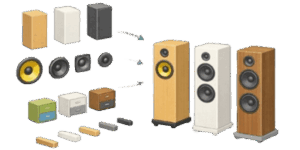
Calculation-driven assistant that helps you instantly estimate box volume, approximate low frequency, enclosure mass, a rough frequency response shape, and driver placement. It is not a replacement for a full Thiele/Small design, but it gives clear intuition about how box size, enclosure type, and driver choice change sound and appearance.



👉 Build hobbyists get fast feedback before cutting wood. Students and beginners learn acoustic cause and effect without getting buried in equations. Designers use quick sketches to reject bad ideas early and to see how changes affect the expected response.
Table of Contents
How the calculator approaches the problem
Enter external cabinet dimensions and panel thickness. The program subtracts panel material to get internal volume and gives a ballpark low frequency. Add driver diameters and power ratings. The tool synthesizes each driver contribution to the overall frequency balance, low driver for bass, mid driver for the middle, and tweeter for highs. Pick enclosure type to alter the response. A ported box shows a resonant bump near tuning. An open baffle reduces low output below a certain frequency. A sealed box flattens the low end and tightens bass control. A 3D preview places drivers on the face and the model becomes part of the exported screenshot.
How to use the tool step by step
Choose enclosure type: sealed, ported, or open baffle. Enter external length, width, and height in inches and panel thickness in inches. The calculator accounts for panel volume when computing internal capacity. Add driver diameters in inches and rated power for low, mid, and high drivers. Leave fields blank for drivers you do not use. Watch the results table and the frequency response graph which plots level in decibels versus frequency on a logarithmic axis. Tweak size, type, and driver power and observe how the estimated low corner shifts and how the response changes. Hit download to export a screenshot that includes the interface and the 3D model.
Meaningful, not perfect modeling
You get fast directional guidance. Do not expect precise T/S modeling. The tool does not use detailed Thiele/Small parameters. It does not simulate room interaction or port end corrections in real time. For finalized designs use specialized software and real T/S data for the drivers.
Practical building tips
If you need deeper bass increase internal volume, but be aware that a very large box can smear midrange clarity. Stiffen panels on compact speakers. Thin plywood or particle board without bracing tends to ring. A tuned port delivers a focused low boost, but it needs correct tuning and flared openings for low distortion. Open baffles sound airy and natural, they suit outdoor or special designs, but they produce less low output than sealed or ported boxes. Position tweeters near the top, mids near center, and woofers low for easier phase alignment and better subjective integration. Add internal bracing to reduce panel vibration and use damping material to tame internal reflections.

Driver guide and typical sizes
These ranges are averages for home and DIY speakers. Actual response depends on driver specifics and crossover choices.
| Driver role | Typical diameter | Nominal band |
|---|---|---|
| Woofer | 5 to 12 inches | about 20 to 800 Hz |
| Midrange | 3 to 6 inches | about 200 to 3,000 Hz |
| Tweeter | 0.75 to 3 inches | about 1.5 to 20 kHz |
Materials and panel thickness for US builds
Choose materials and thicknesses that match cabinet size and budget. Heavier and stiffer boards reduce panel resonances. For compact monitors use thicker panels. For large sub enclosures thicker panels plus internal bracing are needed to avoid flexing at high excursion.
| Material | Typical thickness | Note |
|---|---|---|
| MDF | 1/2 to 1 inch | Good stiffness and consistency |
| Plywood | 3/8 to 3/4 inch | Lighter and durable, needs good joinery |
| Particle board | 5/8 to 7/8 inch | Low cost, may resonate without bracing |
Key formulas the tool uses
Internal volume comes from external size less panel thickness. Use inches converted to feet for volume in cubic feet or convert to cubic meters when needed. Volume in cubic feet equals length in feet times width in feet times height in feet after subtracting twice the panel thickness measured in feet. Convert cubic feet to liters by multiplying by 28.3167. Estimated cabinet mass is surface area times thickness times material density expressed consistently.
✍ Port length is approximated from desired tuning frequency, port cross section, and box volume using a simplified relation. This yields a rough length for quick tuning suggestions and must be refined with correction factors for flanged ports and end geometry when you build.
How enclosure type affects sound
Sealed boxes produce smooth roll-off and controllable bass. Ported boxes add a resonant boost close to tuning frequency and can deliver more perceived bass for a given driver. Open baffles create a freer sound but reduced low level. Choose the type that matches your listening goals and room placement.
Extra practical checks and workflow
Always verify internal volume after accounting for braces, ports, and driver displacement. Mock up a cardboard prototype to check driver layout and front baffle aesthetics. Measure faceplate spacing so grills or bezels do not interfere with driver throw. Keep an eye on driver center spacing to avoid lobing in the crossover region. When possible, measure impedance sweeps and use them to refine final port tuning and box volume.
💡 Tip: make one small build and measure its response before committing to a larger run. A cheap microphone and free measurement software will reveal panel issues, driver integration problems, and port tuning errors faster than theory alone.
Use the case_des_3d helper for fast, visual checks and early-stage decisions. It speeds up iteration and highlights tradeoffs between size, enclosure type, and perceived bass. For production or critical designs follow up with T/S parameter based simulation and measured validation.
References for deeper study
For advanced design use Thiele/Small analysis and room interaction tools. These books are solid next reads for someone who wants to move from rough sketches to precision designs.
- The Loudspeaker Design Cookbook by Vance Dickason
- Loudspeaker and Headphone Handbook by John C. Eargle
- Fundamentals of Acoustics by Lawrence E. Kinsler and Austin R. Frey
- Testing Loudspeakers by Joseph D’Appolito

Markus Fletcher — Structural Design Specialist
Expert in structural integrity, 3D modeling, and applied mathematics. Markus focuses on creating precise tools for construction professionals and DIY engineers.