| Formula | — |
| Mass, g/mol | — |
| Available valences | — |
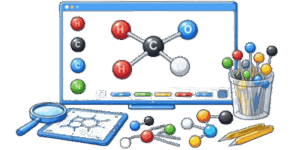
Chemistry becomes much easier to understand when you can see it instead of only reading about it. A molecular builder turns abstract formulas into a visible structure that you can assemble, inspect, and compare. Instead of memorizing names and symbols in isolation, you work directly with atoms, connections, and molecular shape. That makes the subject feel less distant and much more intuitive.


| Element | Valency | Atomic Mass, g/mol |
|---|---|---|
| H – Hydrogen | 1 | 1.008 |
| He – Helium | 0 | 4.0026 |
| Li – Lithium | 1 | 6.94 |
| Be – Beryllium | 2 | 9.0122 |
| B – Boron | 3 | 10.81 |
| C – Carbon | 4 | 12.011 |
| N – Nitrogen | 3 | 14.007 |
| O – Oxygen | 2 | 15.999 |
| F – Fluorine | 1 | 18.998 |
| Ne – Neon | 0 | 20.180 |
| Na – Sodium | 1 | 22.990 |
| Mg – Magnesium | 2 | 24.305 |
| Al – Aluminum | 3 | 26.982 |
| Si – Silicon | 4 | 28.085 |
| P – Phosphorus | 3 | 30.974 |
| S – Sulfur | 2 | 32.06 |
| Cl – Chlorine | 1 | 35.45 |
| Ar – Argon | 0 | 39.948 |
| K – Potassium | 1 | 39.098 |
| Ca – Calcium | 2 | 40.078 |
| Sc – Scandium | 3 | 44.956 |
| Ti – Titanium | 4 | 47.867 |
| V – Vanadium | 5 | 50.942 |
| Cr – Chromium | 6 | 51.996 |
| Mn – Manganese | 7 | 54.938 |
| Fe – Iron | 3 | 55.845 |
| Co – Cobalt | 2 | 58.933 |
| Ni – Nickel | 2 | 58.693 |
| Cu – Copper | 2 | 63.546 |
| Zn – Zinc | 2 | 65.38 |
| Ga – Gallium | 3 | 69.723 |
| Ge – Germanium | 4 | 72.630 |
| As – Arsenic | 3 | 74.922 |
| Se – Selenium | 2 | 78.971 |
| Br – Bromine | 1 | 79.904 |
| Kr – Krypton | 0 | 83.798 |
| Rb – Rubidium | 1 | 85.468 |
| Sr – Strontium | 2 | 87.62 |
| Y – Yttrium | 3 | 88.906 |
| Zr – Zirconium | 4 | 91.224 |
| Nb – Niobium | 5 | 92.906 |
| Mo – Molybdenum | 6 | 95.95 |
| Tc – Technetium | 7 | 98 |
| Ru – Ruthenium | 8 | 101.07 |
| Rh – Rhodium | 6 | 102.91 |
| Pd – Palladium | 0 | 106.42 |
| Ag – Silver | 1 | 107.87 |
| Cd – Cadmium | 2 | 112.41 |
| In – Indium | 3 | 114.82 |
| Sn – Tin | 4 | 118.71 |
| Sb – Antimony | 3 | 121.76 |
| Te – Tellurium | 2 | 127.60 |
| I – Iodine | 1 | 126.90 |
| Xe – Xenon | 0 | 131.29 |
| Cs – Cesium | 1 | 132.91 |
| Ba – Barium | 2 | 137.33 |
| La – Lanthanum | 3 | 138.91 |
| Ce – Cerium | 3 | 140.12 |
| Pr – Praseodymium | 3 | 140.91 |
| Nd – Neodymium | 3 | 144.24 |
| Pm – Promethium | 3 | 145 |
| Sm – Samarium | 3 | 150.36 |
| Eu – Europium | 3 | 151.96 |
| Gd – Gadolinium | 3 | 157.25 |
| Tb – Terbium | 3 | 158.93 |
| Dy – Dysprosium | 3 | 162.50 |
| Ho – Holmium | 3 | 164.93 |
| Er – Erbium | 3 | 167.26 |
| Tm – Thulium | 3 | 168.93 |
| Yb – Ytterbium | 3 | 173.05 |
| Lu – Lutetium | 3 | 174.97 |
| Hf – Hafnium | 4 | 178.49 |
| Ta – Tantalum | 5 | 180.95 |
| W – Tungsten | 6 | 183.84 |
| Re – Rhenium | 7 | 186.21 |
| Os – Osmium | 8 | 190.23 |
| Ir – Iridium | 6 | 192.22 |
| Pt – Platinum | 2 | 195.08 |
| Au – Gold | 1 | 196.97 |
| Hg – Mercury | 2 | 200.59 |
| Tl – Thallium | 3 | 204.38 |
| Pb – Lead | 2 | 207.2 |
| Bi – Bismuth | 3 | 208.98 |
| Po – Polonium | 2 | 209 |
| At – Astatine | 1 | 210 |
| Rn – Radon | 0 | 222 |
| Fr – Francium | 1 | 223 |
| Ra – Radium | 2 | 226 |
| Ac – Actinium | 3 | 227 |
| Th – Thorium | 4 | 232.04 |
| Pa – Protactinium | 5 | 231.04 |
| U – Uranium | 6 | 238.03 |
| Np – Neptunium | 5 | 237 |
| Pu – Plutonium | 6 | 244 |
| Am – Americium | 3 | 243 |
| Cm – Curium | 3 | 247 |
| Bk – Berkelium | 3 | 247 |
| Cf – Californium | 3 | 251 |
| Es – Einsteinium | 3 | 252 |
| Fm – Fermium | 3 | 257 |
| Md – Mendelevium | 3 | 258 |
| No – Nobelium | 2 | 259 |
| Lr – Lawrencium | 3 | 266 |
| Rf – Rutherfordium | 4 | 267 |
| Db – Dubnium | 5 | 270 |
| Sg – Seaborgium | 6 | 271 |
| Bh – Bohrium | 7 | 270 |
| Hs – Hassium | 8 | 277 |
| Mt – Meitnerium | 7 | 278 |
| Ds – Darmstadtium | 6 | 281 |
| Rg – Roentgenium | 5 | 282 |
| Cn – Copernicium | 2 | 285 |
| Nh – Nihonium | 3 | 286 |
| Fl – Flerovium | 2 | 289 |
| Mc – Moscovium | 3 | 290 |
| Lv – Livermorium | 2 | 293 |
| Ts – Tennessine | 1 | 294 |
| Og – Oganesson | 0 | 294 |
This online 3D molecular builder is designed for that purpose. It gives users a simple way to construct familiar substances, test ideas, and learn how atoms fit together in real chemical compounds. The goal is not to overwhelm you with theory. The goal is to make structure understandable, clear, and memorable. When you place atoms into a model and watch a molecule take shape, chemistry starts to make sense in a way that flat diagrams often cannot provide.
Building molecules in three dimensions changes the learning process. You are no longer looking at a symbol on a page. You are creating a structure that reflects how matter is organized in the real world.
Table of Contents
What this tool helps you do
The molecular builder is meant for practical use. You can select preset compounds, add atoms one by one, check the formula and molar mass, and see how many bonding opportunities are still available. That makes it useful for students, teachers, and anyone who wants a clearer picture of molecular structure without opening a dense textbook.
It is especially helpful for learning the relationship between composition and shape. Water, carbon dioxide, methane, and ethanol all have very different arrangements, and those differences affect how they behave. A 3D builder makes those differences visible at a glance.
Why molecular structure matters
A molecule is not just a formula. It is an arrangement of atoms with specific connections, orientation, and balance. Two substances can contain similar atoms but behave very differently because their internal structure is different. That is why chemistry is not only about counting atoms. It is about understanding how those atoms are linked together.
Structure influences boiling point, solubility, reactivity, polarity, and many other properties. A simple looking molecule may hide a very important chemical behavior. That is one reason 3D visualization is so valuable: it connects the formula to the actual arrangement that gives the substance its identity.
How to use the builder
Start with a preset molecule if you want a fast introduction. These ready-made examples show common substances and let you study their structure immediately. If you prefer to build manually, clear the workspace and begin with one atom at a time. Add connected atoms and watch how the formula, mass, and remaining bonding capacity update.
The process is intentionally simple. You do not need to master advanced chemical notation before using it. Click an element, place it in the model, and continue building from there. The interface does the bookkeeping for you, so you can focus on the chemical logic rather than on manual calculations.
Preset molecules
Presets are a good starting point because they show widely known compounds with familiar structures. Water demonstrates a bent molecule, carbon dioxide shows a linear arrangement, methane shows a compact tetrahedral pattern, and ethanol introduces a longer carbon chain with a functional group at the end.
That makes the presets useful as a study set. You can switch between them and compare how the same atoms can combine in different ways to create very different substances.
Valence and bonding in plain language
One of the most important ideas in chemistry is valence. A useful way to think about it is as the number of available connection points an atom can use to form bonds. Some atoms connect only once, while others can connect to several neighbors. That ability controls how molecules grow and how they are shaped.
Hydrogen is a simple example. It usually forms one bond, so it tends to sit at the edge of a molecule. Carbon is far more flexible. It can form four bonds, which makes it a central building block for countless compounds. That is one of the reasons carbon chemistry is so rich: carbon can serve as a framework for long chains, rings, branches, and many other structures.
The builder helps users see this in action. When an atom has no remaining bonding capacity, the program signals that the structure is complete at that point. That is not a limitation of the tool; it is a reflection of chemical reality. Atoms do not connect randomly.
They follow the rules of valence.
Free valences tell you whether a structure is finished or whether it can still grow. A zero value usually means the molecule is stable in its present form, while a positive value suggests that more atoms may still be attached.
Molar mass made simple
Every molecule has mass, and that mass comes from the atoms inside it. The total molar mass is the sum of the atomic masses of all atoms in the structure. The builder performs that calculation automatically, so users can see the result instantly as they assemble a molecule.
That is a small example, but the same principle applies to more complex molecules. Once you understand that molar mass is just the sum of the parts, it becomes much easier to interpret the numbers in the interface.
Why formulas follow a standard order
Chemical formulas are written in a consistent way so scientists can understand them quickly and unambiguously. One common convention is the Hill system. When carbon is present, it is written first, followed by hydrogen, and then the remaining elements in alphabetical order by symbol. This makes formulas easier to sort, search, and compare.
🧪 For instance, ethanol may be written as C2H5OH in standard form. If a molecule does not contain carbon, the remaining elements are listed alphabetically. This convention keeps chemical naming and indexing orderly across books, databases, and scientific tools.
The builder follows that same logic when it displays the formula. That means the user sees a form that matches the standard used in chemistry references and educational materials.
How to think about common molecules
A few familiar compounds are enough to build a strong foundation. Water is one of the best places to start because it is simple and shows a non-linear arrangement. Carbon dioxide is also important because it shows a straight, balanced structure with carbon in the middle. Methane introduces the idea of a carbon-centered framework. Ammonia helps show how one atom can connect to several others in a compact form.
Ethanol is useful because it combines a carbon chain with oxygen. Propane and ethylene show different hydrocarbon patterns. Acetylene shows how bonding can differ even among molecules made only of carbon and hydrogen. Sulfur dioxide and hydrogen chloride are good reminders that not all important molecules are organic.
The point of these examples is not memorization by itself. The point is to recognize recurring patterns. Once you understand a few structural types, many other molecules become easier to read.
What 3D visualization adds
Flat drawings in a book are useful, but they can hide spatial relationships. A 3D model shows the molecule as a real object with volume, direction, and distance between atoms. That matters because many chemical properties depend on geometry.
When you rotate a model and view it from different angles, the structure becomes more meaningful. You begin to notice how atoms are arranged around a center, how chains bend, and how different compounds occupy space. That is especially valuable for organic chemistry, where geometry often matters as much as composition.
A 3D view also makes learning more active. Instead of passively reading a formula, you are constructing and examining the substance. That shift from passive observation to active building often improves understanding and memory.
What the colors and shapes are for
Molecular models often use standard color conventions because they make structures easier to read. Carbon is commonly shown in gray or black, oxygen in red, nitrogen in blue, hydrogen in white, sulfur in yellow, and chlorine in green. These colors are widely recognized and help users identify atoms instantly.
The shapes also matter. Bonds are displayed as connectors between atoms, making the structure visually clear. Even without studying the formula in detail, a user can often recognize whether the molecule is a small gas, a chain compound, or a more compact structure.
This is one of the strengths of visual chemistry: recognition becomes faster than recall alone. The brain learns by pattern, and a good model makes those patterns visible.
How to use the tool for study
A good study method is to begin with a known molecule and then ask a few simple questions. How many atoms does it contain? Which atom is central? Which atoms appear at the edges? How heavy is it? How many bonds are used up, and how many remain available? These questions help you move from seeing a shape to understanding a structure.
Try comparing a few compounds that look similar at first but are built differently. Methane, ethane, propane, and ethanol are useful examples because they share familiar atoms but do not share the same shape or behavior. Carbon dioxide and sulfur dioxide are another useful pair because both contain two oxygen atoms, yet they are not the same in structure or chemistry.
Working this way turns the builder into a study companion. It is not just a toy or a preview window. It becomes a practical way to review bonding, composition, and molecular form.
What beginners should focus on first
- Beginners do not need to learn everything at once. Start with three things: the formula, the atom count, and the basic shape. Once those are clear, more advanced ideas become easier to absorb. The builder is designed to support that gradual process.
- First, identify the main atom in the structure. Then notice how many atoms are attached to it. Finally, check the displayed mass and remaining valences. That sequence gives a simple but powerful picture of how the molecule is assembled.
- As confidence grows, users can begin to recognize structural families: simple gases, straight chains, branched molecules, and compounds with functional groups. Those categories are much easier to learn when the structure is visible.
Why this approach is useful in class and at home
In a classroom, the builder can help students follow a teacher’s explanation without losing track of the structure. At home, it can serve as a self-study tool for reviewing chemistry concepts in a more interactive way. It is also useful for presentations, lab preparation, and quick demonstrations when a fast visual example is better than a long explanation.
A tool like this reduces the gap between reading and understanding. Many learners can repeat a definition without fully grasping the structure behind it. A visual builder bridges that gap by showing what the definition means in practice.
How to explore the presets intelligently
Do not just click through the preset list randomly. Use the presets to compare structure. Water and carbon dioxide show two very different geometries. Methane and ammonia show how central atoms can use different bonding patterns. Ethanol and methanol show how adding carbon atoms changes the size and organization of the molecule.

Even small changes in composition can lead to large changes in behavior. That is one of the most important lessons in chemistry, and a 3D molecular builder is a practical way to see it.
A simple way to remember the purpose of the builder
The easiest way to think about this tool is that it makes invisible structure visible. It helps you see how atoms fit together, how mass is accumulated, how bonding capacity is used, and how formulas are organized. That makes chemical learning more concrete and less abstract. Instead of treating molecules as strings of letters, you begin to recognize them as real architectures. That shift is what makes the builder valuable. It converts chemical ideas into forms that you can inspect, compare, and remember.
Reference books
- Clayden, Jonathan, Greeves, Nick, Warren, Stuart, and Wothers, Peter. Organic Chemistry.
- Atkins, Peter, and de Paula, Julio. Atkins’ Physical Chemistry.
- Housecroft, Catherine E., and Sharpe, Alan G. Inorganic Chemistry.
- Brown, Theodore L., LeMay, H. Eugene, Bursten, Bruce E., Murphy, Catherine J., Woodward, Patrick, and Stoltzfus, Matthew. Chemistry: The Central Science.
- McMurry, John. Organic Chemistry.
- Zumdahl, Steven S., and Zumdahl, Susan A. Chemistry.
- Carey, Francis A., and Sundberg, Richard J. Advanced Organic Chemistry.
- Raven, Peter H., Johnson, George B., Mason, Kenneth A., Losos, Jonathan B., and Singer, Susan R. Biology.

Markus Fletcher — Structural Design Specialist
Expert in structural integrity, 3D modeling, and applied mathematics. Markus focuses on creating precise tools for construction professionals and DIY engineers.