| Table area | — |
| Top volume | — |
| Weight (wood) | — |
Stol_designer turns simple dimensions into a clear 3D preview, cutting list, and assembly sketch so you can test proportions, material needs, and look before you cut anything.


📝 Use it to validate proportions, estimate board footage, check mass and piece lengths, and produce two-view drawings for cutting and assembly. It speeds design decisions and prevents obvious mistakes in the workshop.
Table of Contents
How to run a basic session
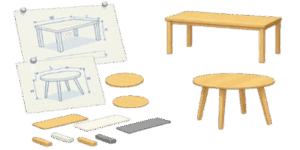
Start by entering top width, top depth, leg height and tabletop thickness. Pick a tabletop shape, choose a leg style, add stretchers and pick a texture for a quick visual. The model updates as you type, showing a 3D view and two projection drawings for top and side. Export a screenshot that includes both the model and drawings for project notes.
Inputs that matter most
Mass and material estimates depend on accurate thickness and density. Enter dimensions in inches for US builds. If you provide volume via panel size the tool converts to board footage automatically. Use the material menu to pick common species and the tool will apply typical densities to estimate mass.
Key controls
- Width across the front edge in inches
- Depth from front to back in inches
- Leg height from floor to top of apron in inches
- Top thickness in inches
- Tabletop shape, corner radius, leg and stretcher styles
Practical building rules and tolerances
Keep tabletop thickness between 3 quarters of an inch and 1 1/4 inches for most indoor tables. Leave a 1 to 2 millimeter allowance for final trimming and sanding when you cut parts. For outdoor furniture allow wider slats for drainage. Holes for dowels should be slightly larger than the dowel diameter to allow glue squeeze and alignment.
Recommended fit practices
- Drill dowel holes 0.02 to 0.04 inches larger than dowel diameter for easy assembly
- Clamp and square during glue up and check diagonals for a true rectangle
- Let glued joints cure before trimming or applying heavy loads
Formulas the tool uses under the hood
Volume of a board is length times width times thickness. The total linear length of boards is the number of pieces times the piece length. Gap between slats is computed from seat depth minus total slat width divided by the number of gaps. Mass equals total volume times material density. The tool converts imperial inputs to metric for volumetric math and back again for reporting.
| Calculation | Formula |
|---|---|
| Single board volume | V = (L inches × 0.0254) × (W inches × 0.0254) × (T inches × 0.0254) |
| Total linear length | L_total = n × (L inches) converted to feet for ordering |
| Slat gap | gap = (Depth − n × W) ÷ (n − 1) when n greater than 1 |
| Estimated mass | mass ≈ V_total × density |
Standard table heights and ergonomics
| Table type | Typical height | Notes for design |
|---|---|---|
| Dining table | 29–30 in | Most chairs pair well with 17–18 in seat height |
| Kitchen work table | 34–36 in | Matches standard countertop height in the US |
| Bar table | 40–42 in | Requires bar stools with footrests |
| Coffee table | 16–18 in | Usually level with or slightly below sofa seat |
| Side table | 20–24 in | Comfortable reach from seating |
Common wood board sizes and yields
| Nominal board size | Actual thickness | Typical use |
|---|---|---|
| 1×4 | 0.75 × 3.5 in | Aprons, stretchers, light frames |
| 1×6 | 0.75 × 5.5 in | Table skirts, narrow tops |
| 1×8 | 0.75 × 7.25 in | Solid tops, wide panels |
| 2×2 | 1.5 × 1.5 in | Legs for small tables and stools |
| 2×4 | 1.5 × 3.5 in | Heavy legs, structural frames |
Example with US numbers
Scenario. Slat length 15.75 inches, number of slats 5, slat width 3.54 inches, thickness 1.18 inches, seat depth 15.75 inches. The numbers are realistic for a small bench top and illustrate common mistakes.
Step one, check the gap
gap equals the depth minus slat widths all divided by the number of gaps. Put numbers in and you get a negative value which means too many slats or too wide slats. Specifically gap equals 15.75 minus 5 times 3.54 divided by 4 which is about minus 0.49 inches. Negative gap means reduce slat count or slat width.
Step two, single slat volume in cubic meters
Convert inches to meters and multiply. One slat is roughly 0.4 meters by 0.09 meters by 0.03 meters which equals 0.00108 cubic meters. For five slats total volume is 0.0054 cubic meters.
Step three, mass estimate
Using a mid density of 700 kilograms per cubic meter the total mass is 0.0054 times 700 which equals about 3.78 kilograms. This quick chain of conversions lets you validate whether your design will be light enough to move or heavy enough to need reinforced legs.
Cutlist, nesting and material yield
The tool produces a basic cutlist and lists total linear feet of boards. For more efficient nesting export the parts list and arrange cuts using your shop saw and panel saw plan. Allow extra for saw kerf and surface planing. If you are ordering stock material order a little extra to cover mistakes and grain matching.
Assembly sequence that saves time
Build the apron or frame first, check squareness, then attach legs and stretchers, finally fit the top. Dry assemble to confirm fit, mark joinery, then disassemble and glue in stages. Pre-drill pocket holes if you plan concealed screws. Use clamping cauls to avoid denting edges during glue up.
Finish and durability tips
Sand to a fine grit between finish coats. For tabletops use a hard, water resisting finish such as polyurethane or a mixed oil and varnish product. If you expect heavy wear consider a thicker top panel or apply a protective laminate. Seal end grain to prevent moisture absorption which causes cupping.
✍ Quick workshop tip: label every part after cutting. Use a simple numbering system so you never try to install the wrong piece during glue up.
Common pitfalls to avoid
Avoid relying solely on visual proportions. Always check internal clearances for drawer slides and skirt overlaps. Do not forget to subtract full panel thickness twice when computing internal heights. Always test a single joint before committing a full batch of identical cuts.

Recommended books for makers
- The Complete Manual of Woodworking by Albert Jackson, David Day, and Simon Jennings
- Shop Drawings for Craftsman Furniture by Gustav Stickley
- Woodworking: The Complete Manual by DK
- The Furniture Bible by Christophe Pourny

Markus Fletcher — Structural Design Specialist
Expert in structural integrity, 3D modeling, and applied mathematics. Markus focuses on creating precise tools for construction professionals and DIY engineers.