| Parameter | Value |
|---|
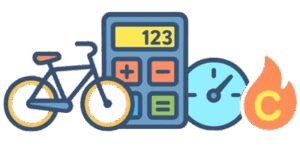
This tool converts route length, speed and mechanical inputs into travel time, required power and energy demand. The tool is designed for trip planning, e-bike battery sizing and performance checks, and for comparing cycling workload with other activities.


Table of Contents
Required inputs
- Route length in kilometres or miles, total distance to ride
- Target or average speed in kilometres per hour or miles per hour, choose whether average includes stops or is moving speed only
- Total mass rider plus bike plus luggage, expressed in kilograms or pounds
- Frontal area times CdA in square metres, or separate drag coefficient and area, reflecting riding position and kit
- Rolling resistance coefficient typical for tyre and surface combination
- Average grade expressed as percent or as total elevation gain for the route
- Wind speed and direction, metres per second or miles per hour
- Electric assist mean motor power and drivetrain efficiency for assisted bikes
- Human efficiency fraction of metabolic power converted to mechanical power, typical values around 0.20 to 0.25
Model and core formulas
All speeds are converted to metres per second for calculations, using standard unit conversion. Use the following force components to estimate mechanical power at a steady speed.
- Rolling force equal to mass times gravity times rolling resistance coefficient
- Grade force equal to mass times gravity times grade fraction
- Aerodynamic force equal to one half times air density times CdA times velocity squared
Mechanical power is the product of velocity and the sum of forces. Energy for the route is mechanical power multiplied by travel time. To estimate metabolic energy divide mechanical energy by human efficiency and convert watt hours to kilocalories using the standard factor. For e-bike battery sizing divide required mechanical energy by the drive system efficiency to obtain battery energy demand.
Practical notes and calibration advice
Short bursts of acceleration, frequent stops and low speed manoeuvres create power peaks and raise average energy consumption for short rides. For accurate energy estimates collect real power profile data from rides, measure actual circumference for wheel counts and log elevation changes with GPS. Tyre pressure and tyre profile alter effective rolling radius and rolling resistance, so re-calibrate wheel based sensors after major tyre changes or when switching surfaces.

When sizing a battery, include at least ten percent to twenty percent margin to account for temperature effects, motor efficiency drop at high current and route variations. For training plans combine cadence, gear selection and computed power to pick intervals that match target metabolic loads. Use averaged power data over relevant intervals for energy budgeting rather than instantaneous spikes.
Reference table, imperial examples
| Route type | Typical speed, mph | Rider power, W | Energy per 6.2 mi, Wh |
|---|---|---|---|
| Urban commuter, flat | 12.4 to 15.5 | 110 to 160 | 55 to 77 |
| Road ride, flat | 15.5 to 18.6 | 160 to 210 | 66 to 99 |
| Rolling road | 12.4 to 17.4 | 190 to 260 | 88 to 132 |
| Mountain singletrack | 7.5 to 12.4 | 210 to 360 | 110 to 176 |
| Loaded touring | 9.3 to 13.7 | 130 to 195 | 77 to 121 |
| E-bike urban assist | 12.4 to 17.4 | 60 to 130 | 22 to 55 |
| E-bike hilly assist | 11.2 to 15.5 | 90 to 165 | 44 to 88 |
Quick calculation checklist
- Confirm whether distance and speed are in metric or imperial units before calculation
- Convert display units to SI for internal power and energy computations
- Use empirical wheel circumference or GPS elevation profiles to refine grade and distance
- Include reserve capacity for battery sizing and expect efficiency losses under heavy load
Accurate trip estimates rely on correct units, careful calibration and awareness of dynamic effects such as stops and short climbs. Use measured power profiles where possible and provide a safety margin for battery capacity and for expected efficiency losses to ensure reliable planning and consistent performance assessment.
Further reading
- Andy Coggan and Hunter Allen, Training and Racing with a Power Meter
- James Papadopoulos, Bicycle Performance and Mechanics
- Edgar H. Meyer, The Science of Cycling

David Parry — Senior Engineering Analyst
Specializing in electronics and physics-based simulations with 20+ years of engineering experience. David ensures the mathematical and physical accuracy of the tools at ProCalcLab.