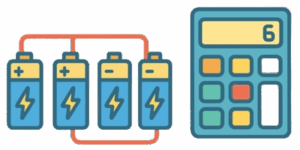


This battery pack calculator helps you instantly compute final pack voltage and total capacity for banks built from identical cells. Use it to verify pack layouts, compare options, and speed up early design decisions. The tool is ideal for engineers, hobbyists, and system integrators who need fast, dependable estimates for battery configuration and basic safety checks.
Table of Contents
Key input parameters
- Cell voltage, volts, the nominal voltage delivered by one cell
- Cell capacity, milliampere hours, the charge capacity of one cell
- Series count N, number of cells in series to raise pack voltage
- Parallel count M, number of parallel strings to increase capacity and current capability
Core formulas and quick rules
Keep the formulas simple for immediate engineering sense checks.
- Total voltage equals N multiplied by cell voltage
- Total capacity equals M multiplied by cell capacity
- Total cell count equals N multiplied by M
Designing the pack from target specifications
If you have a target pack voltage and a target pack capacity the minimal counts are
- N equals the ceiling of target voltage divided by cell voltage, rounding up ensures required voltage is met
- M equals the ceiling of target capacity divided by cell capacity, rounding up ensures required capacity is met
Worked example with changed values
Assume nominal cell voltage is 3.65 volts and cell capacity is 3000 mAh. Required pack targets are 14.6 volts and 9000 mAh. Then the calculations give
- N equals ceiling of 14.6 divided by 3.65 equals 4 in series
- M equals ceiling of 9000 divided by 3000 equals 3 in parallel
- Total cells equal 4 times 3 equals 12 cells
This configuration is written as 4s3p, providing 14.6 volts and 9000 mAh nominal values.

Practical assembly notes and design checks
- Always use a battery management system to balance individual cell voltages and prevent overcharge and overdischarge
- Match cells by capacity and internal resistance before assembling for best cycle life and even current sharing
- Plan mechanical layout, include proper insulation and secure mounting to avoid vibration induced damage
- Design busbars and wiring to carry expected continuous and surge currents, fuse each parallel string where appropriate
- Consider thermal management, high discharge rates produce heat that accelerates aging and can trigger thermal runaway
- Account for C rate requirements of intended application when sizing parallel count, more parallels increase continuous current capability
- For long service life control charge and discharge depth, shallow cycles extend usable cycles compared to deep cycles
- Include a safe charging strategy, cell chemistry dictates acceptable charge voltage and charge profile
Common pack configurations, fresh examples
| Series N | Parallel M | Cell V | Cell C mAh | Pack V | Pack C mAh | Total cells |
|---|---|---|---|---|---|---|
| 1 | 1 | 3.65 | 3000 | 3.65 | 3000 | 1 |
| 2 | 1 | 3.65 | 3000 | 7.30 | 3000 | 2 |
| 1 | 4 | 3.65 | 3000 | 3.65 | 12000 | 4 |
| 3 | 2 | 3.65 | 3000 | 10.95 | 6000 | 6 |
| 5 | 3 | 3.65 | 3000 | 18.25 | 9000 | 15 |
Safety and testing checklist
- Verify individual cell voltages before connecting in series and after final assembly
- Test internal resistance matching, large differences indicate bad candidates
- Perform an initial balanced charge cycle using a proper charger and balancer function
- Run capacity and discharge tests at expected load to confirm thermal behavior and real capacity
- Document cell batch numbers and build details for future service and warranty tracking
Use this battery calculator to get immediate, reliable estimates for pack voltage and capacity. After preliminary sizing build a prototype pack, measure actual performance under load, and add balancing and protection electronics to meet safety requirements. Good testing converts theoretical numbers into robust, serviceable battery systems that match real world needs.
Further reading, useful books
- Battery Systems Engineering by Christopher D. Rahn and Chao-Yang Wang
- Battery Management Systems, Design by Gregory L. Plett
- Lithium-Ion Batteries, Fundamentals and Applications by Masaki Yoshio, Ralph J. Brodd, and Akiya Kozawa
- Rechargeable Batteries, by Michael A. Roscher and Dirk U. Sauer

David Parry — Senior Engineering Analyst
Specializing in electronics and physics-based simulations with 20+ years of engineering experience. David ensures the mathematical and physical accuracy of the tools at ProCalcLab.