| Parameter | Value |
|---|
This interactive tool lets you watch and tune a worm gear mechanism in real time, and is published here under the label worm_gear. The simulation computes rotations for the worm and the wheel automatically and redraws the animation instantly. Use sliders and numeric fields to change the number of starts, the wheel tooth count, module and rotational speed. The interface is optimized for phones and tablets and runs in the browser without installation.



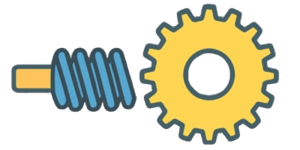
🛠 A worm gear is a two member drive that trades compact size for high reduction ratios and a ninety degree change in axis direction. The drive contains two principal parts, the worm which is a screw like shaft that acts as the driving member, and the worm wheel which is a gear that meshes with the worm thread. Typical uses include machine tool reducers, lifting mechanisms, conveyors, servo drives and adjustable household devices.
Table of Contents
Calculation formulas
1. Pitch diameters
d1 = q × m, d2 = m × Zw
2. Center distance
a = (d1 + d2) / 2
3. Gear ratio
i = Zw / S
4. Rotational speeds
n2 = n1 / i
In the formulas n1 is the worm speed and n2 is the wheel speed. The coefficient q used for the worm pitch diameter depends on the chosen standard and on the worm profile.
Worked example
Given a two start worm and a wheel with many teeth, the following example shows calculation steps with changed values for clarity.
- S equals 2, a double start worm
- Zw equals 54 teeth on the worm wheel
- Module m equals 3 mm
- Input speed n1 equals 1200 revolutions per minute
- Assume q equals 9 for the worm diameter coefficient
- d1 = q × m = 9 × 3 = 27 mm
- d2 = m × Zw = 3 × 54 = 162 mm
- a = (27 + 162) / 2 = 94.5 mm
- i = Zw / S = 54 / 2 = 27
- n2 = n1 / i = 1200 / 27 ≈ 44.44 RPM
Conclusion: the wheel turns 27 times slower than the worm, giving the compact reduction expected from a worm drive.
Key characteristics and design notes
- High reduction ratios are achievable, commonly up to 1 to 100 and above in compact layouts.
- Worm gear sets are smooth and quiet due to sliding engagement, but sliding increases friction and heat.
- Many configurations provide partial or full self locking, preventing the wheel from driving the worm back under load when the helix angle and friction are suitable.
- Sliding contact demands proper lubrication, correct flank geometry and periodic maintenance to avoid wear.
- Materials matter, hardened and bronzed wheel material combinations extend service life and reduce seizure risk.
- Efficiency falls with larger reductions, plan for thermal losses and select bearings and housings accordingly.
Reference tables
Parameter definitions
| Parameter | Symbol | Meaning |
|---|---|---|
| Worm starts | S | Number of thread starts on the worm |
| Wheel tooth count | Zw | Number of teeth on the worm wheel |
| Gear ratio | i = Zw / S | Reduction factor of the drive |
| Module | m | Tooth size expressed in millimetres |
| Worm pitch diameter | d1 | Approximate diameter of the worm thread |
| Wheel pitch diameter | d2 | Diameter derived from m and Zw |
| Center distance | a | Distance between worm and wheel axes |
Sample worm gear parameters
| Module | Starts | Wheel teeth | Ratio | Center distance mm |
|---|---|---|---|---|
| 2.5 | 1 | 22 | 22 | 35 |
| 3.0 | 1 | 36 | 36 | 60 |
| 3.5 | 2 | 56 | 28 | 104 |
| 4.0 | 1 | 48 | 48 | 132 |
| 5.0 | 2 | 70 | 35 | 200 |
Typical combinations and applications
| Module m | Starts S | Wheel Zw | Ratio | Use case |
|---|---|---|---|---|
| 1.8 | 1 | 18 | 18 | Precision instruments |
| 2.5 | 1 | 40 | 40 | Small speed reducers |
| 3.0 | 2 | 48 | 24 | Machine feeds |
| 3.5 | 1 | 66 | 66 | Winches and lifts |
| 4.5 | 2 | 90 | 45 | Heavy duty conveyors |
Practical recommendations
- Choose worm geometry and materials to balance efficiency and self locking where required.
- Check center distance after selecting module and tooth counts, small errors create misalignment and accelerated wear.
- Use oil films with additives for sliding contacts and establish an inspection schedule for scuffing and backlash.
- For accurate torque and thermal calculations, model efficiency losses and heat generation at expected loads.
- When integrating the set into a product, dimension bearings, shafts and housings to prevent deflection under load.

This simulator gives immediate feedback for worm gear design, enabling quick verification of ratios, center distances and rotational speeds. Use the live animation and numeric readouts to validate layouts, check manufacturability and compare configurations for the best balance of size, efficiency and service life. The worm gear remains a compact solution for high reduction needs and offers convenient self locking in many cases.
Further reading
- “Fundamentals of Machine Component Design” by Robert C. Juvinall and Kurt M. Marshek
- “Gear Design and Application” by Eric Oberg and Franklin D. Jones
- “Worm Gear Technology” by A. N. Smith, a practical guide to worm set geometry and lubrication
- “Design of Machinery” by Robert L. Norton, covers gear kinematics and mechanisms

David Parry — Senior Engineering Analyst
Specializing in electronics and physics-based simulations with 20+ years of engineering experience. David ensures the mathematical and physical accuracy of the tools at ProCalcLab.