| Normal force N | — |
| Static Fₛ,max | — |
| Kinetic friction Fₖ | — |
| Result | — |
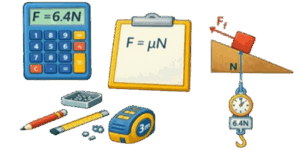
This interactive friction force calculator helps you quickly estimate normal force, static friction limits, and whether an object will slip under load. It is designed for learning, intuition, and fast checks, not for final engineering sign-off. You get clear numbers, visual logic, and a feel for how friction really behaves in everyday situations.



Instead of hiding the math, the friction calculator shows exactly what is going on under the hood. You can follow every step, sanity-check the results, or even re-calc everything with a pen and paper if you want.
Table of Contents
Core friction equations used by the calculator
The model is built around three physical quantities that matter in almost every friction problem: the normal force acting between surfaces, the maximum static friction force that prevents motion, and the kinetic friction force once sliding begins.
For an object resting on a flat horizontal surface, the normal force is simply:
N = m × g
When the surface is inclined at an angle θ, only part of gravity presses the object into the surface:
N = m × g × cos θ
The maximum static friction force that can resist motion is:
Fs,max = μs × N
Once the object starts sliding, friction drops to the kinetic value:
Fk = μk × N
All forces in the calculator are expressed in pounds-force. Mass is entered in pounds-mass, and gravity is taken as 32.174 ft/s² by default.
What this friction force calculator actually computes
The tool supports several practical calculation modes depending on how much information you already have.
- Inclined plane mode to compute normal force and friction limits from weight and slope angle
- Direct normal force mode when contact force is known or measured
- Applied force comparison to check if an object stays put or starts sliding
This makes the calculator useful for physics homework, workshop planning, safety checks, and quick what-if scenarios.
Parameter overview and physical meaning
| Symbol | Description |
|---|---|
| m | Object mass in pounds-mass |
| g | Gravitational acceleration, typically 32.174 ft/s² |
| θ | Incline angle measured in degrees |
| μs | Coefficient of static friction |
| μk | Coefficient of kinetic friction |
| Fapp | Applied force along the surface in pounds-force |
Common unit conversions used internally
| Conversion | Rule |
|---|---|
| lbm → lbf | Multiply by g ÷ 32.174 |
| degrees → radians | Multiply by π ÷ 180 |
| slugs → lbm | Multiply by 32.174 |
Step-by-step friction calculation example
Problem. A 26 lb object rests on a ramp inclined at 30 degrees. The coefficient of static friction is 0.45 and the coefficient of kinetic friction is 0.35. An upward force of 8 lbf is applied along the ramp. Will the object move?
Step 1. Normal force
N = 26 × 32.174 × cos 30° ÷ 32.174 ≈ 22.5 lbf
Step 2. Maximum static friction
Fs,max = 0.45 × 22.5 ≈ 10.1 lbf
Step 3. Downslope gravity component
Fdown = 26 × sin 30° ≈ 13.0 lbf
Step 4. Net force along the surface
Feff = 13.0 − 8.0 = 5.0 lbf
Since the effective force is smaller than the maximum static friction, the object remains stationary.
👉 Real surfaces are rarely ideal. Vibration, dust, temperature changes, surface wear, or lubrication can significantly shift friction behavior in the real world.
Typical coefficients of friction for common materials
| Material pair | μs | μk |
|---|---|---|
| Ice on steel | 0.04 | 0.03 |
| Rubber on dry concrete | 0.60 | 0.50 |
| Rubber on wet concrete | 0.45 | 0.35 |
| Rubber on dry asphalt | 0.90 | 0.80 |
| Rubber on wet asphalt | 0.60 | 0.50 |
| Rubber on ice | 0.15 | 0.10 |
| Rubber on wood | 0.70 | 0.50 |
| Rubber on glass | 0.90 | 0.70 |
| Rubber on rubber | 1.00 | 0.85 |
| Steel on steel, dry | 0.74 | 0.57 |
| Steel on steel, lubricated | 0.01 | 0.01 |
| Steel on aluminum | 0.61 | 0.47 |
| Steel on glass | 0.50 | 0.40 |
| Steel on concrete | 0.55 | 0.45 |
| Iron on iron | 0.40 | 0.25 |
| Cast iron on steel | 0.40 | 0.29 |
| Copper on steel | 0.53 | 0.36 |
| Brass on steel | 0.44 | 0.30 |
| Brass on copper | 0.44 | 0.30 |
| Bronze on steel | 0.35 | 0.25 |
| Aluminum on steel | 0.61 | 0.47 |
| Titanium on steel | 0.30 | 0.25 |
| Copper on bronze | 0.44 | 0.30 |
| Phenolic (G10) on steel | 0.25 | 0.18 |
| Phenolic (G10) on wood | 0.35 | 0.25 |
| Plastic (PE) on steel | 0.20 | 0.15 |
| PTFE (Teflon) on steel | 0.04 | 0.04 |
| PTFE on PTFE | 0.05 | 0.04 |
| Wood on wood, dry | 0.30 | 0.25 |
| Wood on wood, wet | 0.20 | 0.15 |
| Paper on wood | 0.50 | 0.40 |
| Fabric on wood | 0.40 | 0.30 |
| Plastic on wood | 0.35 | 0.25 |
| Leather on metal | 0.50 | 0.40 |
| Leather on wood | 0.60 | 0.50 |
| Human skin on glass | 0.70 | 0.55 |
| Human skin on metal | 0.60 | 0.50 |
| Human skin on skin | 0.80 | 0.60 |
| Rubber on fabric | 0.90 | 0.80 |
| Steel on wood | 0.50 | 0.40 |
| Glass on metal | 0.50 | 0.40 |
| Glass on glass | 0.94 | 0.40 |
| Graphite on steel | 0.10 | 0.08 |
| Graphite on graphite | 0.12 | 0.10 |
| Dry sand on steel | 0.60 | 0.45 |
| Wet sand on steel | 0.45 | 0.35 |
| Dry clay on wood | 0.40 | 0.30 |
| Wet clay on steel | 0.35 | 0.25 |
| Concrete on concrete | 0.70 | 0.60 |
| Steel on concrete (stainless) | 0.55 | 0.45 |
| Rubber on snow/ice (typical winter tire) | 0.30 | 0.20 |
| Rubber on gravel | 0.60 | 0.50 |
| Ceramic on metal | 0.50 | 0.40 |
Practical friction safety tips
Always leave margin. If your numbers land close to the sliding threshold, assume motion will happen sooner or later. Small disturbances like vibration or surface contamination can erase theoretical safety margins instantly.
✍ This calculator is best used as a fast decision aid and an educational tool. For structural or safety-critical systems, a full mechanical analysis with real material testing is the only responsible choice.
Used properly, the friction force calculator builds intuition and helps you understand which parameters actually matter and which ones barely move the needle.

Recommended books for deeper understanding
- Engineering Mechanics: Dynamics — J.L. Meriam, L.G. Kraige
- Physics for Scientists and Engineers — Raymond A. Serway, John W. Jewett
- Classical Mechanics — John R. Taylor
- Contact Mechanics and Friction — Valentin L. Popov
- Applied Physics for Engineering — A.R. Jha

David Parry — Senior Engineering Analyst
Specializing in electronics and physics-based simulations with 20+ years of engineering experience. David ensures the mathematical and physical accuracy of the tools at ProCalcLab.