| Kinetic energy | — |
| Potential energy | — |
| KE share | — |
| Total energy | — |
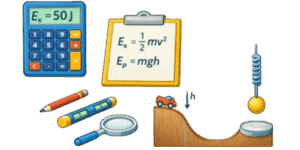
This energy calculator shows kinetic energy, potential energy and the total energy for a body, then breaks down how much each component contributes to the balance. Enter mass, speed and height in US or metric units and get numeric results, a dial indicator and a combined graph you can use for engineering checks or quick intuition.



Table of Contents
Core formulas
These are the equations the tool uses. They are standard and easy to verify on paper.
KE = 1/2 · m · v²
PE = m · g · h
E = KE + PE
share = KE / E · 100% when E is positive
How units are handled
The calculator works in SI internally. If you type pounds, feet or miles per hour the tool converts values before computing. Below are the conversion factors it uses so you can follow the math.
| Input | Conversion to SI |
|---|---|
| mass: pounds to kilograms | kg = lb × 0.45359237 |
| speed: mph to m/s | m/s = mph × 0.44704 |
| height: feet to meters | m = ft × 0.3048 |
| gravity | standard g = 9.80665 m/s² unless overridden |
Worked examples
Example A — small object
Inputs entered: mass 4.40 lb, speed 11.18 mph, height 32.81 ft, g 9.80665 m/s².
Conversions to SI used internally
- m = 4.40 lb × 0.45359237 = 1.998 kg
- v = 11.18 mph × 0.44704 = 5.00 m/s
- h = 32.81 ft × 0.3048 = 10.00 m
Energy math
- KE = 0.5 × 1.998 × 5.00² = 25.0 J
- PE = 1.998 × 9.80665 × 10.00 ≈ 196.1 J
- Total E = 221.1 J
- KE share = 25.0 / 221.1 × 100% ≈ 11.3%
Example B — heavy object
Inputs entered: mass 331 lb, speed 22.37 mph, height 6.56 ft, g standard.
Conversions
- m = 331 lb × 0.45359237 ≈ 150.1 kg
- v = 22.37 mph × 0.44704 ≈ 10.0 m/s
- h = 6.56 ft × 0.3048 ≈ 2.00 m
Energy math
- KE = 0.5 × 150.1 × 10.0² = 7,505 J
- PE = 150.1 × 9.80665 × 2.00 ≈ 2,943 J
- Total E ≈ 10,448 J
- KE share ≈ 71.8%
Extra examples and comparisons
Want a feel for what a joule means in everyday terms. One kilojoule is about the energy in a small candy. A car at highway speeds stores kinetic energy on the order of megajoules. Use these quick sanity checks when you size safety barriers or estimate impact energy.
Extra worked case — a running person
- Mass 165 lb equals 74.8 kg
- Speed 8 mph equals 3.576 m/s
- KE = 0.5 × 74.8 × 3.576² ≈ 478 J
Visuals and reporting
The app shows three outputs at once. A numeric table lists KE, PE and total energy in joules. A dial displays the percent share of kinetic energy. A combined bar or stacked graph plots KE and PE side by side. For widely different magnitudes you can switch to a log scale or normalize the graph so small contributions remain visible.

Rounding, precision and sign rules
Results are presented with sensible rounding by default. If you need full precision you can export values with four significant digits or more. Potential energy depends on your zero level. If you choose negative heights the PE can be negative. The share calculation only makes sense when the total energy is positive so the tool shows a clear note if E is zero or negative.
Practical tips and common pitfalls
Speed dominates kinetic energy because KE depends on velocity squared. Doubling speed quadruples KE. Potential energy scales linearly with height and mass so lifting heavier objects or raising them higher increases PE proportionally.
📝 Units mismatch is the usual source of wrong numbers. If you paste in mph but treat k as per second you will get nonsense. Always confirm that mass, speed and height are in the units you think they are before you act on the numbers.
When the calculator is not appropriate
This is classical mechanics only. No relativistic corrections and no account for energy losses to heat, deformation, air drag or friction. For impact damage estimates add material-specific deformation energy or use experimental drop tests. For high-speed bodies approaching a significant fraction of light speed do not use these formulas.
Suggestions for advanced use
If you analyze many points create a table of scenarios and export the CSV. Use the exported time series to plot energy over time for moving objects on your spreadsheet or in a plotting tool. For systems with multiple masses add them up as separate KE terms before comparing to total PE. If you model bouncing bodies remember that some KE becomes internal energy after impact.
💡 Use this tool to get quick, trustworthy energy numbers in either US or metric units. Convert inputs using the shown factors, check the dial and graph for balance, and export results if you need precise values for reports or safety checks. Small changes in speed matter a lot. That’s the headline to keep in mind whenever you compare kinetic and potential energy.
Books and resources
- Fundamentals of Physics by Halliday, Resnick and Walker
- Classical Mechanics by John R. Taylor
- Engineering Mechanics: Dynamics by J. L. Meriam and L. G. Kraige

David Parry — Senior Engineering Analyst
Specializing in electronics and physics-based simulations with 20+ years of engineering experience. David ensures the mathematical and physical accuracy of the tools at ProCalcLab.