| Parameter | Value |
|---|
If you work with lumber or furniture you need to know EMC. This calculator estimates the equilibrium moisture content of wood from air temperature and relative humidity, shows measured moisture from oven drying and helps you avoid surprises like warping and checking.


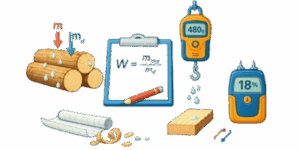
👉 This tool does two jobs. First it computes EMC from air conditions using the Hailwood–Horrobin model. Second it shows the laboratory measured moisture by mass when you provide wet and dry weights. Both results are useful, the measured number tells you what a sample actually contains, EMC tells you where the wood will settle over time in current climate.
Table of Contents
Methodology and the exact formulas
1. Measured moisture by mass
Если у вас есть масса влажного образца mwet и масса сухого образца mdry после сушки при 103–105 °C до постоянной массы, то измеренная влажность по массе (MC, %) вычисляется так:
$$\mathrm{MC}_{meas}=\frac{m_{wet}-m_{dry}}{m_{dry}}\times 100\%$$
2. Equilibrium moisture EMC computation
The calculator implements the Hailwood–Horrobin empirical model which performs well across normal drying and indoor climate ranges. Temperature is converted to Fahrenheit for the empirical coefficients then the EMC is assembled from those coefficients.
Temperature conversion to degrees Fahrenheit:
$$T_f = 1.8\,T_C + 32$$
Temperature-dependent coefficients as functions of \(T_f\):
$$W = 330 + 0.452\,T_f + 0.00415\,T_f^2$$
$$k = 0.791 + 0.000463\,T_f – 0.00000084\,T_f^2$$
$$k_1 = 6.34 + 0.000775\,T_f – 0.0000935\,T_f^2$$
$$k_2 = 1.09 + 0.0284\,T_f – 0.0000904\,T_f^2$$
Final EMC equation in percent:
$$
M_{eq} = \frac{1800}{W}\left(
\frac{k h}{1 – k h} + \\[6pt]
\frac{k_1 k h + 2 k_1 k_2 k^2 h^2}{1 + k_1 k h + k_1 k_2 k^2 h^2}
\right),
\quad h = \frac{\mathrm{RH}}{100}
$$
3. Species correction
Some species consistently run a bit higher or lower than the generic EMC. The calculator offers a simple species correction you can replace with lab values if you have them.
| Species | Approx correction, percent |
|---|---|
| Pine | 0.00 |
| Spruce | 0.00 |
| Oak | +0.45 |
| Beech | +0.30 |
| Ash | +0.25 |
| Birch | +0.20 |
| Maple | +0.35 |
| Larch | −0.25 |
It shows measured moisture MC when you provide wet and dry masses, computed EMC and EMC adjusted for species. The display includes a gauge for quick reading and a graph that shows how EMC varies with RH at the current temperature.
Practical moisture categories
| Condition | Moisture, percent |
|---|---|
| Very dry | < 6 |
| Dry, furniture grade | 6–10 |
| Normal indoor | 8–14 |
| Moist | 14–25 |
| Wet | > 25 |
Detailed example and oven test
Example uses US units for weights. Oven test procedure requires drying at 220 to 221 degrees Fahrenheit until constant weight which is the standard oven dry method converted from metric.
Input data
- Air temperature 68°F relative humidity 60 percent
- Species oak correction +0.45 percent
- Wet sample weight 4.41 ounces dry sample weight 3.53 ounces
- Convert air temperature to Celsius for the model if needed or use the provided Fahrenheit to Celsius relation inside the calculator.
- Compute the empirical coefficients W, k, k1 and k2 using Tf equals 68 degrees Fahrenheit.
- Plug h equals 0.60 into the Hailwood–Horrobin formula and get M_eq approximately 11.005 percent.
- Apply species correction to obtain EMC adjusted for oak 11.455 percent.
- Measured moisture from oven weights MC_meas equals (4.41 minus 3.53) divided by 3.53 times 100 percent which equals about 24.9 percent.
Interpretation note. The lab measured moisture 24.9 percent represents the sample actual condition. EMC about 11.5 percent shows the target equilibrium in the current air. If the wood stays in this climate it will slowly dry toward 11.5 percent with associated shrinkage and possible checking unless drying is controlled.
Expanded practical guidance
Oven drying tips. Use an oven calibrated to 220 to 221 degrees Fahrenheit and weigh samples repeatedly until successive weights differ by less than one tenth of a percent. Use matched samples from near the center of the board to avoid surface bias.
Moisture meter advice. Pin meters read local moisture in the contact zone. Capacitance meters show an average near surface. Always correlate meter readings with occasional oven-dry checks to build a correction table for your species and meter model.
Drying strategy. In kilns ramp humidity slowly to avoid surface checking. Aim for equalized moisture throughout thickness before final conditioning. Thin lumber reaches equilibrium faster, thick beams take much longer and often need staged drying.
Storage and movement. Wood shrinks tangentially more than radially. Expect about twice the dimensional change across grain compared to along radial direction when moisture drops from green to indoor EMC levels. Account for this in joinery and door panels.
Regional EMC targets for the United States
- Southern coastal regions aim for 8 to 12 percent
- Interior temperate regions aim for 6 to 9 percent
- Dry, high desert areas aim for 4 to 7 percent
Common errors and accuracy considerations
Typical sources of error include incomplete drying, incorrect balance calibration and non-representative sampling. Species and surface treatment change equilibrium behavior. The Hailwood–Horrobin model is a strong baseline, but for precision work use lab sorption data for the species and grade you are processing.
Quick checklist for reliable moisture work
- Use matched, representative samples for oven tests
- Calibrate scales and moisture meters regularly
- Record temperature and RH where lumber is stored and where it will be used
- Plan kiln cycles for even moisture distribution through thickness
Conclusion and takeaway about EMC
EMC is the anchor point for predicting how wood will behave in a given climate. Use measured MC to validate meter readings and EMC to plan drying and storage. When measured and computed values disagree check sample handling and instrument calibration before adjusting process settings.

Recommended books
- Wood Handbook: Wood as an Engineering Material — U.S. Forest Products Laboratory
- Dry Kiln Operator’s Manual — United States Department of Agriculture
- Introduction to Wood Science and Technology — This edition focuses on properties and moisture behavior
- Timber: Its Nature and Behaviour — Practical guide for movement and moisture topics

Markus Fletcher — Structural Design Specialist
Expert in structural integrity, 3D modeling, and applied mathematics. Markus focuses on creating precise tools for construction professionals and DIY engineers.