| Enthalpy ΔH° | -- |
|---|---|
| Amount of Substance | -- |
| Process Temper. | -- |
| Gas Volume | -- |
| Heat Effect Q | -- |
| Reaction Type | -- |
Every chemical reaction involves an exchange of energy. When substances interact to form new products, chemical bonds break and new ones form. This process either releases heat into the surrounding environment or absorbs heat from it. Managing this thermal energy is essential for industrial manufacturing, home heating systems, automotive engineering, and laboratory safety. This guide breaks down how reaction heat works, how environmental conditions influence energy changes, and how to use the interactive calculator to analyze these processes instantly.



Table of Contents
The Basics of Thermochemistry
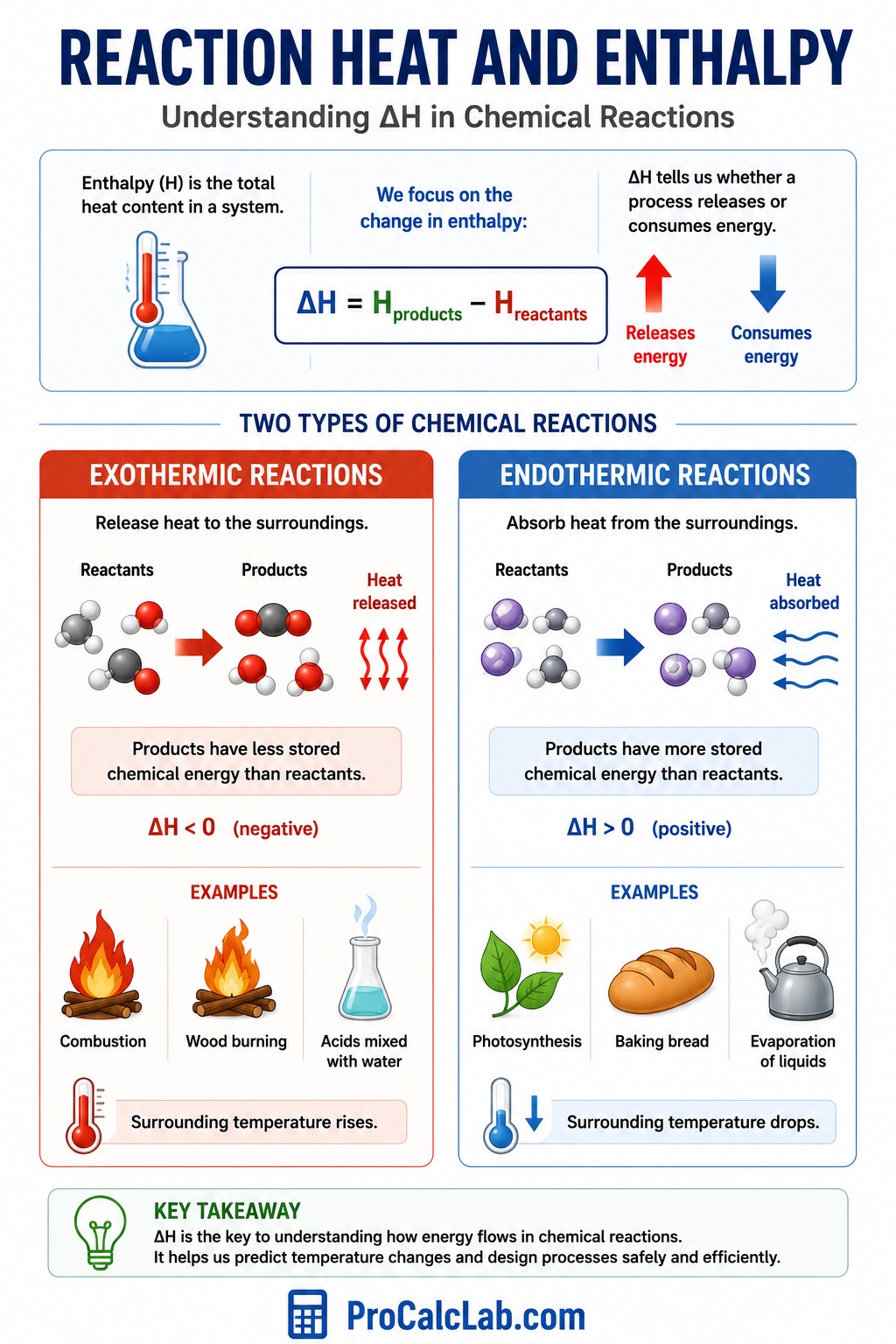
To understand reaction heat, it is necessary to look at enthalpy, which is represented as Delta H. Enthalpy is a measurement of the total heat content in a thermodynamic system. Since measuring absolute enthalpy is practically impossible, scientists and engineers focus on the change in enthalpy during a process. This change is calculated by subtracting the total enthalpy of the starting materials from the total enthalpy of the final products.
Delta H = Hproducts – Hreactants
The resulting value tells whether a process releases or consumes energy. This divides chemical reactions into two primary categories:
- Exothermic Reactions: These processes release heat into the surroundings. The products contain less stored chemical energy than the reactants, resulting in a negative Delta H value. Common examples include combustion, wood burning, and the mixing of acids with water. The surrounding temperature rises during these events.
- Endothermic Reactions: These processes absorb heat from the surroundings. The products contain more stored chemical energy than the starting materials, which leads to a positive Delta H value. Examples include photosynthesis, baking bread, and the evaporation of liquids. The surrounding temperature drops during these events.
Activation Energy explained
Even highly favorable exothermic reactions do not just start spontaneously. A pile of wood does not burst into flames without a spark. This initial energy barrier is called Activation Energy, or Ea. It represents the minimum amount of energy required to kickstart a chemical process by weakening existing chemical bonds. Once the system climbs over this energy hill, the reaction proceeds smoothly, either releasing its stored heat or continuing to draw heat to sustain itself.
How to Operate the Calculator
The interactive tool simplifies complex thermodynamic equations into a user-friendly interface. It operates in two separate modes depending on the available information. Switching between these modes changes how data is input, but both systems utilize the same environmental condition sliders to generate real-time results.
Reaction Equation Mode
This mode is designed for standard chemical equations where the individual substances are known. The system relies on an internal database of thermodynamic properties to calculate energy values automatically.
- Locate the mode selection tabs at the top of the interface and click on Reaction Equation.
- Input a balanced chemical equation into the text field. The system recognizes standard molecular formulas separated by an equals sign or an arrow. Formulas must use correct capitalization, such as H2O for water or CO2 for carbon dioxide.
- Ensure coefficients are placed directly before the formulas to represent the correct molar ratios, for example, 2H2 + O2 = 2H2O.
- Once a valid equation is entered, the tool instantly extracts the corresponding standard enthalpies of formation and molar masses from its reference library.
Custom Data Mode
When working with unique mixtures, experimental data, or substances not included in the standard database, the Custom Data mode provides full manual control over the chemical variables.
- Click on the Custom Data tab to reveal the specialized manual inputs.
- Adjust the Standard Enthalpy slider or type the specific value into the Delta H input box. This value represents the heat change per mole at standard conditions, measured in kilojoules per mole.
- Set the Activation Energy using the Ea slider to establish the initial energy barrier for the process.
- Define the Molar Mass using the M slider to specify the weight of one mole of the primary reactant in grams per mole. This enables the tool to convert physical weights into molar quantities accurately.
Managing Environmental Conditions
Chemical reactions rarely happen under idealized laboratory conditions. Temperature, ambient pressure, and the physical quantity of reactants dictate the actual real-world heat output and gas volume. The lower section of the tool features interactive sliders to adjust these parameters dynamically.
Temperature Adjustments
Temperature alters the baseline energy of molecules. According to Kirchhoff’s Law of Thermochemistry, the heat of a reaction changes with temperature because the heat capacities of reactants and products differ. The calculator supports three standard temperature scales:
- Celsius (°C): The standard metric scale based on the freezing and boiling points of water.
- Fahrenheit (°F): The traditional imperial system widely used in US industrial settings.
- Kelvin (K): The absolute thermodynamic temperature scale used in scientific calculations where zero represents absolute zero.
Moving the temperature slider automatically updates the final enthalpy values, showing how extreme heat or cold shifts the energy efficiency of the process.
Pressure Parameters
While pressure has a negligible effect on solids and liquids, it directly dictates the behavior of gases. When gas moles are produced or consumed during a reaction, ambient pressure controls the final physical volume occupied by those gases. The tool accommodates various regional and industrial pressure units:
- Kilopascals (kPa): The modern metric unit for pressure.
- Atmospheres (atm): A unit representing the average atmospheric pressure at sea level.
- Psi (Pounds per Square Inch): The standard unit used across American engineering and manufacturing industries.
- Bar: A metric pressure unit slightly less than one atmosphere, frequently used in meteorology and industrial processing.
Material Quantity Controls
The total heat output of a process depends heavily on how much material actually reacts. Burning an ounce of fuel releases far less total heat than burning a pound of fuel, even though the energy per mole remains identical. The quantity tool allows users to input amounts based on chemical count or physical weight using four distinct units:
- Moles (mol): The standard scientific unit representing the absolute number of atoms or molecules.
- Grams (g): The base metric unit for mass.
- Pounds (lb): The primary imperial unit for weight in commercial and consumer contexts.
- Ounces (oz): A smaller imperial unit ideal for precise small-scale measurements.
Any adjustment to these sliders instantly modifies the calculated results, updating the metrics table and rebuilding the potential energy graph without requiring a manual page refresh.
Thermodynamic Reference Data
The following tables provide standard reference values used to calculate reaction profiles. These metrics assist users when configuring the manual input fields in Custom Data mode.
Standard Enthalpies of Formation
This table lists the energy change when one mole of a substance is formed from its pure elements under standard conditions of 25°C and 1 atm. A value of zero indicates a stable pure element in its natural state.
| Substance Name | Chemical Formula | Standard Enthalpy Delta H°f (kJ/mol) |
|---|---|---|
| Acetylene (gas) | C2H2 | 227 |
| Ammonia (gas) | NH3 | -46 |
| Butane (gas) | C4H10 | -126 |
| Calcium Carbonate (solid) | CaCO3 | -1207 |
| Calcium Oxide (solid) | CaO | -635 |
| Carbon Dioxide (gas) | CO2 | -394 |
| Carbon Monoxide (gas) | CO | -111 |
| Copper(II) Oxide (solid) | CuO | -156 |
| Ethane (gas) | C2H6 | -85 |
| Ethanol (liquid) | C2H5OH | -278 |
| Ethylene (gas) | C2H4 | 52 |
| Glucose (solid) | C6H12O6 | -1273 |
| Hydrogen Gas | H2 | 0 |
| Hydrogen Chloride (gas) | HCl | -92 |
| Iron(III) Oxide (solid) | Fe2O3 | -824 |
| Methane (gas) | CH4 | -75 |
| Methanol (liquid) | CH3OH | -239 |
| Nitric Oxide (gas) | NO | 90 |
| Nitrogen Dioxide (gas) | NO2 | 33 |
| Oxygen Gas | O2 | 0 |
| Propane (gas) | C3H8 | -104 |
| Sodium Chloride (solid) | NaCl | -411 |
| Sulfur Dioxide (gas) | SO2 | -297 |
| Sulfur Trioxide (gas) | SO3 | -396 |
| Water (liquid) | H2O | -286 |
| Water (steam) | H2O | -242 |
Industrial Material Densities and Weights
When bridging the gap between practical engineering and chemical calculation, converting volume measurements into mass is a frequent requirement. The following table highlights common process materials.
| Material Name | Typical State | Average Density, lb/cu ft |
|---|---|---|
| Water | Liquid | 62.4 |
| Ethanol | Liquid | 49.3 |
| Methanol | Liquid | 49.4 |
| Propane | Liquidified Gas | 30.8 |
| Butane | Liquidified Gas | 36.2 |
| Dry Steam | Vapor (212°F) | 0.037 |
Practical Example: Methane Combustion Process
To see how these variables function together in everyday applications, a real-world scenario using standard American industrial metrics can be analyzed. Consider a small heating system burning methane gas, which is the primary component of natural gas.
The Reaction Scenario
The system processes a specific quantity of fuel under standard building conditions:
- Fuel Source: Methane Gas (CH4)
- Input Mass: 2.00 pounds (lb)
- System Temperature: 77°F
- Atmospheric Pressure: 14.7 psi
Step-by-Step Mathematical Evaluation
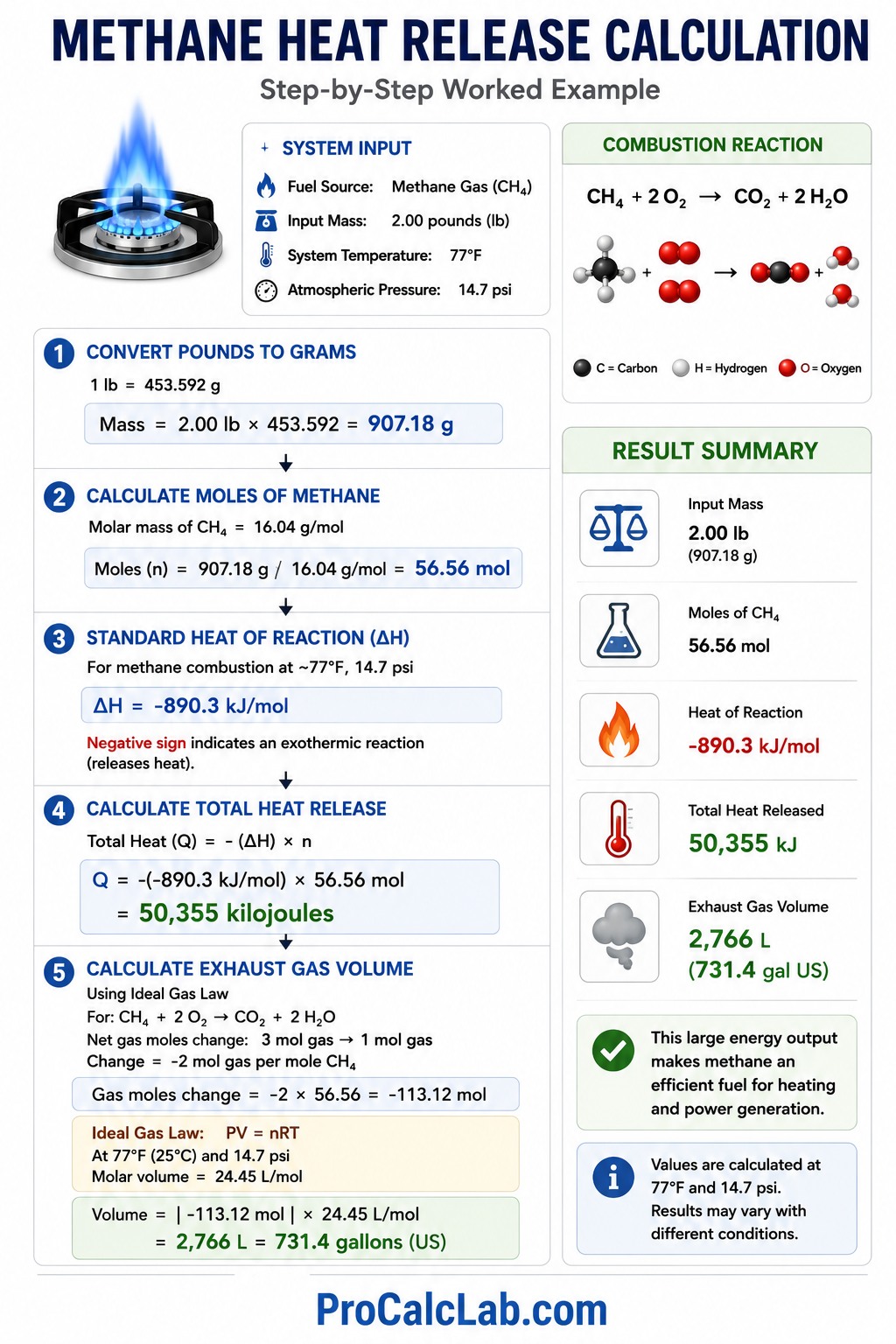
First, the input weight must be converted from pounds to metric grams. One pound is equal to 453.592 grams.
Mass = 2.00 lb × 453.592 = 907.18 grams
Next, determine the total number of moles using the molar mass of methane, which is 16.04 grams per mole.
Moles (n) = 907.18 g / 16.04 g/mol = 56.56 mol
The standard heat of reaction for burning methane at room temperature yields a Delta H value of -890.3 kilojoules per mole. The negative symbol establishes that this is an exothermic process that releases heat energy into the building.
To find the total heat effect, multiply the total moles by the reaction enthalpy:
Total Heat (Q) = -(-890.3 kJ/mol) × 56.56 mol = 50,355 kilojoules
This huge energy output is the reason methane serves as an efficient fuel source for home heating and electricity generation.
📝 Finally, the tool evaluates gas volume using the Ideal Gas Law. When one mole of methane burns completely with oxygen, it forms carbon dioxide gas and liquid water. The net change in gas moles dictates how much volume the resulting exhaust gas occupies. Under these specific conditions, the tool calculates the total volume in liters and automatically provides an imperial alternative in gallons, ensuring technicians can accurately size ventilation ducts or exhaust piping.
Reading the Interactive Visualization
Beneath the numeric data table, the calculator generates a custom potential energy diagram. This visual representation maps out the thermal journey of the chemical system from start to finish.
The vertical axis represents the total Enthalpy, or heat content, measured in kilojoules. The horizontal axis represents the Reaction Progress, tracking the process from raw starting materials on the left to finished products on the right.
Key Graphical Elements
- The Starting Line (H = 0): The flat platform on the left represents the initial energy state of the unreacted materials.
- The Energy Peak: The curve rises sharply to form a hill. The distance from the starting platform to the top of this hill equals the Activation Energy. A taller hill means the reaction requires more initial heat or a stronger spark to begin.
- The Product Platform: The flat line on the right represents the final energy state of the completed reaction products.
In an exothermic reaction, the product platform sits much lower than the starting platform. This visual drop displays the loss of heat to the external environment. In an endothermic reaction, the product platform sits higher than the starting line, visually demonstrating that energy was pulled from the outside world and stored permanently within the new chemical bonds.
Sources and Reference Material
- Smith, J. M., Van Ness, H. C., & Abbott, M. M. Introduction to Chemical Engineering Thermodynamics. McGraw-Hill Education.
- Lide, D. R. CRC Handbook of Chemistry and Physics. CRC Press.
- Zumdahl, S. S., & Zumdahl, S. A. Chemistry. Cengage Learning.
- National Institute of Standards and Technology. NIST Chemistry WebBook, SRD 69. U.S. Department of Commerce.

David Parry — Senior Engineering Analyst
Specializing in electronics and physics-based simulations with 20+ years of engineering experience. David ensures the mathematical and physical accuracy of the tools at ProCalcLab.