
| Parameter | Value |
|---|
This tool helps estimate the effect of sound insulation on cabin noise, showing predicted noise after treatment, expected reduction and total cost. Use the calculator when planning upgrades to comfort, audio performance and vibration control.


Table of Contents
Input parameters
- Desired noise reduction in decibels, dB
- Current cabin noise level in decibels
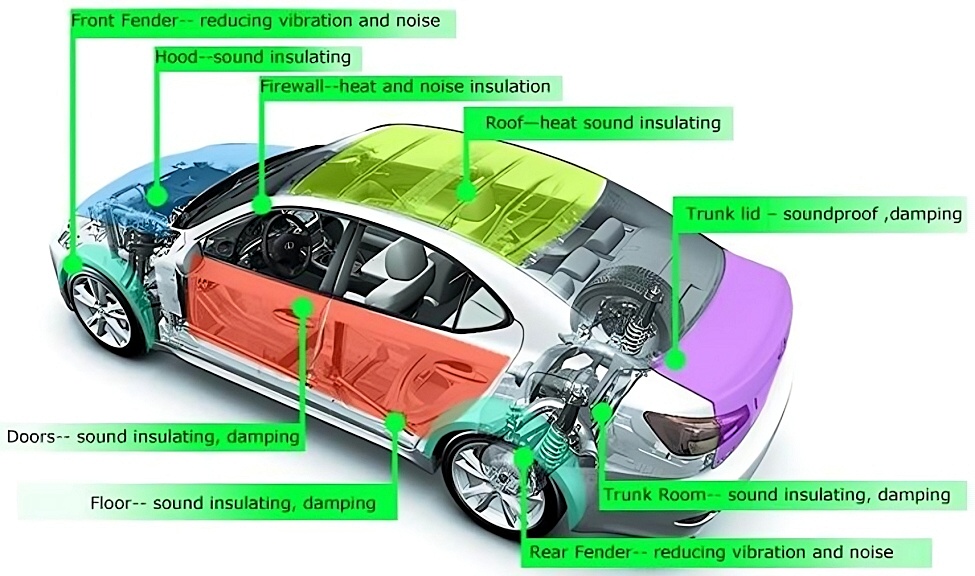
- Zones to treat such as doors, floor, roof, trunk and wheel wells
- Treated area in square feet
- Material cost per square foot and labor cost per square foot in US dollars
What the calculator returns
- Predicted cabin noise after insulation
- Delta between before and after values for quick comparison
- Total project cost for materials and labor
- Visual chart comparing before and after levels
- Audio preview buttons to hear an approximation of cabin noise before and after treatment
Key formulas and calculation logic
Noise after treatment equals initial noise minus achievable reduction
L_after = L_before − DeltaL
Total cost is material plus labor multiplied by treated area
C_total = (C_materials + C_labor) × Area_ft2
Achievable reduction is estimated from material performance and coverage fraction
DeltaL = Min( TargetReduction, MaterialMaxReduction × CoverageRatio )
Coverage ratio equals treated area divided by typical full vehicle area
CoverageRatio = TreatedArea_ft2 ÷ VehicleReferenceArea_ft2
Practical worked example in imperial units
- Initial cabin noise 75 dB
- Target reduction 15 dB
- Treated area 300 ft²
- Material cost 12 USD per ft²
- Labor cost 18 USD per ft²
Step 1, compute achievable reduction
Assume material maximum reduction 12 dB and vehicle reference area 350 ft²
CoverageRatio = 300 ÷ 350 = 0.857
DeltaL = Min(15, 12 × 0.857) = Min(15, 10.28) = 10.28 dB
Step 2, predicted noise after treatment
L_after = 75 − 10.28 = 64.72 dB
Step 3, cost calculation
Material cost = 12 × 300 = 3,600 USD
Labor cost = 18 × 300 = 5,400 USD
Total cost = 3,600 + 5,400 = 9,000 USD
Zones, materials and typical performance
| Zone | Materials | Noise reduction | Thickness, inch | Purpose |
|---|---|---|---|---|
| Doors | Butyl vibration pads, acoustic absorber, sealant | 3 to 7 dB | 0.08 to 0.20 | Reduce road and wind noise, improve speaker enclosures |
| Floor | Heavy damping, barrier mat, thermal acoustic layer | 6 to 12 dB | 0.16 to 0.39 | Block engine, drivetrain and road roar |
| Wheel wells inside | Medium density damping, liquid barrier, absorber | 4 to 9 dB | 0.12 to 0.24 | Reduce stone impact and tire noise |
| Roof | Lightweight damping, thermal acoustic mat | 3 to 6 dB | 0.08 to 0.20 | Reduce rain and wind noise, improve insulation |
| Trunk | Medium damping, isolating mats | 3 to 7 dB | 0.12 to 0.24 | Lower resonance and improve bass quality |
| Hood | Thermal barrier and absorber | 2 to 4 dB | 0.16 to 0.47 | Reduce engine noise and heat transfer |
| Outer wheel wells | Stone guard, liquid spray, top coat | 2 to 5 dB | 0.04 to 0.12 per layer | Shield against stone impact and spray noise |
| Firewall shield | High density damping, thermal mat | 5 to 10 | 0.20 to 0.47 | Barrier for engine noise and heat |
| Trim panels | Absorbing foam, sealers | 1 to 3 | 0.20 to 0.39 | Reduce rattles and high frequency noise |
Installation guidance and best practice
- Surface preparation matters. Clean, dry and degreased metal ensures adhesion and long life
- Always apply damping material first, then absorber layers to manage vibration and airborne noise
- Roll materials firmly to avoid trapped air and moisture pockets that reduce effectiveness and cause corrosion
- Keep access to service points such as window regulators and door mechanisms
- Balance weight concerns. Use lighter materials on roof areas to preserve center of gravity
How to interpret results and calibration tips
- Decibel reductions are logarithmic. A drop of three decibels halved sound energy but feels less dramatic to the ear
- Combine treatments for greatest effect. Door plus floor work gives more benefit than either zone alone
- Calibrate the model with a short measured run. Use a smartphone or data logger to log before and after and adjust material performance values
- Account for ambient factors such as tire type, road surface and vehicle load when comparing runs

Limitations and realistic expectations
- Model estimates do not replace laboratory tests or professional acoustic consulting
- Results depend on workmanship, materials and vehicle specific resonances
- Some low frequency noise may require structural changes or heavy mass loading to alter significantly
Well designed sound insulation improves comfort, reduces fatigue and enhances audio quality. Use this calculator to get realistic cost and performance estimates and to plan an effective treatment strategy for your vehicle.
Recommended reading
- Car Audio for Dummies, by Alan R. Steinfeld
- Noise Control: From Concept to Application, by Colin H. Hansen
- Automotive Noise and Vibration: Practical Issues, by Sang-Il Park
- Sound System Engineering, by Don Davis and Carolyn Davis

David Parry — Senior Engineering Analyst
Specializing in electronics and physics-based simulations with 20+ years of engineering experience. David ensures the mathematical and physical accuracy of the tools at ProCalcLab.


