Mastering complex angles and uneven shapes is a daily reality in construction, landscaping, and custom woodworking. A trapezoid, a four-sided flat shape with at least one pair of parallel sides, appears constantly in architectural designs. Hipped roofs, bay windows, garden planters, and custom staircases all rely on accurate trapezoidal geometry. Calculating the exact area, perimeter, and leg lengths manually leaves room for costly material errors. This interactive calculator eliminates the guesswork, providing instant visual feedback and exact measurements down to fractions of a unit.



Table of Contents
How the Calculator Works
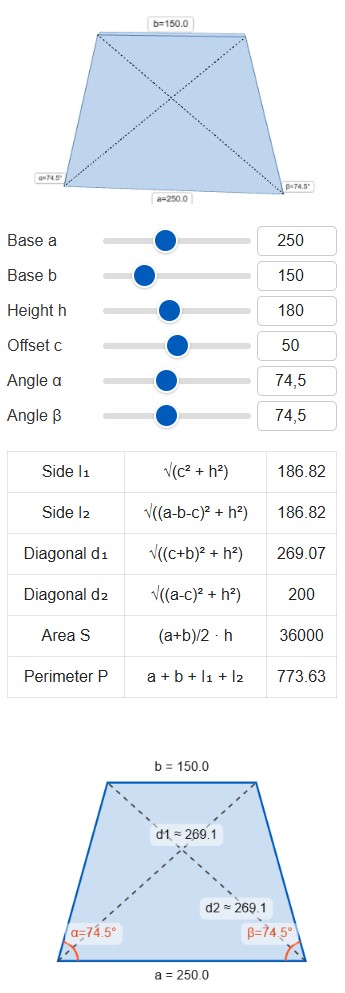
The tool is designed for speed and visual accuracy. It features two primary visualization areas: a flat two-dimensional draft and a dynamic three-dimensional model. These visual aids update in real-time as the input parameters change. The interface relies on sliders and manual text fields, allowing for broad estimations or exact pinpoint measurements.
Input Parameters
The system requires basic dimensional data to construct the shape. All inputs support decimal values down to a tenth of a unit, ensuring precise material planning.
- Base a: The bottom horizontal parallel side. This is typically the longest dimension in standard architectural applications like the bottom edge of a roof plane.
- Base b: The top horizontal parallel side.
- Height h: The vertical distance strictly between the two parallel bases. This is a perpendicular drop, not the length of the slanted sides.
- Offset c: This determines the horizontal shift of the top base relative to the bottom base. A zero offset aligns the left edge of both bases, creating a right trapezoid. A positive or negative value shifts the top line left or right, altering the slant of the side legs.
- Angle α and Angle β: The internal bottom angles. Adjusting these automatically recalculates the offset and base lengths to maintain a closed geometric shape.
Reading the Visual Output
The lower canvas provides a traditional blueprint-style view. It displays the primary dimensions, diagonal lengths, and corner angles. The dashed lines represent the diagonals intersecting across the shape. The upper 3D view offers a spatial understanding of the shape, rendering a solid object with a transparent green fill and solid borders. The 3D model can be rotated using a mouse or touchscreen to inspect the geometry from any perspective.
Practical Application
✍ Consider framing a custom bay window bench seat. The space requires a trapezoidal plywood base. The back wall measures 65 inches long. The front edge needs to be 40 inches long. The depth of the bench seat is 22 inches straight back from the front edge to the wall. The design requires the bench to be perfectly centered, meaning it is an isosceles trapezoid.
Set the parameters as follows:
- Base a: 65 inches
- Base b: 40 inches
- Height h: 22 inches
To make it perfectly centered, calculate the offset. The difference between the bases is 25 inches. Divide this by two to get 12.5 inches. Set the Offset c to 12.5. The calculator instantly processes the rest of the geometry.
📝 The output reveals the side leg lengths are exactly 25.3 inches. The total perimeter is 155.6 inches. The surface area is 1155 square inches. Dividing the area by 144 converts this to roughly 8 square feet of plywood required. This exact leg measurement determines the cut length for the edge banding or framing lumber.
Essential Formulas for Reference
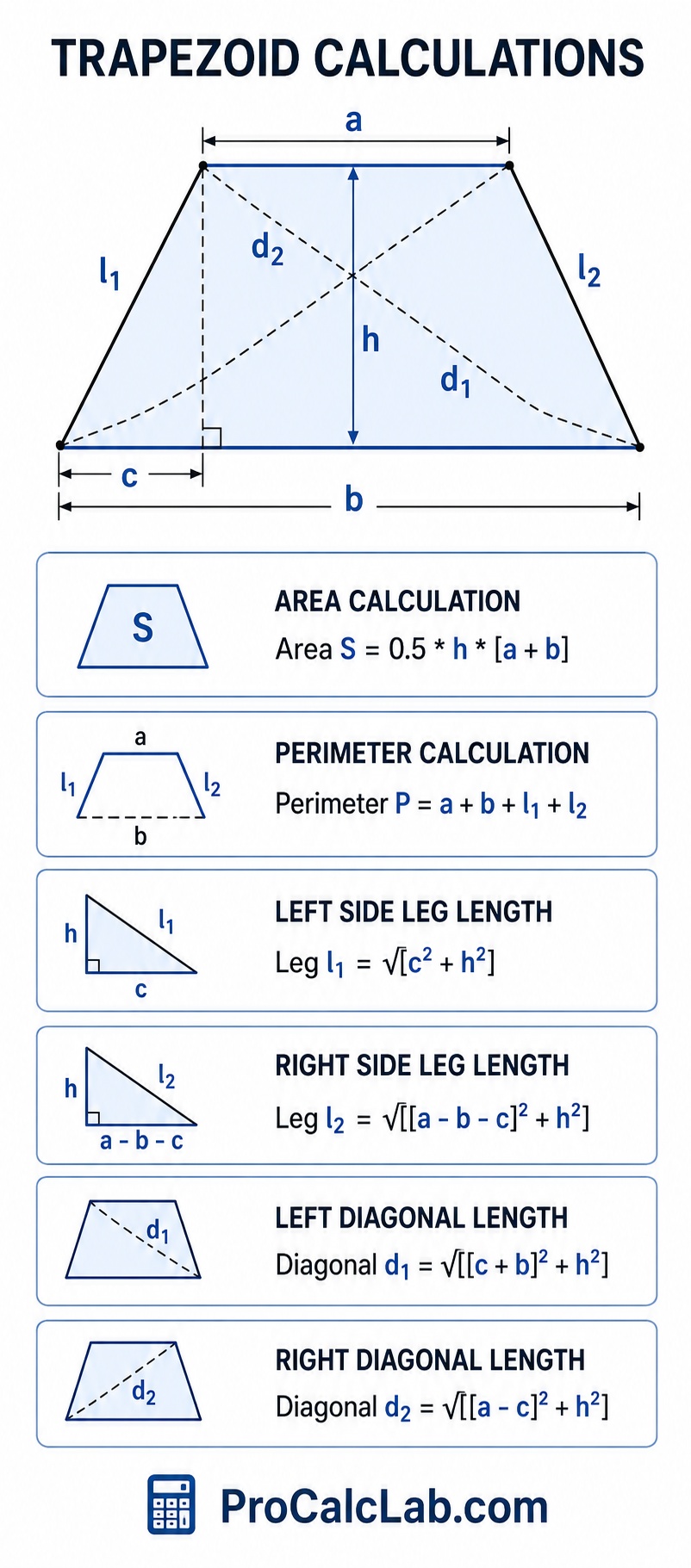
While the tool handles the heavy lifting, understanding the core math is crucial for field verification. The mathematical relationships rely on basic trigonometry and the Pythagorean theorem. Here are the core equations formatted for plain text reading.
Area Calculation:
Area S = 0.5 * h * [a + b]
Perimeter Calculation:
Perimeter P = a + b + l1 + l2
Left Side Leg Length:
Leg l1 = √[c2 + h2]
Right Side Leg Length:
Leg l2 = √[[a – b – c]2 + h2]
Left Diagonal Length:
Diagonal d1 = √[[c + b]2 + h2]
Right Diagonal Length:
Diagonal d2 = √[[a – c]2 + h2]
Reference Tables for Construction
Standardized angles and dimensions frequently appear in building projects. The following reference tables provide quick lookups for typical scenarios.
Table 1: Roof Pitch to Angle Conversion
Roofers rarely use degrees in the field; they use pitch ratios. This table correlates standard roof pitches with their corresponding internal base angle for trapezoidal hipped roof sections.
| Pitch Ratio | Decimal Slope | Angle in Degrees |
|---|---|---|
| 2 in 12 | 0.167 | 9.5° |
| 3 in 12 | 0.250 | 14.0° |
| 4 in 12 | 0.333 | 18.4° |
| 5 in 12 | 0.417 | 22.6° |
| 6 in 12 | 0.500 | 26.6° |
| 7 in 12 | 0.583 | 30.3° |
| 8 in 12 | 0.667 | 33.7° |
| 9 in 12 | 0.750 | 36.9° |
| 10 in 12 | 0.833 | 39.8° |
| 12 in 12 | 1.000 | 45.0° |
| 14 in 12 | 1.167 | 49.4° |
| 16 in 12 | 1.333 | 53.1° |
Table 2: Common Landscape Planter Dimensions
Raised garden beds often utilize angled sides for better soil heat retention and aesthetics. These dimensions reflect standard lumber cuts to minimize waste.
| Planter Type | Base Length a | Base Length b | Height h | Offset c |
|---|---|---|---|---|
| Small Hexagon Segment | 24 in | 12 in | 10.4 in | 6 in |
| Medium Flared Box | 48 in | 36 in | 18 in | 6 in |
| Large Corner Unit | 72 in | 48 in | 24 in | 12 in |
| Long Walkway Border | 96 in | 84 in | 12 in | 6 in |
| Square Tapered Tier 1 | 36 in | 24 in | 16 in | 6 in |
| Square Tapered Tier 2 | 24 in | 16 in | 16 in | 4 in |
| Square Tapered Tier 3 | 16 in | 10 in | 16 in | 3 in |
| Angled Retaining Wall Base | 120 in | 100 in | 36 in | 10 in |
| Deck Bench Section | 60 in | 45 in | 18 in | 7.5 in |
| Octagonal Tree Surround | 30 in | 15.5 in | 17.5 in | 7.25 in |
Table 3: Multiplier for Angled Cuts
When cutting siding or flooring to fit a trapezoidal space, the linear foot measurement must be multiplied by a waste factor based on the severity of the angle. A sharper angle generates more offcut waste.
| Base Angle α | Waste Multiplier |
|---|---|
| 85° – 89° | 1.02 |
| 80° – 84° | 1.05 |
| 75° – 79° | 1.08 |
| 70° – 74° | 1.12 |
| 65° – 69° | 1.15 |
| 60° – 64° | 1.20 |
| 55° – 59° | 1.25 |
| 50° – 54° | 1.30 |
| 45° – 49° | 1.35 |
| 40° – 44° | 1.45 |
| 35° – 39° | 1.55 |
| 30° – 34° | 1.70 |
Managing the Export Function
Fieldwork requires documentation. After dialing in the correct parameters, the tool provides a download feature. Activating the export button triggers a high-resolution snapshot of the entire calculation box, including the 3D model state, the 2D schematic, and the full result table. This PNG file can be attached to project estimates, emailed to clients, or printed for the workshop wall. The rendering process temporarily disables the interface for a fraction of a second to ensure a clean capture.
Advanced Scenarios: The Scalene Trapezoid
Most common designs use isosceles trapezoids where both left and right sides match. However, stairs wrapping around a non-square corner or roofs intersecting odd lot lines create scalene trapezoids. Here, the offset value becomes critical. Shifting the offset dramatically towards one side will eventually align the top base vertically with the bottom base edge, creating a perfect 90-degree corner on one side resulting in a right trapezoid. Pushing the offset further pushes the top base past the bottom base boundary, creating an obtuse angle. The calculator handles these extreme inputs flawlessly, immediately reflecting the structural reality in the visual outputs and updating the diagonal span requirements.
Bibliography and Reference Materials
- Chudley, R., Greeno, R. Building Construction Handbook. 12th Edition. Routledge, 2020.
- Spence, W. P. Construction Materials, Methods and Techniques. 4th Edition. Cengage Learning, 2016.
- Katz, G. The Roof Framer’s Bible. 3rd Edition. K P E, 2003.
- Marshall, P. Carpentry and Joinery. 3rd Edition. Routledge, 2013.
- Bland, Martin. Practical Mathematics for Construction. McGraw-Hill, 2018.

Markus Fletcher — Structural Design Specialist
Expert in structural integrity, 3D modeling, and applied mathematics. Markus focuses on creating precise tools for construction professionals and DIY engineers.