| Frame Tubing | — |
| Infill Material | — |
| Frame Cost | — |
| Infill Cost | — |
| Total Materials | — |
Planning a property upgrade used to involve messy sketches, confusing math, and a lot of guesswork. Today, technology makes it possible to see your project before a single post is dug into the ground. A well-designed gate serves two main purposes: security and curb appeal. Whether you want a simple walking entrance or a massive driveway slider, using a 3D estimator ensures you get the proportions and the budget right from the start. This guide explains how to use the latest digital tools to plan your project and provides the essential data every homeowner needs to know.



Table of Contents
Why Use a 3D Estimator for Your Project
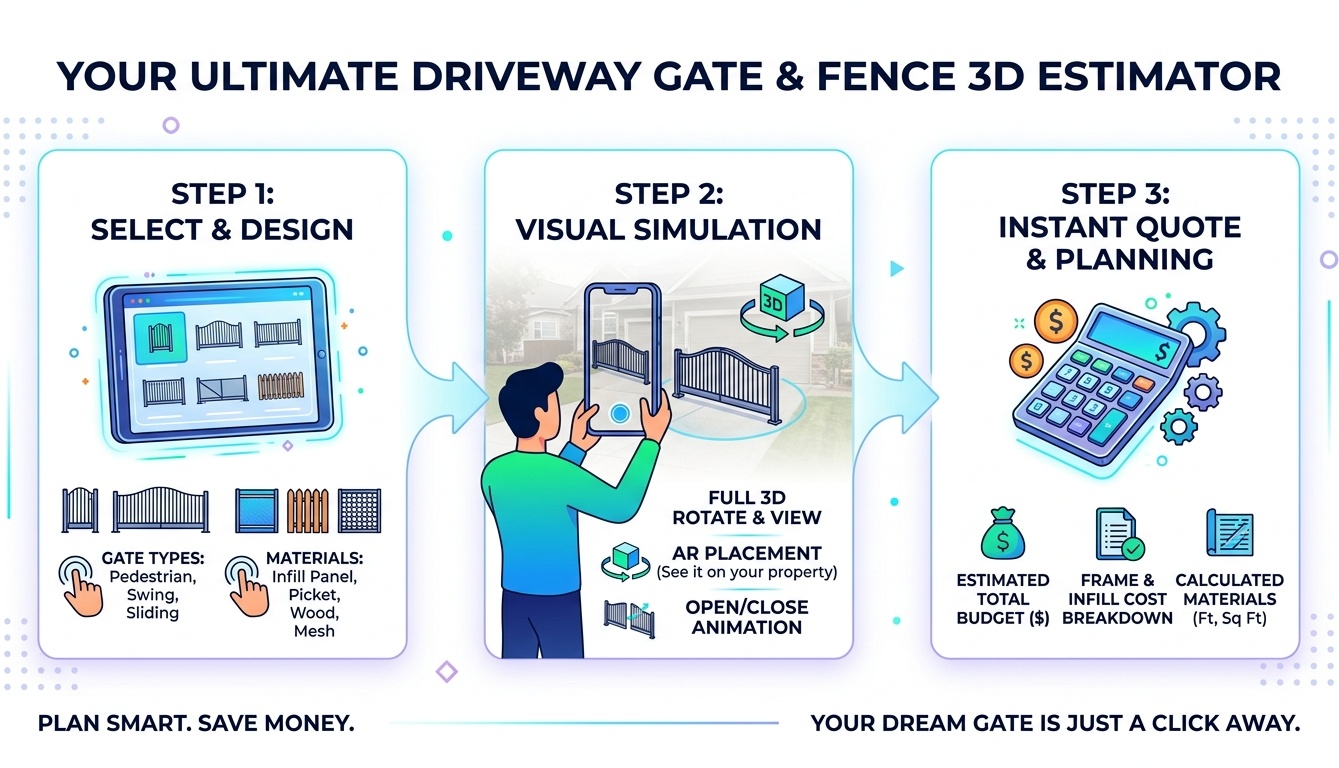
Most people struggle to visualize how different materials look at a specific scale. A 6 ft high fence looks very different when it is 4 ft wide versus 12 ft wide. The 3D estimator removes the mystery by creating a digital twin of your gate. You can swap materials like steel panels, wooden boards, or chain link mesh instantly. This prevents expensive mistakes where you order materials that do not match the style of your home. Additionally, the AR view allows you to place the digital gate directly on your driveway using a smartphone camera. This lets you check if the gate height blocks a window view or if the width is sufficient for your truck.
Choosing the Right Gate Type
The first step in the estimator is selecting the mechanical style of the gate. This decision depends mostly on your available space and how you plan to use the entrance.
Pedestrian Gates
Often called walk-through gates, these are small and designed for people, bikes, or lawnmowers. They usually range from 36 to 48 inches in width. These are the simplest to install because they only require 2 sturdy posts and basic hinges. They are perfect for side yards or garden entrances.


Swing Gates
These are the classic driveway gates that open like a door. You can choose a single swing or a double swing. A double swing gate splits the width into 2 leaves, which reduces the space needed for the gate to swing inward or outward. You must ensure your driveway is flat; otherwise, the bottom of the gate might hit the ground as it opens. Swing gates are generally cheaper to maintain because they have fewer moving parts than sliding systems.

Sliding Gates
If your driveway has a steep slope or if you do not have enough depth for a swing gate, a slider is the best option. The gate moves sideways along a track or a cantilever system. This requires extra space to the side of the opening, usually 1.5 times the width of the gate itself, to accommodate the tail or the counterweight. Sliding gates are very secure and are difficult to force open, making them a top choice for high-security properties.

Selecting Infill Materials
The infill is what fills the frame of your gate. It determines your privacy level and the final weight of the structure.
- Panel (Corrugated Steel): High privacy and very durable. It blocks the wind and the view completely. It is a heavy material, so it requires strong hinges.
- Picket: The classic American look. Vertical slats with gaps between them. It allows for airflow and visibility while still defining the boundary.
- Wood: Offers a natural, warm aesthetic. Wood requires more maintenance, such as staining or sealing every 2 years to prevent rot.
- Mesh: Best for security without blocking the view. It is lightweight and budget-friendly. Modern mesh is often coated in green or black for a cleaner look.
Planning and Measurements
Accuracy is the most important part of using the estimator. You should measure the opening between your existing posts or the total distance where the new posts will go. Always measure at the top and the bottom of the opening to check if the area is level. If one side is higher than the other, you might need to adjust your gate height to clear the ground. Most residential gates are 4 ft, 5 ft, or 6 ft tall. Driveway gates for cars should be at least 10 ft wide, while 12 ft is better for larger SUVs and 14 ft is recommended for trailers or emergency vehicles.
Understanding the Costs
The total price of a gate is split between the frame and the infill. The frame is the “skeleton” made of steel or aluminum tubing. It provides the strength. The infill is the “skin.” In the estimator, you can adjust the price per foot for the frame and the price per square foot for the infill. This allows you to see how choosing a cheaper material for the skin can save you hundreds of dollars even if you keep a heavy-duty frame.
Standard Sizes and Use Cases
Below is a table showing the most common gate configurations used in residential projects across the United States.
| Project Type | St. Width, ft | St. Height, ft | Best Material | Typical Opening Style |
|---|---|---|---|---|
| Garden Walkway | 3 | 4 | Picket or Wood | Single Swing |
| Side Yard Access | 4 | 6 | Panel or Wood | Single Swing |
| Small Driveway | 10 | 5 | Mesh or Steel | Double Swing |
| Standard Driveway | 12 | 6 | Panel or Picket | Double Swing |
| Large Property | 14 | 6 | Steel | Sliding |
| Commercial Entry | 16 | 7 | Mesh | Sliding |
| Utility Access | 12 | 4 | Mesh | Double Swing |
| Pool Safety | 4 | 5 | Picket | Self-Closing Swing |
| Privacy Barrier | 10 | 8 | Panel | Sliding |
Material Comparison and Durability
Choosing a material involves balancing the initial cost against long-term maintenance. This table compares the four main types of infill available in the tool.
| Material | Cost Level | Lifespan, Years | Maintenance Needed | Privacy Level |
|---|---|---|---|---|
| Steel Panel | Medium | 25 | Very Low (Cleaning) | 100% |
| Wood Boards | High | 10-15 | High (Staining) | 90-100% |
| Steel Pickets | Medium | 20 | Low (Paint touch-ups) | 30-50% |
| Chain Link Mesh | Low | 30 | None | 10% |
| Aluminum Panel | Very High | 40 | None | 100% |
| Vinyl Pickets | Medium | 20 | Low (Cleaning) | 40% |
Simple Formulas for Calculation
You can verify the estimator’s results using these basic formulas. All dimensions should be converted to feet before calculating the final price.
1. Calculating Square Footage for Infill:
Area = Width x Height
Example: 12 ft wide gate x 6 ft high gate = 72 sq. ft of material.
2. Calculating Number of Pickets:
Number of Pickets = Total Gate Width / (Picket Width + Gap Width)
Example: If the gate is 48 inches wide, the picket is 4 inches wide, and the gap is 2 inches: 48 / (4 + 2) = 8 pickets.
3. Estimating Frame Tubing Length:
For a basic rectangular frame: (Width x 2) + (Height x 2) + (Diagonal Support Length)
Practical Example: A Double Swing Driveway Gate
Let’s look at a common scenario for an American suburban home. The owner wants a double swing gate for a driveway that is 160 inches wide. They want it 72 inches tall for privacy, using steel panels.
Step 1: Convert units.
Width: 160 / 12 = 13.33 ft.
Height: 72 / 12 = 6 ft.
Step 2: Calculate Area.
13.33 x 6 = 79.98 sq. ft (Round to 80 sq. ft).
Step 3: Estimate Frame.
Each leaf is 80 inches wide (6.66 ft). The frame for one leaf is roughly: (6.66 x 2) + (6 x 2) = 25.32 ft. Two leaves total roughly 51 ft of tubing, plus internal supports.
Step 4: Costs.
If the frame costs 10 dollars per foot and the panels cost 5 dollars per sq. ft:
Frame: 51 x 10 = 510 dollars.
Infill: 80 x 5 = 400 dollars.
Total Material Cost = 910 dollars.
Installation and Spacing Tips
When planning, never forget the hinges and the latch. These take up space. A typical pedestrian gate needs about 0.5 to 1 inch of clearance on each side to swing freely. For heavy driveway gates, the posts must be set in concrete deep enough to get below the frost line in your area. In northern states, this might be 36 to 48 inches deep. If your posts lean even 1 degree, the gate will not meet in the middle correctly. Always use a level and allow the concrete to cure for at least 48 hours before hanging the gate leaves.
Picket Spacing Standards
The gap between pickets is a balance between safety and style. If you have a small dog, you need a narrow gap. If you want a modern look, wider gaps are popular.
| Application | Rec. Gap, in | Picket Width, in | Visibility Level |
|---|---|---|---|
| Small Pet Containment | 1.5 | 3.5 | Moderate |
| Standard Residential | 2.5 | 4 | Good |
| Modern Architectural | 4 | 2 | Very High |
| Commercial Security | 3 | 1 | High |
| Privacy Wood Fence | 0 | 5.5 | None |
| Semi-Privacy Wood | 0.5 | 5.5 | Very Low |
Final Checklist Before Ordering
Before you hit the download button on your estimate or start buying metal, go through this list to ensure your project succeeds.
- Check local HOA rules: Many neighborhoods restrict gate heights or colors.
- Locate underground utilities: Never dig post holes without calling 811 to check for gas, water, or power lines.
- Account for slope: If your driveway is not flat, a sliding gate might be easier than a swing gate.
- Post strength: A 6 inch x 6 inch steel post is standard for heavy driveway gates. Smaller 4 inch x 4 inch posts are fine for walk gates.
- Hardware choice: Ensure your hinges are rated for the weight of the gate you designed in the 3D tool.
Using a 3D estimator is the smartest way to start any fencing project. It gives you the confidence to talk to contractors or the data you need to build it yourself. By adjusting the width, height, and materials in the digital space, you can find the perfect balance between your vision and your bank account. Take your time with the measurements, experiment with the AR view, and enjoy the process of building something that will protect your home for years to come.
Reference Literature
- Standard Practice for Construction of Chain-Link Fence – ASTM International.
- Residential Code Requirements for Gates and Fences – International Code Council (ICC).
- Architectural Graphic Standards – The American Institute of Architects (AIA).
- Homeowner Guide to Fence Installation and Zoning – American Fence Association (AFA).

Markus Fletcher — Structural Design Specialist
Expert in structural integrity, 3D modeling, and applied mathematics. Markus focuses on creating precise tools for construction professionals and DIY engineers.