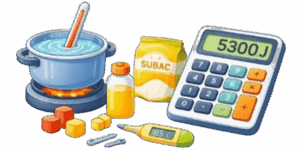
Meet heats_calc, a stripped down energy calculator that turns mass, specific heat, and temperature change into an exact energy number so you can size heaters, estimate run times, or sanity check lab data.
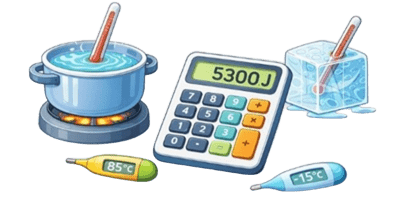

Table of Contents
How this heat calculator works
The core formula is compact and reliable
Q = m · c · ΔT
Here Q is heat in joules, m is mass, c is specific heat in J per kilogram per degree, and ΔT is temperature change final minus initial in degrees Celsius. The tool accepts mass in pounds or kilograms and temps in Fahrenheit, Celsius, or Kelvin and converts everything to SI for the math. Results are presented in joules, kilojoules or megajoules depending on scale.
Quick inputs and tips
Enter mass directly or give volume plus density and the calculator computes mass automatically. Pick units with buttons for a no-mistake workflow. If you choose Fahrenheit the calculator adjusts the temperature delta correctly so you do not have to think about unit math.
- Mass can be pounds or kilograms
- Specific heat must be in J per kg per degree
- ΔT can be input in Fahrenheit or Celsius, deltas scale automatically
- Positive Q means energy added, negative Q means energy released
Core conversions for US users
Quick conversion values to keep in your head or to check inputs:
| Unit | Conversion |
|---|---|
| 1 pound | 0.45359237 kilograms |
| 1 US gallon | 0.00378541 cubic meters |
| °F to °C | (°F − 32) × 5 / 9 |
| Joules to BTU | 1 BTU = 1,055.05585 J |
Practical examples
Example 1 — Heat 5.00 pounds of water from 68 °F to boiling
Mass 5.00 pounds is 2.26796 kilograms. Temperature 68 °F converts to 20 °C. Boiling is 212 °F which is 100 °C. Delta temperature is 80 degrees.
Q = 2.26796 × 4186 × 80 ≈ 759,495 joules which is 759.5 kilojoules. That equals about 720 BTU.
Example 2 — Thaw and warm 2.205 pounds of ice from 14 °F to 68 °F
2.205 pounds is very close to 1.000 kilogram. Heat ice from −10 °C to 0 °C uses about 21,000 J. Melting uses 334,000 J. Heating the resulting water to 20 °C uses about 83,720 J. Total is roughly 438,800 joules or 438.8 kilojoules.
Example 3 — Partially evaporate 1.102 pounds of water starting near boiling
1.102 pounds equals 0.50 kilograms. Heat the liquid a bit, vaporize, then heat the steam a bit. Combined heating and vaporization totals about 1,169,530 joules which is 1,169.5 kilojoules or about 1,108 BTU.
Common specific heats
| Material | c in J·kg⁻¹·K⁻¹ |
|---|---|
| Liquid water | 4,186 |
| Ice | 2,100 |
| Air at 20 °C | 1,005 |
| Aluminum | 900 |
| Copper | 385 |
| Steel | 460 |
| Mercury | 140 |
The display adapts by orders of magnitude so small energies read in joules and large ones show in kilojoules or megajoules. The gauge uses discrete steps to avoid confusing decimals and the numeric readout keeps two decimals for clarity.

Troubleshooting and accuracy checks
Most mistakes are avoidable. Always confirm units for mass and specific heat. If you input volume check density units. Use absolute values for energy budgets. For partial phase change or latent heat you will need the full heats_full_calc module; this simple heater calculator only handles sensible heat. For high accuracy use temperature dependent specific heats and verified property tables.
Smart practial tips
Run a short test with a known mass and a power meter to measure actual energy delivered. Compare that number to the calculator; adjust for system heat loss. When sizing heaters add a safety margin for losses and control inefficiencies. If heating a solid with a low conductivity heat the part slowly to avoid surface damage.
💡 Tip: save a reference run for each system. Comparing new runs to the reference catches unit flips and bad inputs fast.
Conclusion on using heats_calc reliably
Use heats_calc for fast, transparent energy estimates. Start with correct units, verify densities, and cross-check with a short trial. For anything beyond single-phase sensible heating move to a phase aware module or a transient heat transfer model.
Recommended books
- Thermodynamics: An Engineering Approach by Yunus A. Çengel and Michael A. Boles
- Fundamentals of Heat and Mass Transfer by Frank P. Incropera and David P. DeWitt
- Heat Transfer by J.P. Holman
- Process Heat Transfer by Kern

David Parry — Senior Engineering Analyst
Specializing in electronics and physics-based simulations with 20+ years of engineering experience. David ensures the mathematical and physical accuracy of the tools at ProCalcLab.