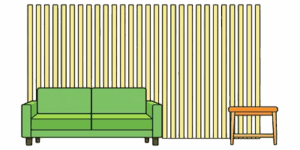
A practical online tool for planning and calculating wood slats – lamellas, for furniture fronts, partitions, and decorative wall panels. It quickly determines the number of slats, material usage, volume, weight, and estimated cost. A drawing and 3D preview are generated for better visualization. Useful for carpenters, cabinetmakers, interior designers, and DIY home projects.



Table of Contents
How to Use
- Select the slat orientation: vertical (along panel height) or horizontal (along width).
- Enter the panel or wall dimensions — width and height in meters.
- Provide slat parameters: width and thickness in mm, available slat length in meters.
- Set the gap between slats and add a waste percentage for cutting and defects.
- Click “Calculate.” Results include covered area, number of slats, actual boards required, total volume, weight, and estimated price.
- View both a 2D layout with spacing and a 3D visualization.

Calculation Formulas
Volume of a single slat (m³):
$$V_{\text{slat}} = \frac{t_{mm} \cdot w_{mm} \cdot L_{mm}}{10^{9}}$$
where \(t\) = thickness in mm, \(w\) = width in mm, \(L\) = length in mm.
If slats run vertically, the number of slats fitting across the width:
$$N = \left\lfloor\frac{W_{\text{panel}} + \Delta}{w + s}\right\rfloor$$
where \(W_{\text{panel}}\) = panel width (m), \(w\) = slat width (m), \(s\) = gap (m), \(\Delta\) = edge adjustment.
Required segments per slat:
$$\text{segments} = \left\lceil \frac{L_{\text{needed}}}{L_{\text{available}}} \right\rceil$$
Total volume:
$$V_{\text{total}} = V_{\text{slat}} \cdot N$$
Weight with moisture W (%):
$$m = V_{\text{total}} \cdot \rho \cdot \left(1 + \frac{W}{100}\right)$$
Cost (if price given per m²):
$$P = A_{\text{cover}} \cdot (1 + \frac{\text{waste\%}}{100}) \cdot C_{\text{m²}}$$
Useful exact coefficients
- 1 inch = 25.4 mm
- 1 foot = 0.3048 m
- 1 sq ft = 0.09290304 m²
- 1 ft³ = 0.028316846592 m³
- 1 board-foot = 144 in³ = 0.002359737216 m³
- 1 lb = 0.45359237 kg
- 1 lb/ft³ = 16.01846337396 kg/m³
Technical Notes
Slats are narrow boards widely used in joinery and decorative cladding. Important considerations:
- Spacing (slat width + gap) defines total slat count.
- Available stock length affects cuts and joints.
- Add cutting allowance (5–15%).
- Density and moisture change overall weight and deformation risk.
Density Reference Table
| Wood Species | Density | Typical Use |
|---|---|---|
| Pine | 500 kg/m³ | Partitions, cladding |
| Spruce | 430 kg/m³ | Light panels |
| Larch | 480 kg/m³ | Exterior work |
| Oak | 680 kg/m³ | Durable decorative panels |
Standard Slat Dimensions
| Parameter | Common Values |
|---|---|
| Width | 20 – 140 mm (40, 60, 90, 100 mm common) |
| Thickness | 6 – 24 mm (12, 16, 18 mm typical) |
| Length | 2, 2.5, 3, 4 m |
Practical Tips
- Switching between vertical and horizontal orientation only changes slat length, not panel size.
- For smooth 3D previews, limit visualization to ~20 slats (calculation remains exact).
- Always confirm real stock dimensions and finishing details before purchase.
- Acclimatize wood indoors for 24h before installation to reduce warping.
- Use sharp carbide tools for cutting — cleaner edges, less waste.
- Pick suitable fasteners: concealed screws for decor, heavy-duty anchors for load-bearing cases.
- Sand edges and test coatings on scrap pieces before applying finish to the whole surface.
References
- Hoadley, R. B. Understanding Wood: A Craftsman’s Guide to Wood Technology. Taunton Press, 2000.
- Allen, E. & Iano, J. Fundamentals of Building Construction: Materials and Methods. Wiley, 2019.
- Ching, F. D. K. Building Construction Illustrated. Wiley, 2020.
- Walker, J. C. F. Primary Wood Processing: Principles and Practice. Springer, 2006.

Markus Fletcher — Structural Design Specialist
Expert in structural integrity, 3D modeling, and applied mathematics. Markus focuses on creating precise tools for construction professionals and DIY engineers.