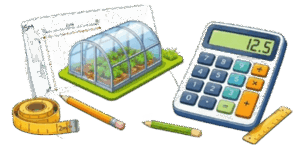
This online tool gives fast, usable numbers for a DIY greenhouse. Tell it the dimensions, pick a roof style and pipe profile, enter material prices, and it returns area, volume, how many frame pieces you need, approximate metal weight and a cost estimate. Everything updates visually in the 3D view so you can judge geometry and access at a glance.


Table of Contents
Why use this calculator
- Estimate usable floor area and total cover area quickly
- Calculate how many linear feet of profile pipe you need
- Get a rough mass for the metal frame to check foundations
- Find how many cover panels to buy and the approximate cost
- Export a drawing and a 3D view for sharing with a fabricator or your contractor
What you enter
- Basic geometry: overall length and width in feet and the total ridge height in feet.
- Frame spacing: set the spacing between frames along the length.
- Roof type: choose from arched, single slope, gable, or A-frame.
- Profile selection: cross section dimensions of the tube in inches and wall thickness in inches.
- Material prices: cost per linear foot for pipe and cost per square foot for covering.
- Hit calculate and the model, drawing and summary update instantly.
Immediate outputs
- Usable floor area in square feet and the base perimeter in feet
- Greenhouse internal volume in cubic feet
- Number of frames and the length of one frame
- Total linear feet of profile broken down by arcs, purlins and uprights
- Estimated weight of the metal frame in pounds
- Count of cover panels and total cover area in square feet
- Quick material cost estimate based on your prices
Which roof shape to pick
Choice depends on site, snow and wind loads and how you plan to use the space. Arched roofs shed snow well and distribute loads evenly. Gable roofs are traditional and simplify doors, vents and ridge ventilation. Single slope roofs are excellent when attaching to a wall or when space is limited. A-frame designs give high stiffness with simple repeated parts. Try alternate shapes in the tool to compare material and labor trade offs.

Quick how-to for inputs
- Length and width are the external working dimensions. Use the footprint you can dedicate to the greenhouse.
- Ridge height is the highest point. Wall height is the straight vertical portion before the curve or slope starts.
- Frame spacing controls how many arches or frames you get along the length. Tighter spacing increases stiffness and material use.
- Pipe selection affects mass and cost directly. Thicker wall thickness increases strength but also weight and price.
- Cover panel size helps calculate how many sheets to buy. Always allow cutting waste.
Practical guidelines and recommendations
- Check local snow and wind loads. If you expect heavy snow, increase arch radius, tighten frame spacing and use a stronger profile.
- Allow a 5 to 10 percent material waste factor for cuts and mistakes.
- If you plan on permanent use, invest in thicker-walled profile and a quality covering. It pays off in longevity.
- Position the greenhouse to maximize sun exposure during the critical growing months.
- Think logistics: wide doors and a small working threshold simplify moving heavy planters and equipment.

Reference sizes and quick tables
Typical greenhouse size ranges
| Type | Typical width | Ridge height | Suggested frame spacing |
|---|---|---|---|
| Compact hoop | 6.6–9.8 ft | 5.9–7.2 ft | 16–24 in |
| Standard hoop | 9.8–13.1 ft | 7.2–8.5 ft | 20–28 in |
| Gable | 9.8–19.7 ft | 6.6–9.8 ft | 24–40 in |
| Lean-to | 6.6–19.7 ft | 5.9–9.8 ft | 24–40 in |
| A-frame | 6.6–16.4 ft | 6.6–9.8 ft | 24–40 in |
Profile examples and approximate mass per foot
| Profile | Wall thickness | Section area | Approx mass |
|---|---|---|---|
| 1.6 × 0.8 in | 0.08 in | 224 mm² equivalent | 1.18 lb/ft |
| 2.4 × 1.6 in | 0.10 in | 475 mm² equivalent | 2.51 lb/ft |
| 0.8 × 0.8 in | 0.06 in | 111 mm² equivalent | 0.58 lb/ft |
Typical cover panels
| Panel type | Sheet size | Area per sheet | Note |
|---|---|---|---|
| Multiwall polycarbonate | 6.6 × 3.4 ft | 22.4 ft² | Common standard sheet |
| Solid polycarbonate | 6.6 × 3.3 ft | 21.8 ft² | Good for large spans |
| Tempered glass | 4.9 × 3.3 ft | 16.2 ft² | Needs stronger frame |
Key formulas used
- Floor area S equals length times width
- Perimeter P equals two times length plus two times width
- Number of frames N equals floor(length divided by frame spacing) plus one
- Arc length for a hoop uses the segment radius found from rise and chord then arc length equals radius times central angle
- Rafter length for gable equals square root of half width squared plus rise squared
- Total profile length equals frames length times number of frames plus purlins times greenhouse length plus sum of uprights
- Estimated metal mass equals total profile length times section area times steel density then convert to pounds
- Cover area equals arc length times greenhouse length for hoops or two times rafter length times length for gable
📝 Example: a hoop greenhouse 30 ft long and 12 ft wide, ridge height 8 ft, frame spacing every 2 ft and using 1.6 × 0.8 inch pipe. The calculator computes arc length per frame, number of frames, total pipe length, approximate metal weight and number of 6.6 × 3.4 foot polycarbonate sheets needed. Use the tool and enter your local prices to get the cost estimate immediately.
Site preparation and foundations
Pick a flat, well drained location with full sun. A simple perimeter foundation of compacted gravel or a shallow concrete strip keeps the frame stable and away from wet soil. In frost-susceptible areas use a frost-resistant shallow footing or driven anchors. Always slope the site slightly or add drains so water runs away from the greenhouse base.
✍ Film is cheap and lightweight but needs frequent replacement. Multiwall polycarbonate gives insulation, impact resistance and a long service life. Glass delivers the best light quality but increases weight and cost. Choose cover based on budget and how long you want the structure to last.
Ventilation and microclimate control
Natural ventilation works by using ridge vents and side vents. For larger or commercial setups mechanical fans with thermostatic control are better. Consider zoned ventilation so different beds can run different microclimates.
Design internal aisles for access and irrigation. Use raised benches for good drainage and easy work. Leave room to move wheelbarrows and tools. Plan storage close to the entrance to minimize trips.
Maintenance recommendations
- Inspect fasteners, seals and the frame at least once a season
- Clean cover panels annually to maintain light transmission
- Remove heavy snow quickly if the frame rating is marginal
- Replace weathered seal tape and re-secure loose purlins
Final note
This planner produces quick, actionable numbers for budgeting and basic build planning. It is not a substitute for an engineered design when heavy loads, wide spans or local code compliance are required. Use the output as a working estimate, iterate with different spacing and profiles, then share the drawing and 3D view with a professional for final checks.
Recommended reading
- Design of Steel Structures by Edwin Gaylord for structural basics
- The Year-Round Solar Greenhouse by Lindsay and Wallace for growing tips and passive heating
- Greenhouse Engineering by Gong Chun for detailed technical guidance
- Build Your Own Greenhouse by Roger Marshall for practical DIY plans

Markus Fletcher — Structural Design Specialist
Expert in structural integrity, 3D modeling, and applied mathematics. Markus focuses on creating precise tools for construction professionals and DIY engineers.