
Accurate material estimation is the backbone of any successful physical project. Whether planning a custom piece of furniture, fabricating a metal frame, or pouring concrete structures, knowing the exact weight and volume of the materials prevents costly mistakes. Overestimating leads to wasted budget on excess supplies. Underestimating brings work to a grinding halt. A reliable 3D assembly weight and volume estimator removes the guesswork from this process.



This tool is designed for practical workshop use. It calculates the physical properties of a project consisting of multiple distinct parts. Instead of running complex math on scrap paper, the estimator visualizes the components, computes their individual metrics, and aggregates the final numbers needed for purchasing and logistics.
Table of Contents
How to Use the Estimator
The interface is built for speed and clarity. No complex CAD software knowledge is required to get precise numbers. The workflow consists of a few straightforward steps.
- Select the Unit System: Start by choosing either Imperial or Metric units using the toggle at the top. This global setting adjusts all inputs, outputs, and standard densities instantly.
- Add Components: Use the quick-add buttons to insert basic geometric shapes into the project space. Choose from cubes, cylinders, or spheres based on the closest match to the real-world parts.
- Adjust Dimensions: Each added part features dedicated sliders and input boxes. Modify the width, height, depth, or diameter. The 3D viewer updates in real time to reflect these changes.
- Set Material Density: Input the specific density of the material being used. The reference tables provided further down in this guide offer standard values for common materials.
- Specify Quantity and Price: If a project requires four identical steel legs, simply adjust the quantity slider to four. Enter the price per unit to automatically calculate the total project cost.
- Review the Blueprint and Results: A dynamically generated SVG blueprint provides a clear flat-view schematic. The results table breaks down the volume, mass, and cost per individual item and the total batch.
- Export Data: Use the download function to save a visual copy of the setup and results for reference at the hardware store or workshop.
Basic Volume Formulas
While the software handles all the heavy lifting, understanding the core math ensures greater confidence in the results. Below are the basic formulas used to determine the volume of standard geometric shapes. Measurements must always be in the same unit before calculating.
Rectangular Prism (Cube, Board, Sheet)
Volume = Length × Width × Height
V = L × W × H
Cylinder (Pipe, Rod, Round Post)
Volume = Pi × Radius Squared × Height
V = π × r2 × h
Note: Radius is exactly half of the diameter. π is approximately 3.14.
Sphere (Ball, Globe)
Volume = 4/3 × Pi × Radius Cubed
V = 1.33 × π × r3
Total Project Mass
Total Mass = Volume × Material Density
M = V × D
Material Density Reference Guide
Density is the crucial variable in weight estimation. It dictates how heavy a specific volume of material will be. The tables below provide average density values for a wide variety of common materials. Natural materials like wood exhibit slight variations depending on moisture content and exact species, but these rounded numbers are perfectly suited for practical project estimation.
Wood Species
Lumber weights can vary based on kiln-drying processes. The values below represent standard dry lumber.
| Material | Density, lbs/ft3 | Density, kg/m3 |
|---|---|---|
| Balsa | 10 | 160 |
| Cedar, Red | 23 | 370 |
| Pine, White | 25 | 400 |
| Spruce | 28 | 450 |
| Poplar | 30 | 480 |
| Mahogany | 34 | 540 |
| Cherry | 35 | 560 |
| Walnut | 40 | 640 |
| Oak, Red | 44 | 700 |
| Maple, Hard | 45 | 720 |
| Birch | 46 | 740 |
| Teak | 49 | 780 |
| Hickory | 50 | 800 |
| MDF Panel | 48 | 750 |
| Plywood | 36 | 580 |
Metals and Alloys
Metals have highly consistent densities. Knowing the exact alloy provides extreme precision, but generic categories work perfectly for general fabrication estimates.
| Material | Density, lbs/ft3 | Density, kg/m3 |
|---|---|---|
| Magnesium | 108 | 1730 |
| Aluminum | 169 | 2700 |
| Titanium | 281 | 4500 |
| Zinc | 445 | 7130 |
| Cast Iron | 450 | 7200 |
| Steel, Carbon | 490 | 7850 |
| Steel, Stainless | 500 | 8000 |
| Brass | 530 | 8500 |
| Bronze | 548 | 8780 |
| Copper | 559 | 8940 |
| Lead | 708 | 11340 |
| Gold | 1206 | 19320 |
Plastics and Polymers
Modern construction frequently involves synthetic materials. These are generally much lighter than metals but offer excellent structural integrity for their weight.
| Material | Density, lbs/ft3 | Density, kg/m3 |
|---|---|---|
| Polyurethane Foam | 2 | 35 |
| Polyethylene (HDPE) | 60 | 960 |
| ABS Plastic | 65 | 1040 |
| Nylon | 71 | 1140 |
| Acrylic (Plexiglass) | 74 | 1190 |
| Polycarbonate | 75 | 1200 |
| PVC | 86 | 1380 |
| Teflon (PTFE) | 137 | 2200 |
Masonry and Miscellaneous
For heavy landscaping or foundational projects, determining the exact mass of concrete or stone is vital to ensure structural supports can handle the load.
| Material | Density, lbs/ft3 | Density, kg/m3 |
|---|---|---|
| Water | 62.4 | 1000 |
| Ice | 57 | 916 |
| Brick, Common | 120 | 1920 |
| Concrete | 145 | 2300 |
| Glass, Window | 160 | 2580 |
| Granite / Marble | 165 | 2650 |
Practical Estimation Example
Let us walk through a real-world scenario to see how this data translates into workshop success. Imagine building a heavy-duty shop cart. The design calls for a thick wooden top platform mounted on four solid steel cylindrical legs. We will calculate this using Imperial measurements.
Part 1: The Wooden Platform
The top is a solid piece of Hard Maple. It measures 48 inches long, 24 inches wide, and 2 inches thick.
- Shape: Cube / Rectangular Prism
- Dimensions: W = 48 in, H = 2 in, D = 24 in
- Volume in cubic inches: 48 × 24 × 2 = 2304 in3
- Convert to cubic feet: 2304 / 1728 = 1.33 ft3
- Material Density: Hard Maple is roughly 45 lbs/ft3
- Weight of Platform: 1.33 ft3 × 45 lbs/ft3 = 59.85 lbs
Part 2: The Steel Legs
The cart uses four solid Carbon Steel rods for legs. Each rod is 2 inches in diameter and 30 inches tall.
- Shape: Cylinder
- Dimensions: Diameter = 2 in, Height = 30 in
- Radius: 1 inch
- Volume of one leg: 3.14 × 12 × 30 = 94.2 in3
- Convert to cubic feet: 94.2 / 1728 = 0.0545 ft3
- Material Density: Carbon Steel is roughly 490 lbs/ft3
- Weight of one leg: 0.0545 ft3 × 490 lbs/ft3 = 26.7 lbs
- Total weight for four legs: 26.7 lbs × 4 = 106.8 lbs
Total Project Metrics
By adding the components together, the total weight of the bare shop cart structure is 166.65 lbs. Knowing this is crucial. It means heavy-duty casters rated for at least 300 lbs combined load are necessary to support the cart itself plus any tools placed on it. If this manual calculation seems tedious, inputting these dimensions into the 3D tool yields the exact same results in seconds, complete with a visual model to ensure the proportions look right before buying materials.
Best Practices for Project Planning
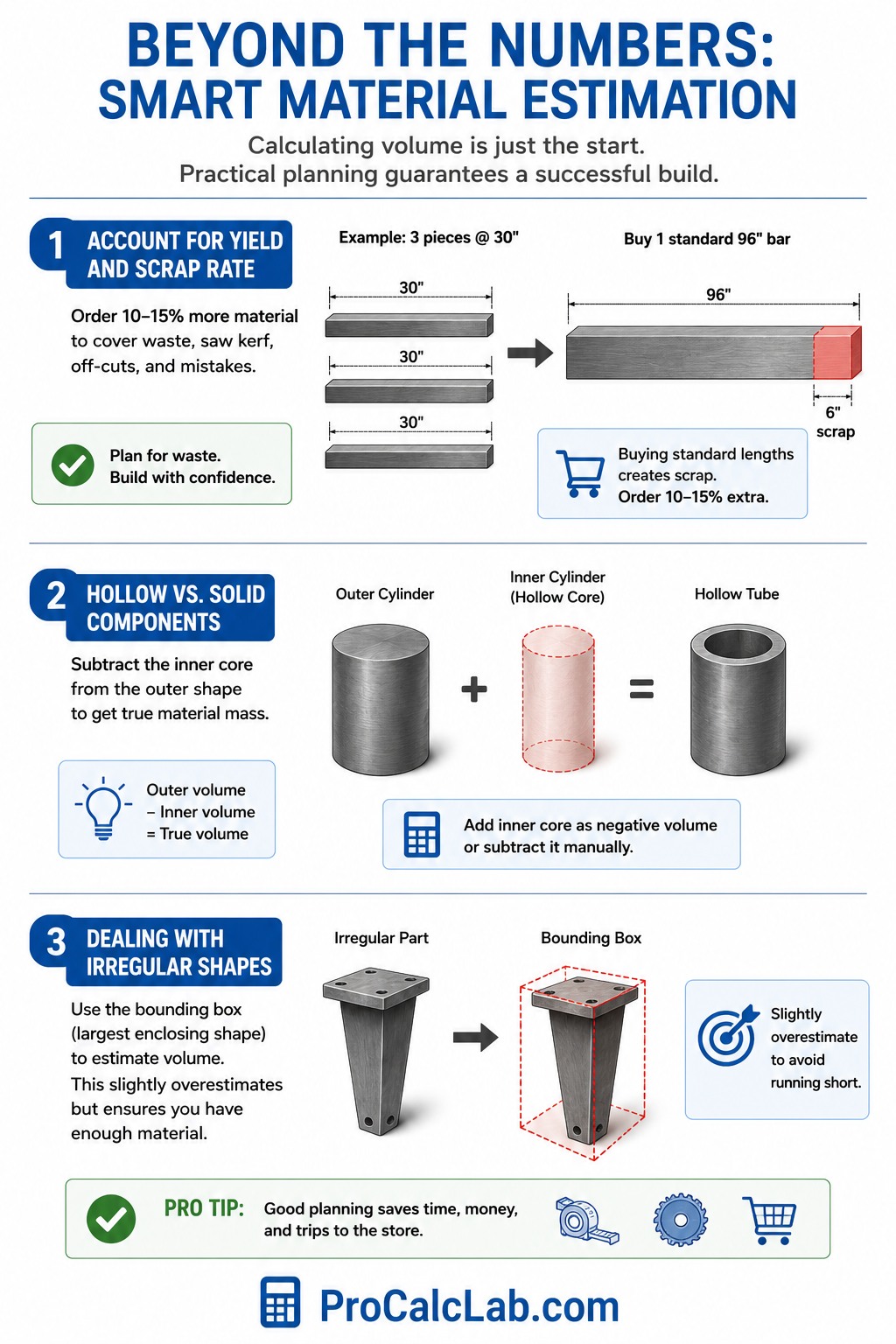
Calculating the raw mathematical volume is only the first phase of project planning. Applying practical workshop experience to those numbers guarantees success.
Account for Yield and Scrap Rate
Raw materials rarely arrive in the exact dimensions needed. Purchasing lumber or steel requires buying standard lengths. If a project requires three 30-inch steel legs, buying a single 96-inch bar leaves 6 inches of scrap. Always order 10 to 15 percent more material than the total calculated volume to account for saw kerf blade thickness, off-cuts, and inevitable mistakes during fabrication.
Hollow vs. Solid Components
The estimator assumes parts are solid blocks of material. In reality, many projects use hollow tubing or pipes to save weight and cost. To calculate hollow tubing using a solid volume tool, simply add the full solid cylinder as one part, then add a second cylinder representing the hollow empty core. Assign a negative price or simply subtract the inner core’s volume and weight from the outer solid shape manually to get the true mass of the tube.
Dealing with Irregular Shapes
Not every project component is a perfect cube or sphere. When dealing with complex geometry like tapered legs or bevel-cut panels, find the bounding box the largest rectangular shape that completely encloses the irregular part. Calculate the weight based on this maximum size. This method slightly overestimates the weight, which is always safer than underestimating when planning structural supports or shipping costs.
✍ Mastering these principles bridges the gap between digital design and real-world construction. By leveraging reliable density data and fast calculation tools, project planning becomes predictable, economical, and significantly less stressful.
References
- Wood Handbook: Wood as an Engineering Material. Forest Products Laboratory, United States Department of Agriculture.
- Machinery’s Handbook. Industrial Press Inc. Standard reference for metal properties and engineering math.
- Standard Specifications for Construction Materials. General reference for masonry and synthetic polymer densities.

Markus Fletcher — Structural Design Specialist
Expert in structural integrity, 3D modeling, and applied mathematics. Markus focuses on creating precise tools for construction professionals and DIY engineers.