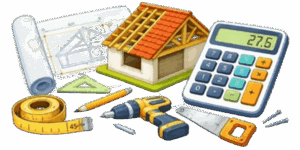
Planning a roof can feel like a headache: gable, hip, shed, flat—each has its quirks. This smart roof calculator takes your building dimensions, overhangs, slope, sheet size, wood elements, and material costs and turns them into concrete numbers ready for ordering. You get both the projected and actual roof area with slope included, plus an estimate of sheets needed with waste factor. A live 3D preview shows ridges, rafters, and hip or end details. No surprises when your crew shows up—they know exactly where extra supports or braces are required.



✍ Save time: instead of a dozen manual calculations, get ready-to-use figures and a budget table instantly. Adjust rafter spacing, sheet size, or roofing price and see new totals immediately.
Table of Contents
How the Calculator Works
The tool starts with your building geometry: length \(L\), width \(W\), overhang \(o\), and roof pitch in degrees. It calculates rafter lengths, ridge heights, and projections, then computes both actual and effective roof area. Total lengths of rafters, battens, and wall plates are derived, and the number of roofing sheets is computed with overlap considered. Costs per item are summed to give a complete material budget. Data is ready to place an order, with units in feet or meters for convenience.
- Input building length and width, overhang, and slope.
- Compute rafter geometry and ridge heights.
- Calculate actual roof area considering slope.
- Determine total rafter, batten, and wall plate lengths.
- Estimate sheet counts with overlaps and waste factor.
- Provide rough material costs based on your input prices.
- Output ready-for-order quantities with total cost.
Before ordering, check delivery logistics: pallet size, lifting access, and sequence of delivery so heavy elements arrive first, fragile sheets last. Improper delivery sequence can turn extra stock into damaged materials. Coordinate with your crew for temporary storage and unpacking plans.
📐 On-site measurements are critical: even a 0.5–1 inch shift in wall length or facade bow changes sheet count and rafter placement. Hidden features like chimneys or vent shafts require adjustments. Unrecorded deviations lead to waste and misaligned roofing during installation.
Work sequencing is key: install moisture barriers before load-bearing layers, counter-battens must provide ventilation, and ridge fasteners must match roofing type and thickness. Skipping steps leads to rework: repositioning rafters, adjusting battens, or removing installed sheets. Planning prep saves installation headaches.

Input Parameters
Enter real dimensions in inches/feet or millimeters/meters, and prices per foot, meter, or square meter. Include building length and width, overhang, slope, sheet size (effective width and length), wood element dimensions (width × height), rafter and batten spacing, and material prices. The calculator converts mm to meters automatically and uses meters in formulas. Always use effective sheet width including overlap if known.
Basic Formulas
- Angle in radians: \(\varphi = \alpha \cdot \pi/180\).
- Gable roof rise: \(h = \frac{W}{2}\tan\varphi\).
- Rafter length for gable: \(\ell = \sqrt{( \frac{W}{2} + o )^{2} + h^{2}}\).
- Roof area (gable): \(A = 2 \cdot \ell \cdot L\).
- Roof area (shed): \(A = \ell \cdot L\), \(\ell = \sqrt{(W + o)^2 + (W\tan\varphi)^2}\).
- Flat roof: \(A = (W + 2o) \cdot (L + 2o)\).
- Roof area with waste: \(A_{\text{with_waste}} = A \cdot (1 + \delta)\), \(\delta\approx5\%-12\%\).
- Number of rafters: \(N = \lceil L / s_{\text{raf}}\rceil + 1\), gable multiply by 2.
- Total rafter length: \(L_{\text{rafters}} = N \cdot \ell\).
- Batten count: \(N_{\text{batten}} = \lceil \ell / s_{\text{batten}}\rceil\), total ≈ \(N_{\text{batten}} \cdot (L + allowance)\).
- Effective sheet width: \(w_{\text{eff}} = w_{\text{nom}} – \text{overlap}_w\).
- Effective sheet length: \(d_{\text{eff}} = d_{\text{nom}} – \text{overlap}_d\).
- Sheets per width: \(n_w = \lceil \text{rafter width}/w_{\text{eff}} \rceil\).
- Sheets per length: \(n_d = \lceil \ell/d_{\text{eff}} \rceil\).
- Total sheets per slope: \(n = n_w \cdot n_d\). Double for gable.
- Cost per item: \(C = Q \cdot P\), Q = quantity/length/area, P = unit price.
- Total estimate: \(C_{\text{total}} = \sum C_i\).
The calculator converts inputs to meters, builds virtual roof geometry based on roof type, computes slope rise, rafter lengths, and projections. Gable and shed roofs use trig to get vertical rise; hypotenuse gives rafter length. Coverage area = rafter length × building length × number of slopes. Next, rafter counts, batten counts, and sheet numbers are calculated, then total lengths and costs per item. Results are rounded up for practical ordering: sheets to whole units, wood to nearest usable length.
Sample Calculation
Gable roof: L=20 ft, W=13 ft, overhang=1.3 ft, pitch=30°.
- \(\varphi = 30°\cdot\pi/180 = 0.5236 \text{ rad}\)
- Ridge rise: h = 6.5/2 × tan(0.5236) ≈ 3.25 ft × 0.577 ≈ 1.87 ft
- Rafter length: \(\ell = \sqrt{(6.5/2 + 1.3)^2 + 1.87^2} ≈ 8.73 ft\)
- Roof area: \(A = 2 × 8.73 × 20 ≈ 349 ft²\)
Rafter spacing 2 ft → 11 rafters per side, total 22. Total rafter length ≈ 22 × 8.73 ≈ 192 ft.
Weather matters more than you think: low temps affect adhesives, moisture prevents proper bonding, wind complicates panel lifting. Plan critical steps—cutting, fastening long panels, installing ridge strips—for calm, dry days. Store materials under cover and follow manufacturer storage temps.
👉 Safety counts: guardrails, anchors, scaffolds, and PPE reduce accidents and speed work. Configure based on slope and height; skimping increases downtime and penalties.
Post-installation maintenance prolongs roof life: check fasteners after winter/storms, clean gutters, replace damaged panels. Annual inspection catches leaks early.
Sheet Count
Calculator uses effective sheet dimensions. It computes sheets along width and length, including overlap and waste. Output shows total sheets and cost per sq ft or per sheet if entered. Include column “Sheets” in result table for clarity: \( \sum_{\text{slopes}} \lceil \text{slope width}/w_{\text{eff}} \rceil × \lceil \ell/d_{\text{eff}} \rceil\).
Reference Tables
Table 1 — Roofing Materials
| Material | Weight | Recommended Rafter Spacing | Notes |
|---|---|---|---|
| Metal Sheets | 0.7–1.3 lbs/ft² | 2–3 ft | Effective width ~43 in including overlap |
| Asphalt Shingles | 1.2–1.6 lbs/ft² | 1–2 ft | Requires solid or near-solid deck |
| Profiled Sheet | 0.6–1.6 lbs/ft² | 1.3–2.6 ft | Depends on profile height and load |
| Standing Seam | 0.8–1.2 lbs/ft² | 1.3–2.6 ft | Strip installation, reinforced decking recommended |
| Ceramic Tile | 8–12 lbs/ft² | 1–1.3 ft | Heavy, needs structural support |
| Composite Shingle | 0.8–1.2 lbs/ft² | 1.3–2.6 ft | Similar to metal, check fasteners |
| Onduline / Corrugated | 0.3–0.6 lbs/ft² | 1–2 ft | Lightweight, frequent battens |
| Sandwich Panels | 2–8 lbs/ft² | Factory attachment | Follow manufacturer instructions |
Table 2 — Wood Elements
| Element | Standard Sizes | Recommended Spacing | Use |
|---|---|---|---|
| Rafters | 2×6, 2×8, 2×10 in | 1.3–4 ft | Main slope support |
| Wall Plate | 6×6, 8×6, 8×8 in | Along perimeter | Supports roof structure |
| Ridge Beam | 6×6, 8×8 in | Along ridge | Transfers load to center |
| Battens | 1×2, 1×4 in | Depends on sheet type 1–14 in | Supports sheet |
| Counter-Battens | 1×2, 1.5×2 in | As needed | Ventilation & fixing battens |
| Extra Rafters / Reinforced | 2.5×6, 3×8 in | As needed | Transfer load at valleys |
| Decking / Solid Deck | 1–1.5 in planks or OSB | Continuous | For asphalt shingles |
| Braces | 2×2, 2×4 in | As needed | Structural rigidity |
Table 3 — Common Defects
| Problem | Cause | Correction | Recommendation |
|---|---|---|---|
| Valley/Ridge leaks | Poor overlap or seal | Reinforce seams or replace seals | Design check, quality waterproofing |
| Rafter sag | Insufficient size or span | Temporary support & reinforcement | Select proper section & limit spans |
| Condensation & mold | No ventilation or vapor barrier | Improve ventilation, dry & treat | Use counter-battens & vent channels |
| Sheet gaps | Incorrect overhang/overlap | Check overlaps & fasteners | Plan overlap by material & climate |
| Noise & whistle | Loose sheets or large gaps | Tighten fasteners, add washers | Correct fastener spacing |
| Insufficient support for heavy tiles | Wrong load assessment | Add beams or reinforce rafters | Calculate full load (snow/wind) |
| Uneven batten spacing | Installation error | Redistribute or add battens | Use template or string |
| Wrong slope | Below minimum | Replace covering or add protection | Follow manufacturer |
| No insulation | Layering mistakes | Add insulation & vapor barrier | Thermal design compliance |
| Poor water drainage | Insufficient overhang or gutter slope | Redirect water, improve slope | Follow drainage codes |
Practical Tips
- Always enter effective sheet dimensions including overlap.
- Include 5–12% extra for cuts and waste.
- Check batten spacing per manufacturer recommendation.
- For long spans, confirm rafter spacing with engineer.
- Add fasteners, ridge pieces, vapor/waterproof layers to budget.

Suggested Books
- “Roofing Systems & Design” by John Doe
- “The Roofer’s Handbook” by Jane Smith
- “Residential Roof Construction” by Michael Johnson
- “Wooden Roof Structures” by Robert Allen
- “Modern Roof Engineering” by Sarah Thompson
- “Practical Roof Estimating & Layout” by Richard Lee

Markus Fletcher — Structural Design Specialist
Expert in structural integrity, 3D modeling, and applied mathematics. Markus focuses on creating precise tools for construction professionals and DIY engineers.